Microsoft Zune

Microsoft's answer to the iPod arrived in November 2006 — thicker, later, and available in brown. The Zune became tech's favorite punchline, but the punchline hid real ideas: wireless song-sharing, a subscription music pass years before streaming won, and a UI so good it became the design language of Windows Phone.
The Zune 30 launched on November 14, 2006 — five years after the first iPod, into a market Apple already owned. Microsoft's player packed a 30-gigabyte hard drive, an FM radio, and a 3-inch screen, but the things people remembered were the squat body and the color options: black, white, and a much-discussed brown that instantly became shorthand for the whole doomed enterprise. Launch week went respectably — roughly 9% of unit sales, a distant second to the iPod's 63% — and it was downhill from there.
The irony is that the Zune's weirdest ideas were the future arriving early. Its marquee feature was wireless sharing — "squirting" a song to a nearby Zune owner, who could play it three times over three days before the DRM took it back. The restriction made the feature a joke (and finding a second Zune owner made it a thought experiment), but it was peer-to-peer music sharing on a mainstream device in 2006. Zune Pass went further: a monthly subscription for unlimited music downloads, later sweetened with ten permanent tracks a month — a streaming-era business model shipped to an audience that wasn't ready for it yet.
The hardware got genuinely good right as the world stopped caring. The 2009 Zune HD was a sleek OLED touchscreen player whose interface — big typography, sideways-scrolling panes, content over chrome — was widely admired even by people who mocked the brand, and it directly inspired the Metro design language of Windows Phone 7. It wasn't enough: by 2009 Zune's share of the market was around 2% against Apple's 73%. Microsoft discontinued Zune hardware in October 2011, and the Zune services were folded into Xbox Music in 2012.
Then came the strange afterlife. The Zune outlived its punchline status to become a genuine cult object — an eBay collectible and the patron gadget of everyone who ever backed the wrong format. Its epitaph is the kindest thing you can say about a failed product: it was wrong about nothing except when, and whom, and versus what.
Similar items

iPod
Steve Jobs unveiled the iPod on October 23, 2001, promising "1,000 songs in your pocket." The original model packed a 5GB hard drive, mechanical scroll wheel, and FireWire connection—Mac-only, $399. The click wheel, iTunes Music Store (2003), and later Windows support made it the gateway device to digital music and one of the most influential electronics ever built.

iPod Shuffle
A gum-stick iPod with no screen: you loaded it with iTunes' AutoFill, hung it around your neck, pressed play and took what it gave you. Announced in 2005 as the first iPod under $100, sold with the tagline "Life is random." It bet that surrendering control of your music could feel like freedom — which is roughly how everyone listens now.
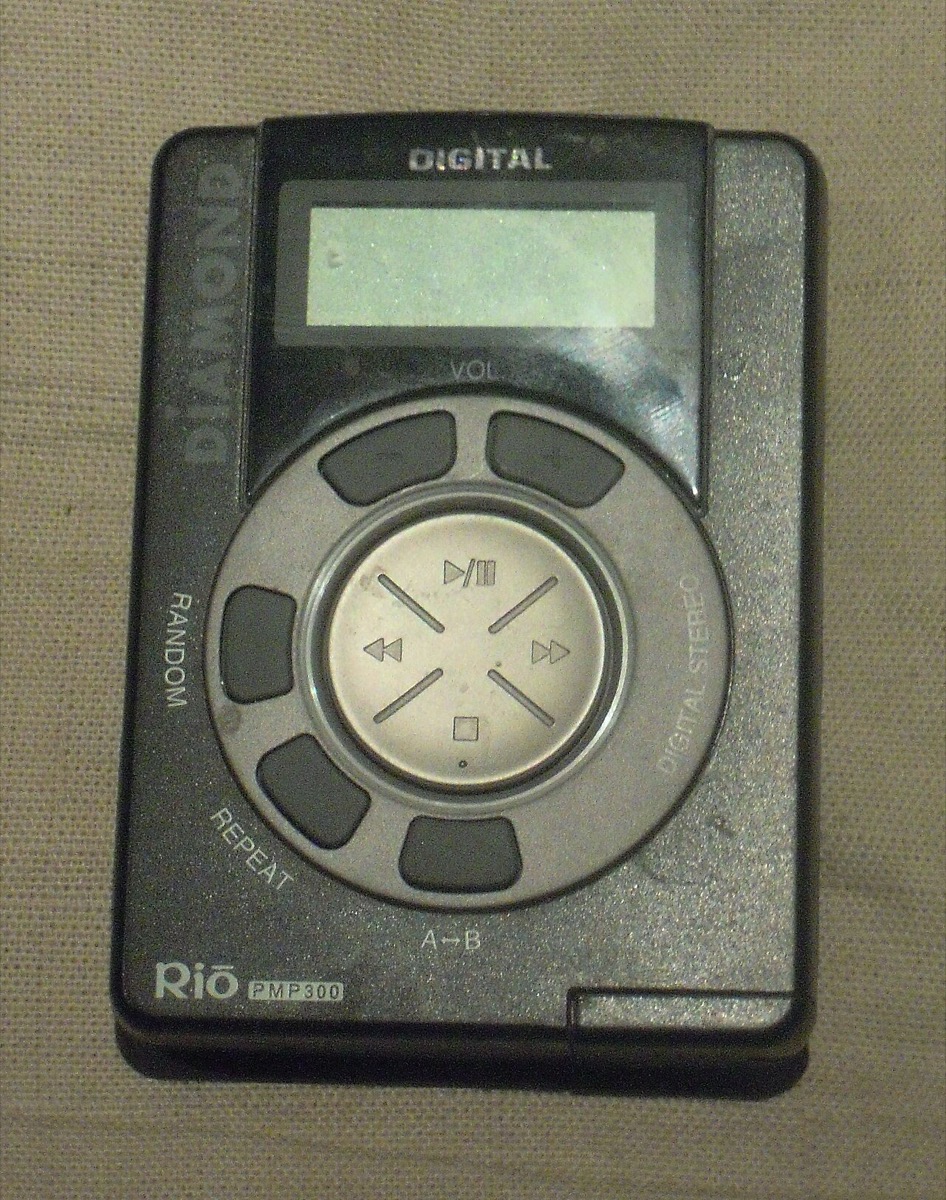
Early MP3 Players
The flash-memory bricks that freed your MP3s from the desktop. Diamond's Rio PMP300, arriving in September 1998 at $200, was the first MP3 player that actually caught on — deck-of-cards sized, running forever on one AA battery, holding maybe eight or ten songs. No moving parts meant no skips, a revelation after a decade of portable CD players. The RIAA sued to kill it; the courts sided with you instead.

Creative Zen & Nomad Jukebox
Your Nomad Jukebox or Creative Zen sounded better than any iPod — more formats, zero iTunes, pure PC-forum credibility — and it battled the white earbuds in every comment thread of the 2000s. Then came the wildest ending in the MP3 wars: Creative sued Apple over a music-navigation patent, and Apple paid $100 million to settle.