Microsoft Entertainment Pack
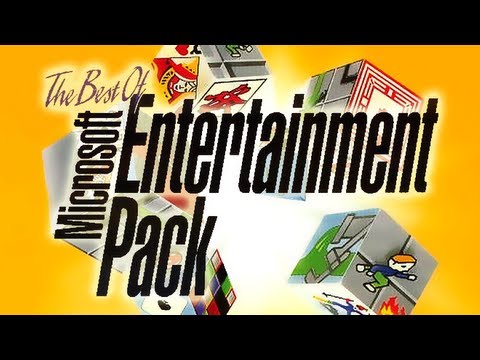
Four boxes of tiny Windows games — JezzBall, Rodent's Revenge, Chip's Challenge, SkiFree, Tetris — sold to office workers under the slogan "No more boring coffee breaks." Minesweeper and FreeCell started here before Windows itself swallowed them, and a sampler disk came free in packs of blank floppies.
Microsoft released four Entertainment Packs between 1990 and 1992, collections of small 16-bit games that ran only under Windows, not MS-DOS. That was the point. The company's "Entry Business" team was charged with making Windows appealing to homes and small businesses, and former product manager Bruce Ryan later said Microsoft worried that the operating system's steep hardware requirements would make people see it as a tool for large enterprises only. The project had almost no budget, and no major game publisher wanted in, since few believed Windows was a gaming platform. So Ryan gathered games that Windows employees had been writing in their spare time. According to FreeCell's developer Jim Horne, the packs shipped without copy protection so buyers could hand copies to friends, and each author reportedly received ten shares of Microsoft stock.
The games are the memory. Pack 1 (1990) carried Minesweeper, Taipei, Tetris and the peg-jumping Pegged; Pack 2 added FreeCell, Pipe Dream and Rodent's Revenge; Pack 3 brought Klotski, TetraVex and SkiFree; Pack 4 (1992) delivered JezzBall, Dr. Black Jack and Chip's Challenge, a 1989 Atari Lynx launch title that found a far larger audience here. The boxes pitched office procrastination outright: "No more boring coffee breaks" and "Only a few minutes between meetings? Get in a quick game of Klotski." It worked. Computer Gaming World called the series "the Gorillas of the Gaming Lite Jungle" in 1992, with more than 500,000 copies sold.
Many people never bought a box at all. For much of the early 1990s a Gamesampler subset, with JezzBall, Rodent's Revenge, Tetris and SkiFree, came as a free eleventh disk in ten-packs of Verbatim blank floppies, and a "Best of" disk turned up as a Kellogg's cereal mail-in premium. Minesweeper was bundled into Windows 3.1 and FreeCell into Windows 95, which is how two Entertainment Pack games ended up on office PCs everywhere.
Microsoft ended support for every pack on January 31, 2003. Digital Trends later wrote that for many the Entertainment Pack "provided a first taste of early PC gaming and served as a gateway to more complex classics," which is about right for anyone who learned the family PC by drawing JezzBall walls between the bouncing atoms.
Similar items

Minesweeper
The grid of gray squares you clicked to uncover numbers — and the flags you planted over the mines you hoped weren't there. Bundled with Windows for years, it was equal parts logic puzzle and nerve test.

SkiFree
You picked a mode, pointed your pixel skier downhill, and raced a Windows 3.0 mountain — until the moment at 2,000 meters when something terrible crested the hill behind you. The Abominable Snow Monster of SkiFree ate a generation of office workers, and most of them never learned about the F key.

Floppy Disks
IBM's 1971 invention, shrunk twice — to 5.25 inches, then 3.5 inches — until the 1.44 MB disk became the default on every 90s computer. That hard plastic shell with the sliding metal shutter, your homework labeled in marker, ferried between the school lab and home in a backpack pocket.

Microsoft Encarta
The CD-ROM encyclopedia that killed the twenty-volume set on the shelf. Encarta turned book reports into a multimedia experience — clickable maps, audio clips of national anthems and animal sounds, video snippets — and hid the MindMaze trivia game inside for when you were supposed to be studying.