"Blurry"

Wes Scantlin, alone in a Hollywood Boulevard hotel room and missing his son, reworked an old Kansas City song into "Blurry." Fred Durst's label had signed him and replaced his entire band; the result was 2002's biggest rock song in America, number five on the Hot 100, with a video of Wes watching his boy get driven away.
Puddle of Mudd formed in Kansas City, Missouri, in 1992 — Wes Scantlin, guitarist Jimmy Allen, bassist Sean Sammon and drummer Kenny Burkitt — and took the name from a practice space beside the Missouri River levee that kept flooding. By early 1999 the original band had broken up, leaving Scantlin on his own. That October, when Limp Bizkit's Family Values Tour came through town, he got a demo tape to Fred Durst, and Durst's Flawless Records signed him. The label was unimpressed with his bandmates, scrapped them all, and rebuilt the group around him with players he had never met: Doug Ardito, an Interscope intern; Paul Phillips, a guitarist from Durst's hometown of Jacksonville; and drummer Greg Upchurch.
Scantlin was flown to Los Angeles in late 2000 and put up in a hotel on Hollywood Boulevard, where he spent his days with an acoustic guitar reworking an old Puddle of Mudd song called "Electron Moon." "'Blurry' was basically about being flown to freaking Los Angeles and y'know, I didn't have any friends…" he told American Songwriter. "And I was just missing my family and son, I missed my grandma and stuff." Credited to Scantlin, Ardito and Allen, the slow, E-flat-minor song was the second single from Come Clean, following "Control," and came out October 16, 2001.
It was 2002's most successful rock song in the United States: ten weeks at number one on Mainstream Rock, nine on Modern Rock, and the top of both year-end charts, plus number five on the Hot 100 and number eight in Britain. It won ASCAP's Song of the Year and two Billboard Awards, and with 753,000 copies sold by 2010 it remains the band's best-selling single. Durst directed the video: Scantlin playing with his son Jordan, the band in a garage, and a closing shot of a man and woman driving off with the boy in the back seat as Wes watches.
Come Clean went triple platinum by January 2003 and past five million copies worldwide, with "Drift & Die" and "She Hates Me" both reaching number one on rock radio. The follow-up, Life on Display, sold below expectations, Upchurch left for 3 Doors Down, and Puddle of Mudd carried on with Scantlin as the only constant member through Famous in 2007 and a string of later lineups.
Similar items

Limp Bizkit
The Jacksonville metal band that defined nu-metal's MTV dominance. Fred Durst's backwards red Yankees cap and Wes Borland's shock-value body paint made them impossible to ignore. They broke through with a cover of George Michael's "Faith" reimagined as down-tuned metal. They became the sound of late-90s TRL, then evaporated just as fast.

"It's Been Awhile"
The post-grunge confession that owned rock radio in 2001: Aaron Lewis's slow-burning inventory of a wasted year, a then-record sixteen weeks atop the Modern Rock chart, and a Fred Durst-directed video that ends with a dropped cigarette burning the apartment down. It carried Staind from Springfield, Massachusetts clubs to a number-one album.

Three Days Grace
Three guys from Norwood, Ontario whose demo of "I Hate Everything About You" got them a Jive deal and then never left rock radio: 45 weeks on the Modern Rock chart, nine-times platinum, a billion Spotify streams. Three Days Grace turned Adam Gontier's rehab notebooks into One-X and became the angst band of every mid-2000s locker.
"Closing Time"
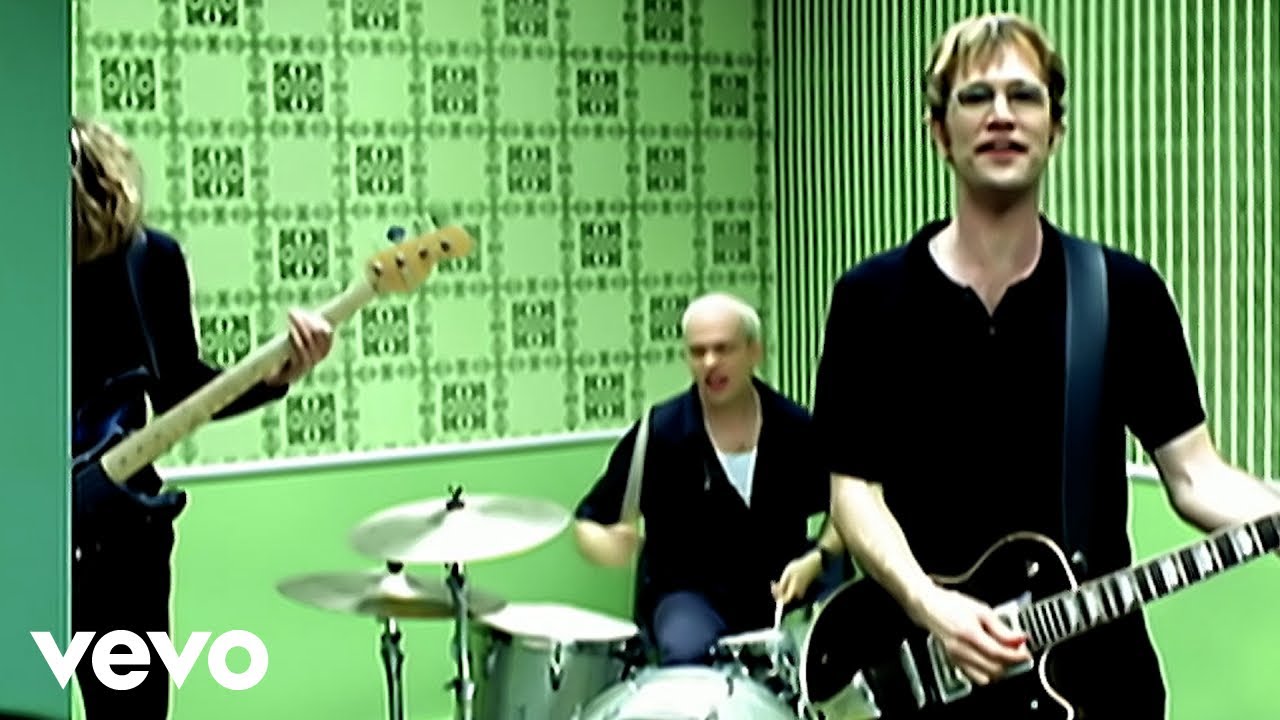
Dan Wilson wrote "Closing Time" so Semisonic would have something new to end their shows with, and realized partway through that it was also about the baby his girlfriend was carrying. It topped the modern rock chart in 1998, earned a Grammy nomination, and became the song radio stations play right before they change formats.