Tri-Fold Presentation Board

The white cardboard monolith that folded open into three panels and stood up on the table by itself. Every science fair, history day, and book report eventually came down to one: glue-sticked construction paper, printed clip art, and a rainbow WordArt title. You balanced it across the back seat on the drive to school, praying nothing peeled off before the bell.
The board itself was simple — a big piece of corrugated cardboard scored into three sections so the outer panels folded forward and the whole thing propped up on any tabletop. But it became the default stage for a kid's first real presentation. Science fair was its natural habitat: a hypothesis taped to the left panel, the procedure and a few photos in the middle, results and a conclusion on the right, usually with a plate of the actual project sitting in front of it. History Day, book reports, and health-class projects all landed on the same format.
What dated a board to its era was the surface. You cut mats of colored construction paper to frame each printout, ran a glue stick around the edges, and lined everything up crooked no matter how careful you were. The titles came off the family computer: a banner of Microsoft WordArt bent into an arc or a rainbow gradient, printed on the inkjet in streaky bands, next to clip art of a beaker or a lightbulb dropped in from a CD-ROM gallery. That printed-graphics look is what makes these boards read as late-'90s-to-2000s rather than the plainer hand-lettered posters of earlier decades — home computers, clip-art discs, and cheap color printers were what put the WordArt on the cardboard.
The ritual came with its own dread: the night-before-it's-due scramble, the glue that wouldn't dry, the letters that fell off in the hallway, and the slow-motion horror of a panel flopping shut mid-presentation. Then it went home and lived behind a door or on top of the fridge until the recycling. The tri-fold board never really went away — it still shows up at science fairs — but its peak as the universal school-project canvas belongs to the era when every kid finally had a printer at home.
Similar items

Clip Art
Before Google Images, decorating a book report meant clip art: flipping through a phone-book-thick catalog of tiny thumbnails, finding the picture you wanted by number, digging out the right CD-ROM, and printing it one image at a time. Every 90s birthday flyer and school newsletter was built from these libraries.

Scholastic Book Fairs
The ritual: your school gym transforms overnight into a pop-up bookstore of rolling display cases, and you wander the aisles with a wish list and a budget. Scholastic Book Fairs dominated the 90s market, though what kids actually bought — glittery gel pens, novelty pencils, poster books — often had nothing to do with the Goosebumps stacks they wandered past.

School Assignment Planners
The agenda book your school handed out on the first day — printed with your school's name, a homework grid for every class, and pages of rules and study tips. The Y2K editions came wrapped in a holographic cover that made an irresistible record-scratch sound when you dragged a fingernail across it.
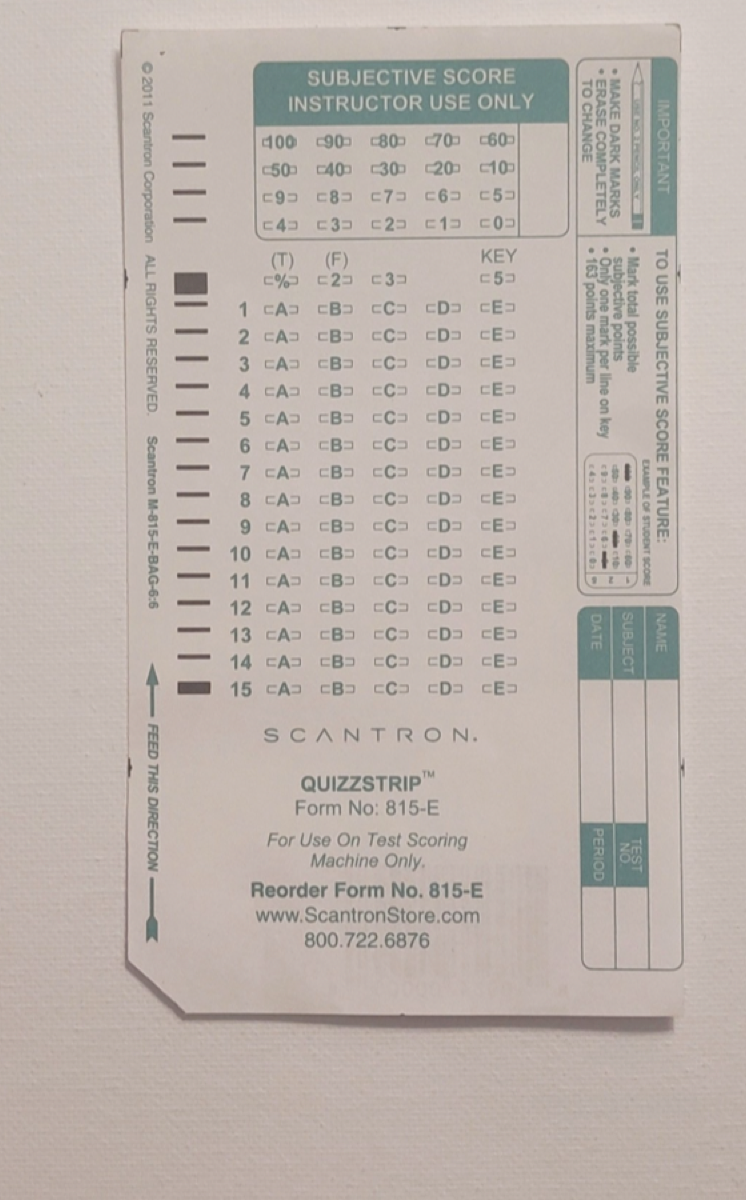
Scantron
The green (or blue, depending on your school) bubble sheet that turned testing into a ritual of dread. The Scantron form—with its perfectly aligned bubbles and #2-pencil-only mandate—wasn't just a testing tool; it was a rite of passage, complete with the terror of erasure shadows and red hash marks on the returned sheet.