Toys "R" Us

The cathedral of childhood shopping. Charles Lazarus's toy superstore — the backwards "R," aisle upon aisle of Christmas lists waiting to happen, and Geoffrey the Giraffe's unmissable jingle — defined how kids experienced wanting. Then a leveraged buyout, five billion in debt, and a 2018 collapse ended the era.
Charles Lazarus opened Children's Supermart, a baby-furniture store, in Washington, D.C. in April 1948; in June 1957 he refocused the concept as Toys "R" Us with the first toy-dedicated location in Rockville, Maryland. The backwards "R" — styled as if a child had written it — became one of retail's most famous marks. Geoffrey the Giraffe began in 1950s print ads as "Dr. G. Raffe" and made his first TV appearance in 1973, and the jingle "I don't wanna grow up, I'm a Toys 'R' Us kid" became generational shorthand.
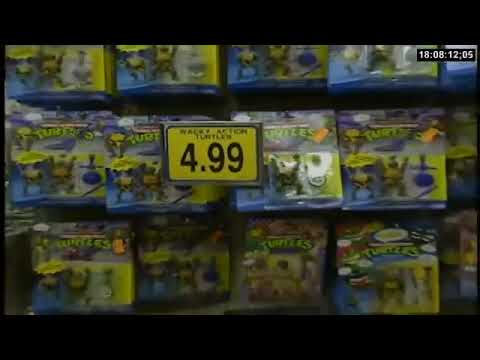
Through the 70s, 80s and 90s it grew into America's dominant toy retailer — the place where birthday parties were planned, Christmas lists were drafted, and the wide aisles promised that everything you'd seen in a commercial was real and in stock. For a 90s kid, being taken to Toys "R" Us was an event with the emotional weight of a minor holiday.
The fall was financial, not cultural: a $6.6 billion leveraged buyout by Bain Capital, KKR and Vornado, announced March 17, 2005, loaded the company with debt just as retail shifted online. It filed Chapter 11 on September 18, 2017 carrying roughly $5 billion in debt, and permanently closed all remaining US stores on June 29, 2018 — 70 years after Lazarus's first shop. Revivals followed (Tru Kids in 2019, Macy's store-within-a-store shops from 2022), but the big-box wonderland is gone.
Similar items

Blockbuster Video
The blue-and-yellow torn-ticket empire where Friday nights meant wandering the new-release wall, hoping the big movie wasn't rented out, and dreading the late fees. At its peak in 2004, Blockbuster dominated home entertainment with 9,094 stores worldwide—until Netflix and streaming dismantled the whole business model.

Tower Records
The iconic big-box music retailer founded by Russ Solomon in 1960, which grew into a global chain of 200+ stores before collapsing under digital competition and file-sharing. Tower Records was the archetypal "browse-the-racks" record store — deep catalog, knowledgeable staff, late hours, listening stations — that became a cultural hangout and symbol of pre-digital music retail.
Toys "R" Us Game Ticket Slips
In the Toys "R" Us video-game aisle, you didn't grab the cartridge — you pulled a paper ticket from a plastic pouch under the box art, paid at the register, and traded the receipt at a counter window for the actual game. It was loss prevention that accidentally let you see exactly how many copies were left.

Bath & Body Works
The scent wall: every bottle a different color, every color a different smell, and you had to sniff them all. Bath & Body Works opened in 1990 and within a decade its body sprays were a generational signature — half a middle school could leave for class smelling of Cucumber Melon.