Spore

Will Wright's evolution sim promised everything from primordial cell to galactic empire — and its Creature Creator was an all-timer. Then the game itself arrived: shallow where the hype was deep, and wrapped in DRM so hated it drew class-action lawsuits and an Amazon review-bombing for the ages.
Will Wright — creator of The Sims — unveiled Spore at GDC 2005, and for three years it was the most anticipated idea in gaming: a Maxis simulation in which you evolve a species through five stages — cell, creature, tribal, civilization, and space. EA released the Spore Creature Creator ahead of the game on June 17, 2008, at $9.95 for the full version with a free demo carrying a quarter of the parts, and players ran wild: by late June, over one million creatures had been uploaded. At E3 that July, Wright joked that players had created as many creatures as there are known species on Earth — roughly 1.6 million — in about 18 days.
The full game landed in North America on September 7, 2008, and sold 2 million copies in its first three weeks. The verdict split immediately: the creation tools were widely praised, while the game around them was called shallow — GameSpot put it flatly: "Individual gameplay elements are extremely simple." The five-stage epic played less like evolution than like five thin minigames wearing a masterpiece's marketing.
Then there was the DRM. Spore shipped with SecuROM copy protection that authenticated the game on only three computers (EA later raised the limit to five), and buyers revolted: within ten days of release, 2,016 of its 2,216 Amazon ratings were one star, most citing the DRM. A class-action lawsuit followed on September 22, 2008, and a second in October — while more than 500,000 people downloaded the game illegally in its first week, on the way to its standing as one of the most pirated games ever. What survives warmly in memory is the Creature Creator: the goofy, googly-eyed things everyone built turned out to be the real game all along.
Similar items

The Sims
Will Wright's dollhouse simulator where you controlled virtual lives, sent them to work, made them fall in love, and then deleted the pool ladder and watched them drown. Launched in February 2000 by Maxis and EA, The Sims became the best-selling PC game of its era—a mania that never ended, spawning sequels that kept the franchise dominant for decades.

RollerCoaster Tycoon
You designed roller coasters and managed an amusement park in this beloved strategy sim. Created almost single-handedly by Chris Sawyer and released in 1999, RollerCoaster Tycoon became a sandbox classic — famous for coaster design and infamous for the player habit of trapping guests. RollerCoaster Tycoon 2 followed in 2002.

Zoo Tycoon
Build the exhibits, hire the keepers, keep the guests happy — and then, inevitably, delete the lion fence just to see what happens. Zoo Tycoon was the zoo-management sim on every family PC and school computer lab in the early 2000s, and everyone who played it broke it on purpose at least once.
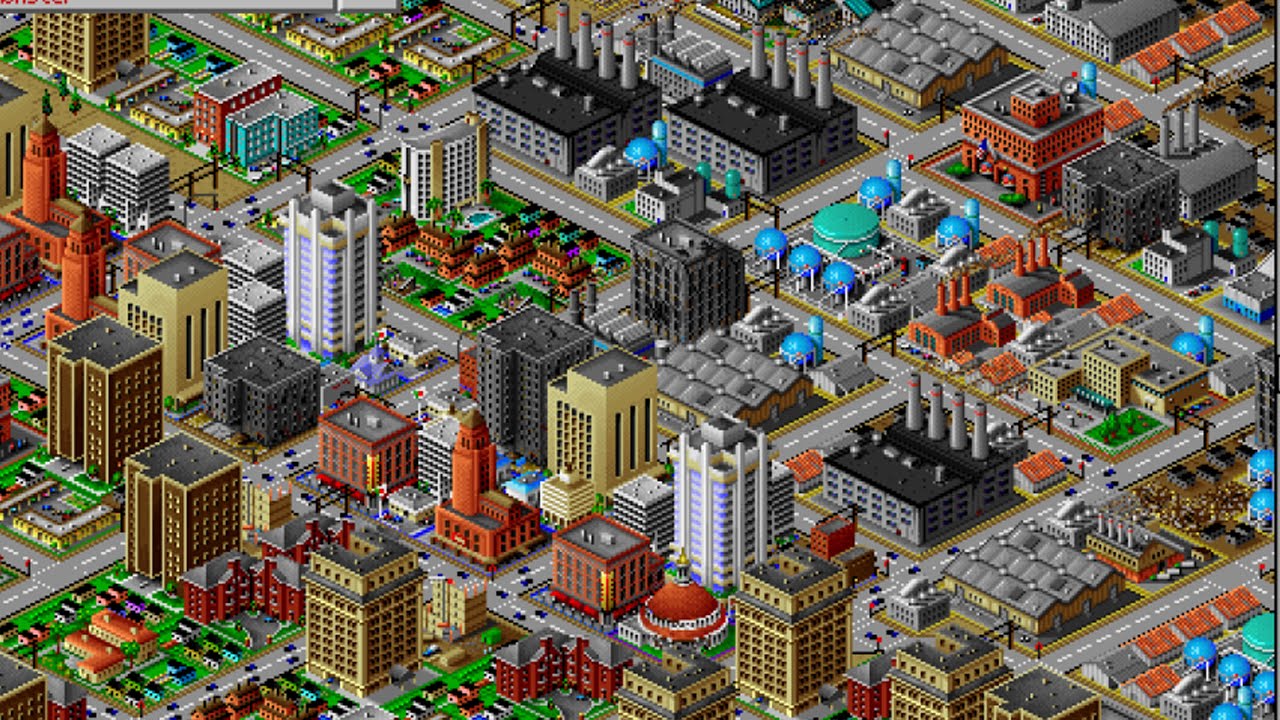
SimCity 2000
The city-building game that made zoning feel like destiny. SimCity 2000 traded the original's flat grid for a gorgeous isometric view with terrain elevation, underground layers, and a tech tree capped by arcologies — massive self-contained future cities that could blast into space. For a generation of 90s kids on the family PC, it was equal parts urban-planner simulator and disaster-unleashing sandbox.