Living Books

Brøderbund's CD-ROM storybooks, starting with Mercer Mayer's Just Grandma and Me in 1992: a page read aloud, then a screen where everything you clicked did something. Arthur, the Berenstain Bears and Dr. Seuss followed, and a generation learned to read with a mouse in its hand.
Mark Schlichting was working at Brøderbund as an animator when he began pushing an idea: take existing picture books, read them aloud on screen, and make every object on the page a hot spot that did something when clicked. In 1989 Philips saw the prototype on a tour of the office and offered $500,000 for a version for its coming set-top box; Brøderbund co-founder Doug Carlston, who had noticed births among his own staff jumping to fifteen a year, saw a market for software for small children, and Schlichting got a development group. The first full prototype adapted Mayer's Little Monsters at School. Schlichting playtested relentlessly with kids, who told him what bored them, and set a rule: everything that looked clickable had to be clickable.
Just Grandma and Me shipped in 1992, when Brøderbund was not sure enough people owned CD-ROM drives to buy it; in six months it sold more than ten times the projection, and PC Magazine called Living Books Brøderbund's major hit of 1993. Arthur's Teacher Trouble, also 1992, gave Marc Brown's aardvark a voice four years before the TV series, and Brown said it changed how he thought about books. Random House's Alberto Vitale saw a demo at a booksellers' convention and bought half the operation; the joint venture was signed in September 1993, and in April 1994 it won the digital rights to Dr. Seuss, chosen by Audrey Geisel over richer offers because of the Random House connection. The catalog grew to the Berenstain Bears, Stellaluna and an original retelling of The Tortoise and the Hare, and Living Books' pre-tax profits topped $6 million in 1994.
The titles were expensive to make and cheap to sell, schools could rarely afford the computers, and the CD-ROM shelf filled with imitators and shovelware. In 1997 Brøderbund bought back Random House's half and folded the division into itself; in August 1998 The Learning Company took Brøderbund in a hostile takeover, and in May 1999 Mattel bought The Learning Company for $3.8 billion in a deal since called one of the worst acquisitions of all time. Former developers eventually licensed the titles back and re-released them for iPad in 2012. Schlichting says Just Grandma and Me sold over four million copies. For the kids, the memory is simpler: the page read itself, and then everything on it did something when you clicked.
Similar items

Kid Pix
Broderbund's gloriously chaotic kids' drawing program — the one with the honking sound effects, the rubber stamps, and the stick of dynamite that blew your whole picture apart in a burst of black-and-white circles. For a generation of 90s kids it was the first "art" they ever made on a computer.
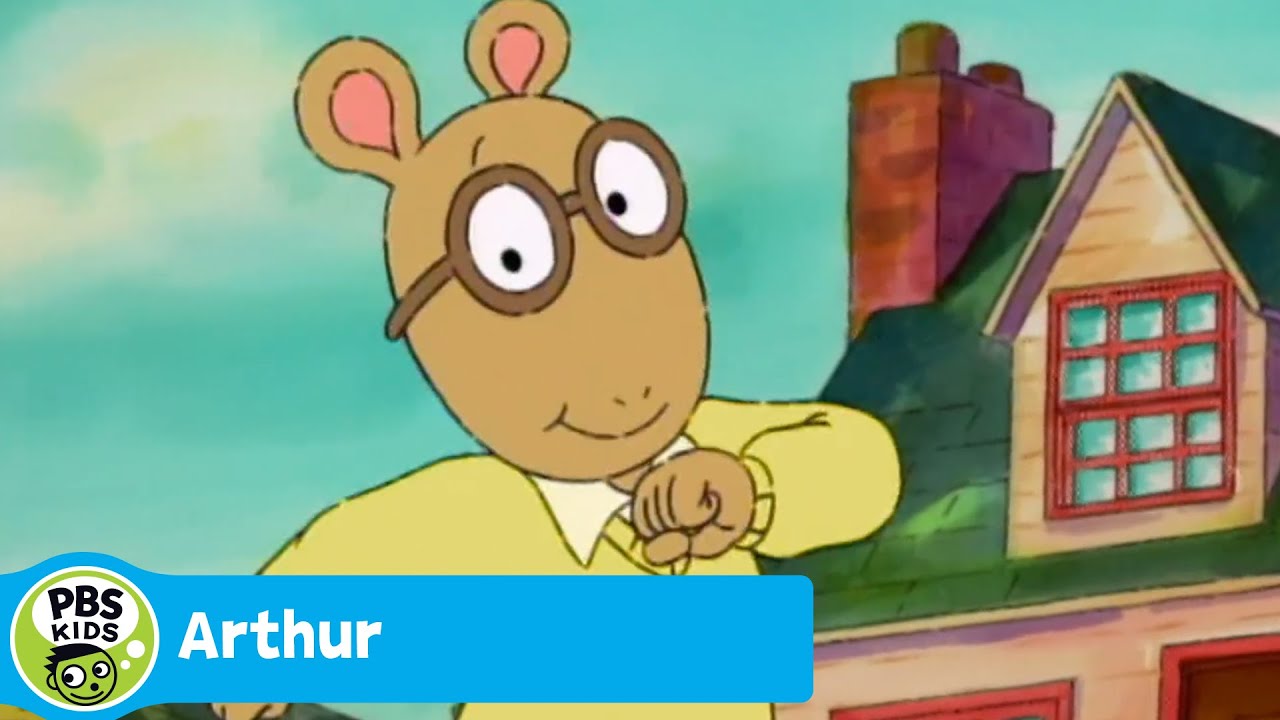
Arthur
PBS's 25-season juggernaut about an aardvark navigating school, friendship, and suburban angst. Arthur Read, his friends Buster, Francine, Muffy, and the Brain, and his little sister D.W. defined childhood TV for an entire generation. The show ran from 1996 to 2022, becoming one of the longest-running animated kids' series in US television history.

Putt-Putt
A cheerful purple convertible car who was born as a bedtime story and became a staple of 90s family PCs. Putt-Putt's point-and-click adventures were forgiving, consequence-free, and brimming with clickable animations — nothing to lose, everything to discover.

Microsoft Encarta
The CD-ROM encyclopedia that killed the twenty-volume set on the shelf. Encarta turned book reports into a multimedia experience — clickable maps, audio clips of national anthems and animal sounds, video snippets — and hid the MindMaze trivia game inside for when you were supposed to be studying.