Chain Emails

"FORWARD THIS TO 10 PEOPLE OR..." — the chain letter reborn at internet speed in 90s inboxes. Bad-luck threats, sick-kid legends, glurge poems, free-money hoaxes and virus panics, all forwarded with a wall of ">>>" quote marks and a hundred strangers' email addresses.
The Good Times virus hoax appeared November 15, 1994, warning that opening an email with the subject "GOOD TIMES!!" would destroy your hard drive or send your computer into an "nth-complexity infinite binary loop" — a phrase nonsensical enough to sound credible. The joke was that the warning itself was the thing replicating, spreading across CompuServe, Prodigy and AOL for years; in 1997 the hacker collective Cult of the Dead Cow claimed it as a deliberate experiment in online gullibility.
Three years later came the free-money era. On November 18, 1997, Iowa State student Bryan Mack, sitting in a campus computer lab, sent a joke to the friend next to him: an email claiming Bill Gates had written an "e-mail tracing program" and would pay everyone $1,000 if the message reached 1,000 forwards. The Bill Gates hoax escaped the lab and circulated for decades, mutating into promises of $245 per forward from Microsoft itself. And the whole genre had a pre-internet blueprint: in 1989, friends of Craig Shergold — a real British boy diagnosed with terminal brain cancer — launched a get-well-card chain appeal. By May 1990 he'd received 16.25 million cards, a Guinness World Record. Surgery in 1991 saved him, but the chain letter refused to die, mutating through postal and email variants (business cards, misspelled names) until he'd received roughly 350 million cards, the Royal Mail had assigned his house its own postal code, and Guinness had retired the record to make it stop.
The ritual faded in the mid-2000s as spam filters improved and the forwarding impulse migrated to social media. But for a solid decade it was universal: deleting one felt vaguely risky, forwarding one felt vaguely embarrassing, and everyone's aunt did it anyway.
Keep talking about it (Reddit)
Similar items
Chain Letters
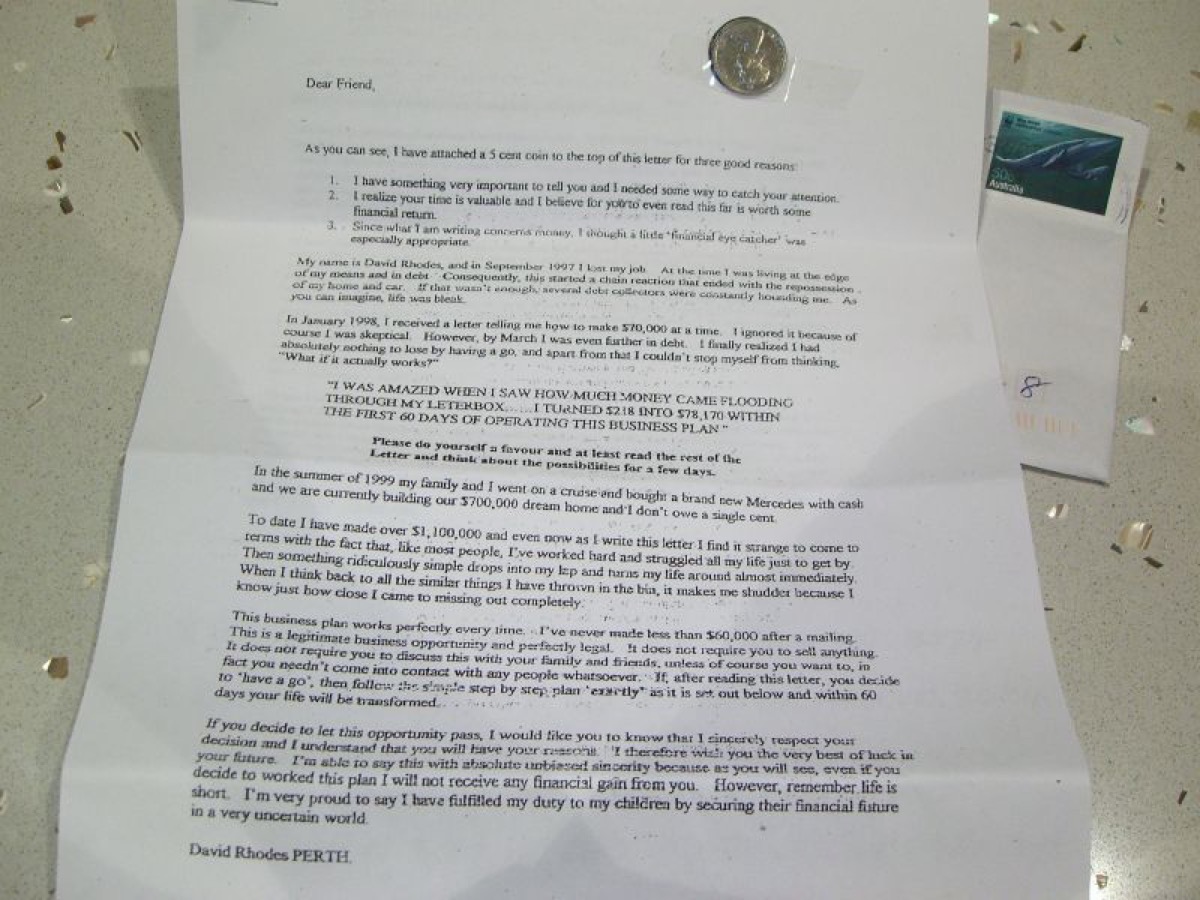
The letter that arrived in the mailbox with instructions and a threat: copy this out ten times, mail it to ten people, and good luck will find you — break the chain and something terrible would happen. Some just promised fortune; others told you to send a dime or a dollar to the name at the top. Either way you sat there hand-copying it, half-laughing and half-not-wanting-to-risk-it.

AOL
The dial-up gateway that wired up America. AOL's "You've Got Mail" voice, aggressive free-trial CD carpet-bombing, and shift to unlimited $19.95/month pricing triggered the legendary busy-signal crisis — millions of Americans' first taste of the internet.

AIM & MSN Messenger
The after-school ritual: logging on to a dial-up modem, scanning your buddy list, typing AIM away messages packed with song lyrics and veiled drama, and knowing your 12-year-old screen name would haunt you forever. AIM and MSN Messenger were the social nervous system of the '90s and 2000s — instant, informal, and utterly addictive.

Dancing Baby
A 3D-rendered infant doing the cha-cha — arguably the first viral video-meme of the internet age. Born as a software demo in 1996 and spread through email chains like a digital chain letter, the "Ooga-Chaka baby" went fully mainstream when it started haunting Ally McBeal.