Borders
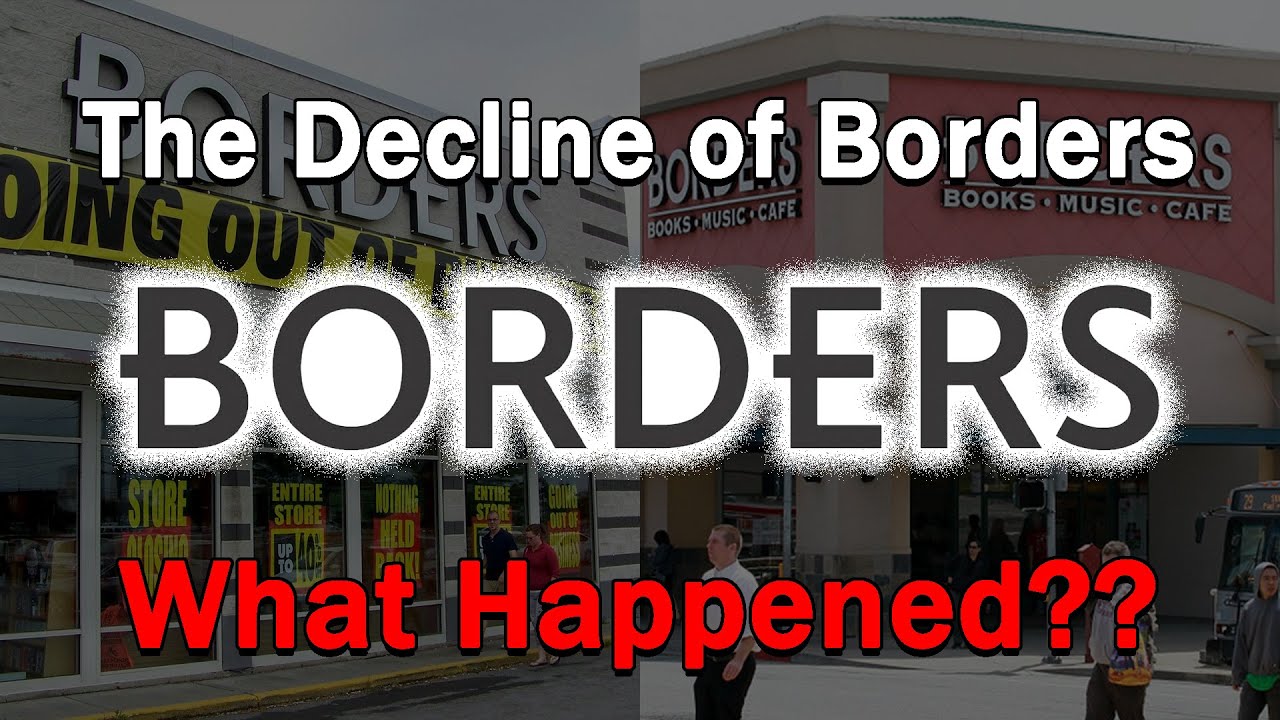
Three hours in the armchairs with a stack of books you never bought, a chai from the café, and a lap through the CD listening stations — Borders wasn't a store so much as a place to be. Then it was gone, all of it, in a single September.
Brothers Tom and Louis Borders opened the original Borders Book Shop in 1971 on South State Street in Ann Arbor, Michigan. It grew into one of the pioneers of the book superstore — a bookstore the size of a supermarket, stocked deep enough to feel like a library you could shop in. Kmart bought the company in October 1992 and spun it off in 1995 as Borders Group, with the mall-based Waldenbooks chain as its sibling; through the 1990s the superstores marched into seemingly every American retail corridor.
The 2000s were the era anyone nostalgic for Borders actually remembers: the café tables colonized by students, the armchairs where nobody stopped you from reading a whole book, the CD and DVD sections with headphone listening stations, the magazine wall. At its 2003 peak the company had 1,249 Borders and Waldenbooks stores, and it employed some 19,500 people in America. As a third place — somewhere to exist between home and school that asked nothing of you — it was arguably the chain bookstore's finest form.
The collapse came from decisions that look almost unbelievable in hindsight: for six years starting in 2001, Borders handed its online bookselling to Amazon itself, ending the alliance only in 2007 — with its own online store not relaunching until 2008, by which point the store's own music and movie aisles were dying with the CD and DVD. The company's last profitable year was 2006, with annual income falling by a billion dollars over the following four years. Borders filed for Chapter 11 on February 16, 2011, and closed its final US stores on September 18, 2011 — leaving the armchairs, the chai, and the browsing ritual to memory.
Similar items

Circuit City
The electronics superstore where your parents went to buy the first family PC, camcorder, or big-screen TV — with a commissioned salesman in a dress shirt walking them through every feature. Those red-tower storefronts were the 90s temple of consumer electronics. From superstore dominance to total liquidation in 2009, Circuit City is the retail ghost story of the era.

Blockbuster Video
The blue-and-yellow torn-ticket empire where Friday nights meant wandering the new-release wall, hoping the big movie wasn't rented out, and dreading the late fees. At its peak in 2004, Blockbuster dominated home entertainment with 9,094 stores worldwide—until Netflix and streaming dismantled the whole business model.

Sam Goody
The ubiquitous mall record store where 90s kids bought CDs, cassettes, and band tees. Sam Goody was the go-to destination for new releases and the social hub of music shopping before big-box discounters and digital downloads reshaped retail.
CompUSA
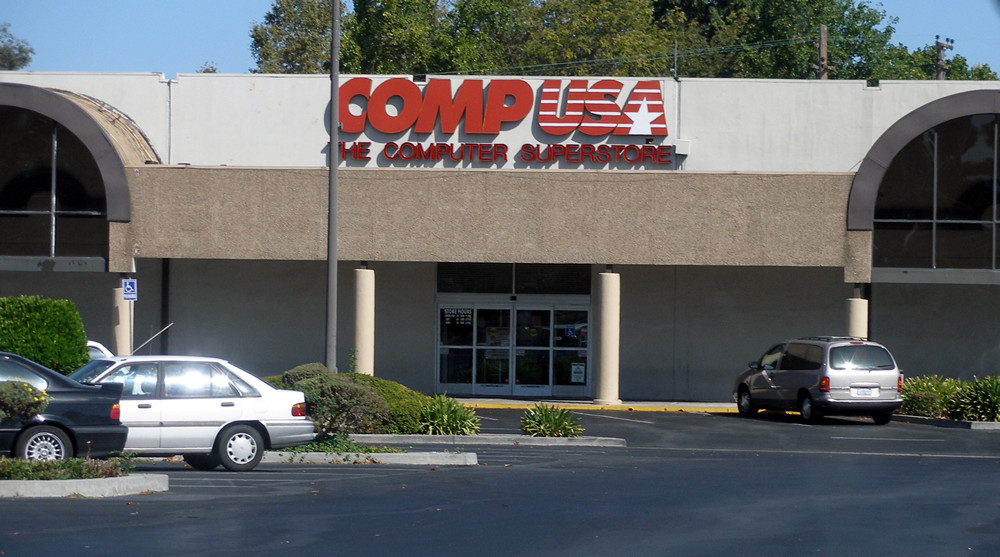
Aisle after aisle of boxed software, a wall of printer cables, and a cart carrying your family's first PC. CompUSA — the self-billed Computer Superstore — was where America went to buy the future, one weekend errand at a time.