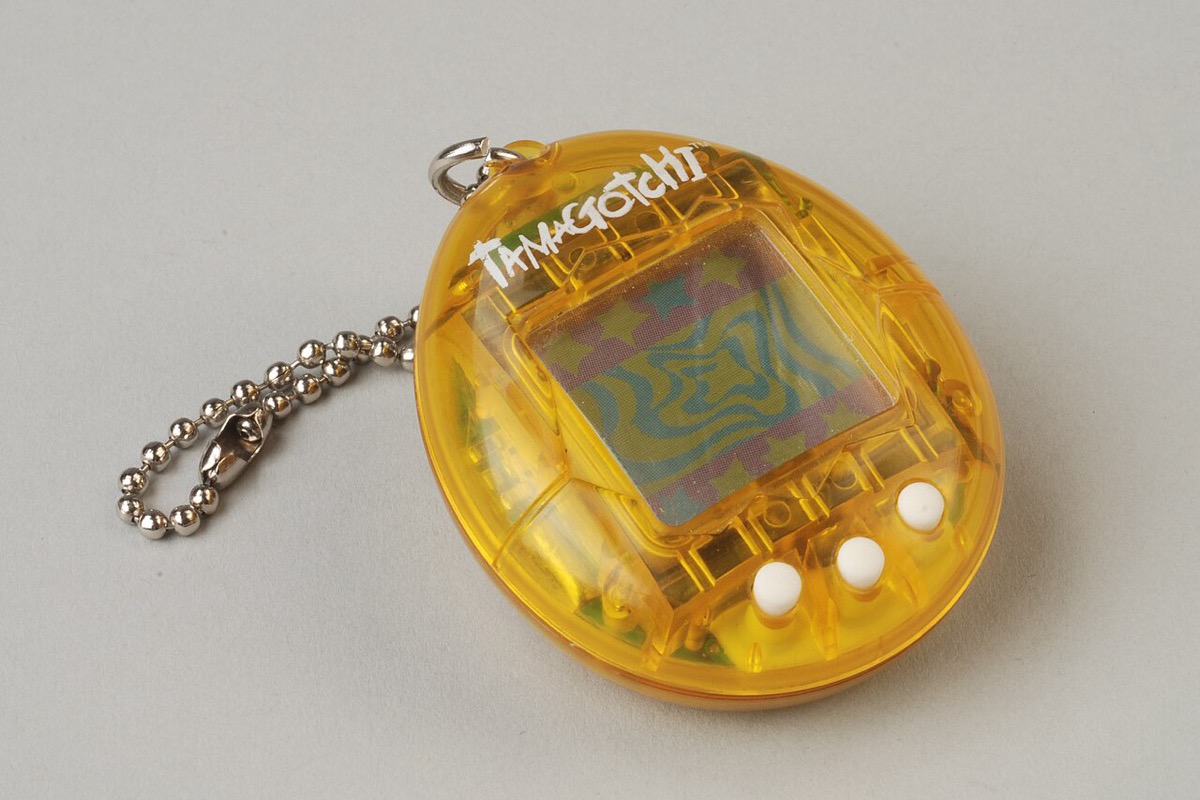
The first Tamagotchi went on sale in Japan on November 23, 1996. Thirty years later Bandai is still making them, and the newest one, Tamagotchi Paradise, has a dial on its side and a whole planet inside. By Bandai’s count, 100 million Tamagotchi had shipped worldwide as of July 2025.
This is a side-by-side of the two eggs: the original Tamagotchi as American newspapers described it in the spring of 1997, and Tamagotchi Paradise as Bandai’s own pages and instruction manual describe it today. We have not used a Tamagotchi Paradise. Where a detail comes from someone who has, we say who.
The short version, going by Bandai’s pages: Tamagotchi Paradise keeps the egg, the three buttons, the feeding, the poop and the sick days, and a neglected pet can still die. Thirty years added a color screen, a dial that zooms from a single cell out to space, more than 50 characters to raise and a way to dock two eggs together. It costs $44.99. The original was $17.99 in 1997, about $38 in today’s money.
Original Tamagotchi vs. Tamagotchi Paradise at a glance
Swipe the table sideways to see both Tamagotchi.
| Original Tamagotchi (1996) | Tamagotchi Paradise (2025) | |
|---|---|---|
| Released | November 23, 1996 in Japan; May 1, 1997 in the United States | July 2025, by Bandai's account; its announcement said the date could vary by area |
| Price | $17.99 at F.A.O. Schwarz in May 1997, about $38 in today's money | $44.99 |
| Controls | Three buttons | Three buttons and a zoom dial that turns and clicks |
| Screen | A small LCD. Bandai Namco's timeline has a color screen arriving in 2008 | Color, with adjustable brightness |
| Size | About 5.5 × 4.5 × 1.5 cm, measured on a 1997 unit in Museum Rotterdam's collection | In one reviewer's words, "roughly lemon-sized" |
| Power | Button batteries | Two AAA batteries, sold separately |
| Pets you look after at once | One | One, while pets you have released live on in the fields |
| Characters | 11 on a Gen 1 or Gen 2 egg, hidden ones included, by Bandai's FAQ for today's re-release | More than 50 in 12 species, and over 50,000 variations with breeding |
| Daily care | Feed it, play with it, discipline it, give it medicine, clean up its droppings | Feed it, play with it, wash it, clean up its poop, treat it when it is sick |
| Connecting to another one | None | Two Paradise eggs dock together; stores have Lab Tama kiosks. No Wi-Fi |
| If you neglect it | In Japan the pet died. In the American version it sprouted wings and flew home | The Grim Gotchi appears and can be shooed away. If the pet dies, a Death screen |
| Someone to mind it | A parent, in the 1997 reports | A Tama Sitter, paid in Gotchi Points |
What the 1996 Tamagotchi was
The Ig Nobel Prize committee called Akihiro Yokoi of WiZ and Aki Maita of Bandai “the father and mother of Tamagotchi.” Their egg went on sale in Japan on November 23, 1996, and by Bandai Namco’s count sold 10 million there within eight months. American papers the next spring translated the name as “lovable egg” or “cute little egg.”
It reached the United States on May 1, 1997, at F.A.O. Schwarz. The San Francisco store planned a red carpet and an armored car for the first shipment. The chain said it sold 30,000 in its stores in the first three days, at $17.99 each, and QVC said it sold 6,000 in five minutes. A manager at the San Francisco store had already told a reporter, “Apparently, it’s going to be the pet rock of the ’90s.”
What $17.99 bought was an egg on a ball chain with a small screen and three buttons. A creature hatched, and from then on it had to be fed, played with and disciplined, given medicine when it was sick and cleaned up after. It slept at night and beeped during the day when it wanted attention. “If you give it too much candy and not enough exercise, you can get a fat, lazy Tamagotchi,” Gene Morra of Bandai America told the same reporter. Bandai, one paper reminded its readers, was also the company that made the Mighty Morphin Power Rangers.
Before the month was out, schools were banning it. A third-grade teacher at the Dalton School in Manhattan explained why: “The children were checking it every five seconds.” An elementary school in Edgemont, New York, banned the toy after third graders taking a standardized test put down their pencils to feed their pets.
The 1997 Ig Nobel Prize in economics went to Yokoi and Maita “for diverting millions of person-hours of work into the husbandry of virtual pets.”
What’s the same on Tamagotchi Paradise
The egg. Bandai’s product photos show a jagged, cracked-shell frame around the screen and three buttons under it, the same layout as the 1997 egg at the top of this page.
The chores. Hunger and happiness are still what you manage. The pet still needs feeding and playing with, it still leaves poop to clean up, and it still gets sick.
One pet at a time. You raise a single character, as you did in 1997. Cheyenne MacDonald, who reviewed Paradise for Engadget in September 2025, called this their biggest gripe with it.
Batteries you replace. The 1997 egg in Museum Rotterdam’s collection ran on button batteries. Paradise takes two AAAs, which are not in the box. Bandai’s FAQ says a new battery should last for about 10 hours of gameplay.
No internet. MacDonald notes that Paradise has no Wi-Fi. The Tamagotchi Uni of 2023 did, by Bandai Namco’s account, so on this point the newest egg is closer to the first one than its predecessor was.
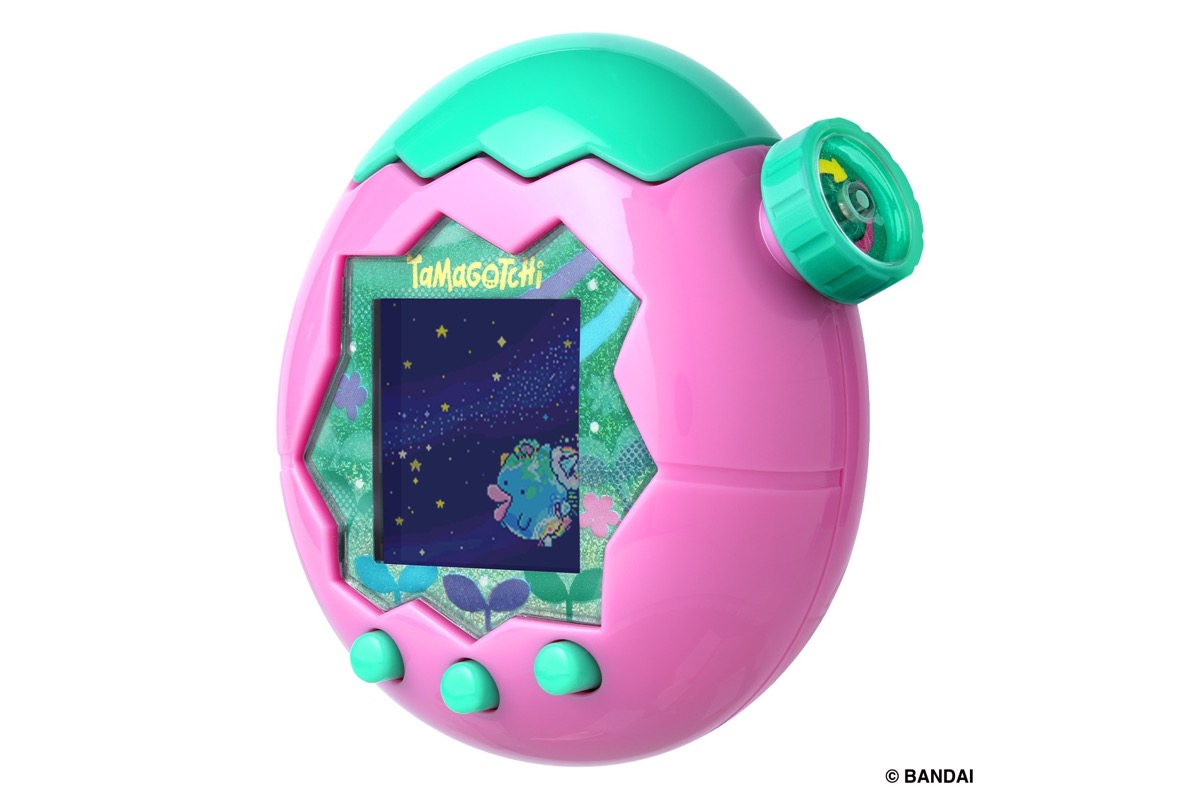
What’s new on Tamagotchi Paradise
The zoom dial. On the first shells, turning it moves between four views: Tama Space, Tama Field, Tama and Tama Cell. Bandai’s pitch is “Zero in on tiny cells or gaze out at the vast universe!” A sick pet is treated at the cell level. The dial also scrolls and confirms menu choices.
A planet with fields. Each egg starts in one field, and its color decides which: Pink Land starts on land, Blue Water in water and Purple Sky in the sky. The other fields unlock later. Bandai has added shells since, each with its own starting field: Jade Forest, Orange Tropics, White Glacier and Neon Planets. Neon Planets is due on sale in Japan on November 21, 2026, two days before the anniversary, and adds a fifth zoom level called Tama Galaxy. We did not find a U.S. date for it on Bandai’s American pages. When you finish raising a pet you release it into a field and get a new egg. MacDonald wrote that Paradise “completely reimagines the classic toy not as a pet-keeping experience, but something more akin to wildlife conservation.”
More than 50 characters. Bandai lists over 50 characters in 12 species, and what you feed a pet changes how it grows: “Feed meat for cat-like features! Feed carrots for rabbit-like features!” A bred baby can inherit its parents’ colors and eyes, which is how Bandai arrives at “over 50,000 different variations.”
Docking. Two Paradise eggs connect physically. MacDonald describes the top of the shell flipping open to reveal a docking port, “a throwback to design from the ’90s.” Bandai’s page promises that a good match can become family, and warns: “Fail and something strange might happen!” Paradise does not connect to older Tamagotchi. Some stores have Lab Tama kiosks to connect to; MacDonald found that they “don’t seem to be particularly widespread.”
A sitter. When you cannot look after the pet, the manual says to call the Tama Sitter. It costs Gotchi Points, the planet’s money, which you earn in mini games.
Poop is fuel. Bandai’s How to Play page puts it plainly: “Clean up poop and recycle into biofuel for space travel!”
Nine languages. English, French, Spanish, German, Portuguese, Italian, Japanese, Simplified Chinese and Korean.
What happens when you neglect a Tamagotchi, in 1997 and now
In the Japanese original a neglected pet died. For America, Bandai softened it. “We felt it was more benevolent (in the American market) to say it flew away,” Morra said in a story printed two days before the launch. “It takes off the pressure.” The pet was said to return to its home planet, and owners competed over how long theirs stayed. The record being touted that week was 26 days.
It did not take off all the pressure. One New York mother minded her son’s Tamagotchi after his teacher banned it from class. Two days later, in the reporter’s words, “the pet sprouted wings.”
Paradise gives more warning. If the pet is sick or badly looked after, the manual says, “the Grim Gotchi will appear,” and pressing any button shoos it away. If the pet dies anyway, a Death screen appears and you start a new egg. Past pets are remembered as stars on a Tama Stars screen. A Bandai notice adds a twist. When a pet that has lived past 30 of the device’s years dies, there is a “peaceful death” scene and a shining star, and a pet you are raising afterwards is saved once when it is near death.
That same notice, posted in May 2026, is about a defect on the earlier shells. When a pet of 256 years or more dies, its age is displayed wrongly, and in certain age ranges it gets an ordinary star and the rescue does not happen. Bandai apologized and said it does not plan to offer replacements.
MacDonald found the new egg easier to live with than its ancestors: “perhaps the least needy of all Tamagotchi models I’ve run.”
What a Tamagotchi cost in 1997, and what one costs now
Before the launch, the San Francisco paper expected Tamagotchi to sell for between $15 and $20, and F.A.O. Schwarz charged $17.99. A month later Kidscreen put the whole virtual pet shelf at $9.99 to $19.99. In Japan, where the eggs were scarce, the same report said parents had paid up to $600 for one.
Adjusted with the Bureau of Labor Statistics’ consumer price index, $17.99 in May 1997 is about $38 in October 2026. Tamagotchi Paradise is $44.99 on Bandai’s U.S. site, plus two AAA batteries. MacDonald points out that this is less than the Tamagotchi Uni, Pix and On cost in the United States.
You can still buy the original Tamagotchi
Bandai America brought the first two generations back as Original Tamagotchi on September 30, 2018, at a suggested $19.99. A current one on Bandai’s U.S. site, in the Tama Candy shell, is still $19.99. That is about half of the 1997 price once the 1997 price is adjusted for inflation.
Bandai describes it as having “original programming.” You feed the pet, turn its lights on and off, play with it, give it medicine, flush after it and discipline it, and there is a game where you guess which way the character will move next. Gen 1 and Gen 2 are the first two generations of characters, and Bandai also sells a Gen 3, the Tamagotchi Angel. There is no connection feature.
One name to watch: Bandai’s catalogue has an “Original Tamagotchi Paradise.” That is an Original Tamagotchi in a shell with pastel flowers. It is not a Tamagotchi Paradise, and it has no dial.
The virtual pets that followed Tamagotchi in 1997
Tamagotchi had company within weeks. On June 1, 1997, the trade magazine Kidscreen named three leading brands, and called Tamagotchi the first of them to launch in the United States: Bandai’s Tamagotchi, Tiger Electronics’ Giga Pets and Playmates’ Nano pets, the line that included Nano Baby. Toys “R” Us and Kay-Bee, the chain later known as KB Toys, reported that they could not keep up with demand. Stores had just been through the Tickle Me Elmo shortages and did not want to be caught without inventory. One newspaper measured the egg against Beanie Babies: “Will Tamagotchi become a post-Beanie Babies craze?”
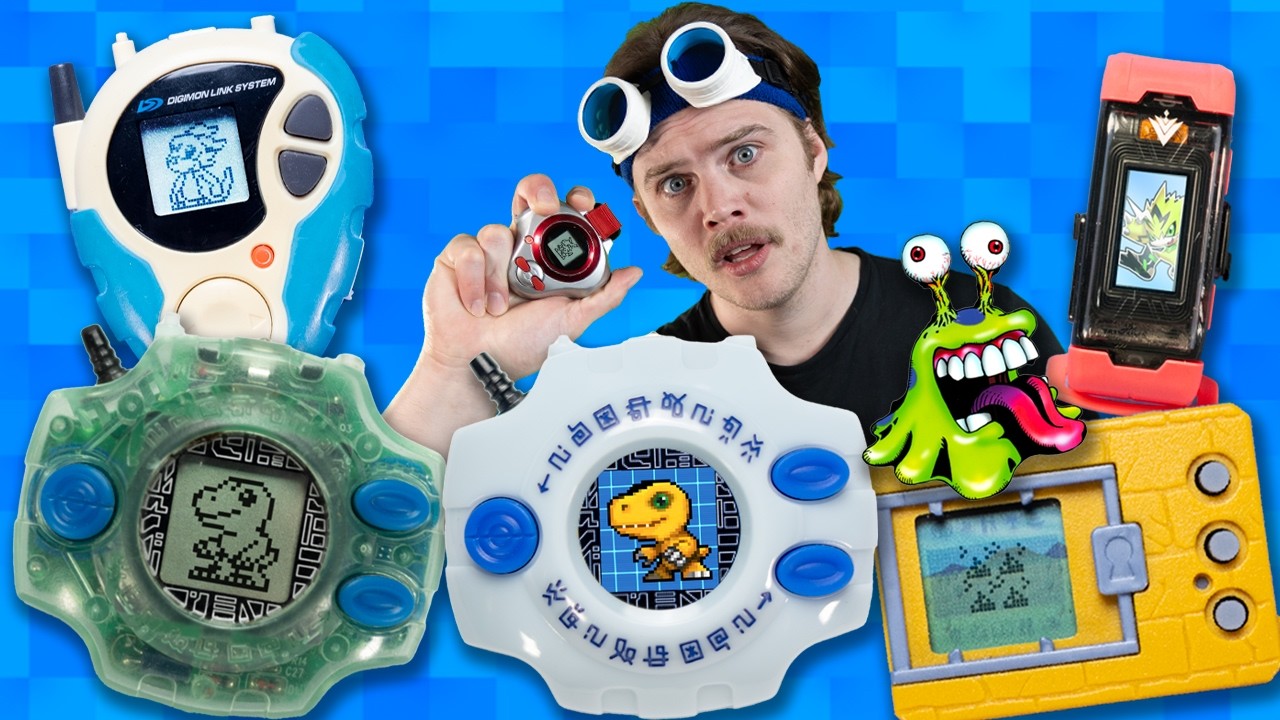
Bandai and WiZ made their own follow-up. The Digital Monster, the Digimon virtual pet, came out in Japan on June 26, 1997. Bandai’s own description is a pocket device on which the monsters that owners had raised could battle each other. Connecting one egg to another is the part of that idea Paradise has too.
Kidscreen ended its 1997 report undecided: “only time will tell whether virtual pets are this decade’s Cabbage Patch Kids or pet rocks.”
How Bandai is marking Tamagotchi’s 30th anniversary
“November 23rd, 2026 marks exactly 30 years since the Tamagotchi series’ first launch,” Bandai’s anniversary announcement says. Its announced plans for New York on November 22 are a show on the screens of Times Square from 7 to 7:30 p.m. and a pop-up in Duffy Square where visitors can “try out the new Tamagotchi Paradise along with other devices from the series’ history.” It also says the F.A.O. Schwarz flagship, now at 30 Rockefeller Plaza, will have a Tamagotchi area in November. F.A.O. Schwarz stores are where the egg made its American debut in 1997.
American owners get a second anniversary. Taro Tsuji, whose title at Bandai is Chief Tamagotchi Officer, said in Bandai Namco’s investor newsletter: “since the international launch of the original Tamagotchi was one year later than Japan, 2027 will mark its 30th anniversary in overseas markets.” The American launch was about five months after Japan’s, in the next calendar year. Thirty years after the F.A.O. Schwarz debut is May 1, 2027.
Original Tamagotchi or Tamagotchi Paradise: which one?
If what you miss is the egg you had in 1997, Bandai still sells it, at $19.99, with what it calls original programming. Paradise is for a different wish: more to do, more characters to find and, by one reviewer’s account, a pet that asks less of you.
Morra’s advice from 1997 covers both. “It’s just a toy,” he said. “Tamagotchi is not a substitute for a real pet.”
Sources
- History of Tamagotchi · Bandai, Official Tamagotchi Site
- Tamagotchi special feature, Newsletter No. 82 · Bandai Namco Holdings
- Tamagotchi Paradise: product pages, How to Play and FAQ · Bandai, Official Tamagotchi Site
- Tamagotchi Paradise instruction manuals · Bandai, Official Tamagotchi Site
- Notice regarding Tamagotchi Paradise (May 20, 2026) · Bandai, Official Tamagotchi Site
- Celebrating 30 years of Tamagotchi, the Tamagotchi Times Square Spectacular kicks off soon in New York City! (dated November 13, 2026 in the site's news list) · Bandai, Official Tamagotchi Site
- Original Tamagotchi FAQ · Bandai, Official Tamagotchi Site
- Original Tamagotchi Tama Candy product page · Bandai, Official Tamagotchi Site
- The All-New Tamagotchi Paradise is Coming Soon! (May 21, 2025) · Bandai, Official Tamagotchi Site
- Tamagotchi Paradise - Neon Planets on sale November 21 (October 9, 2026, in Japanese) · Bandai, Official Tamagotchi Site (Japan)
Show all 21 sources Show the first 10 only
- The Original Tamagotchi Now Available Online And In Stores (October 1, 2018) · Bandai America, via PR Newswire
- Original Tamagotchi Paradise product page · Bandai, Official Tamagotchi Site
- Virtual menagerie (April 29, 1997) · SFGate
- Virtual pet is breaking their hearts (May 26, 1997) · Tampa Bay Times archive
- Retailers predict a virtual petting zoo (June 1, 1997) · Kidscreen
- Gele tamagotchi, object 78041 (a 1997 Tamagotchi and its catalogue record) · Museum Rotterdam, via Wikimedia Commons
- Past Ig Nobel Prize winners (1997, Economics) · Improbable Research
- Tamagotchi Paradise trades stressful virtual pet parenting for nature and tranquility (review, September 5, 2025) · Engadget
- Here's the absolutely massive Tamagotchi Paradise next to other objects in the wild, for scale (August 8, 2025) · Engadget
- Consumer Price Index for All Urban Consumers, all items (series CUUR0000SA0) · U.S. Bureau of Labor Statistics
- Digital Monster Ver.20th press release, with the 1997 launch date (2017, in Japanese) · Bandai, via @Press
In this article

Tamagotchi
1996–1999
The egg-shaped digital pet that lived on a keychain and died if you ignored it during math class. Bandai's Tamagotchi demanded constant feeding, cleaning, and attention, sparking a global craze — and a wave of school bans.

FAO Schwarz
1862–present
The toy store as a destination — the marble-and-magic Fifth Avenue palace with the giant walk-on piano from Big, toy-soldier doormen, and stuffed animals taller than you were. For a '90s kid, FAO Schwarz was the place a trip to New York was really about.

Giga Pets
1997–1998
The keychain virtual pet you fed, cleaned, and played with between classes — America's answer to the Tamagotchi craze. Neglect it and it got sick; ignore it too long and it died right there in your backpack.

Nano Baby
1997–1999
The virtual pet that handed you a human baby on a keychain. While Tamagotchi kids nursed space blobs, Nano Baby owners were on feeding, medical checks, and cleanup duty for a tiny pixel infant that did not care that you were in math class.
Digimon Virtual Pet
1997–2000
The boy's answer to Tamagotchi, and somehow more addictive: a digital monster you didn't just keep alive, you trained to fight. Snap your device to a friend's, and both creatures would duel on screen, their fate determined by every decision you'd made. The winning evolution wasn't the prettiest — it was the strongest.
Mighty Morphin Power Rangers
1993–1996
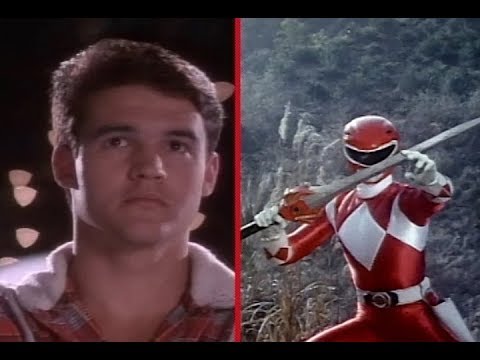
Five teenagers morph into color-coded superheroes to fight Rita Repulsa and her rubber monsters in Angel Grove. Haim Saban's audacious adaptation of Japanese suit footage and American cheesiness became an unstoppable juggernaut—kids bought the toys, wore the costumes, and shouted "It's morphin' time!" in playgrounds across America.

Tickle Me Elmo
1996
The furry red monster that laughed when you tickled it — and triggered a holiday stampede that redefined toy panic. Released in July 1996 at $28.99, Tickle Me Elmo became the blueprint for every must-have frenzy to follow, complete with store stampedes and thousand-dollar scalper asks.

Beanie Babies
1993–1999
Ty Warner's small, under-stuffed plush animals launched in 1993 with a genius (and cynical) business strategy: artificial scarcity through deliberate 'retirements' sparked a mid-90s speculative mania. Kids and desperate adults bought price guides, protected tags with plastic sleeves, camped out for McDonald's Teenie Beanies, and treated them as retirement investments before the bubble collapsed around 1999.

Toys "R" Us
1957–2018
The cathedral of childhood shopping. Charles Lazarus's toy superstore — the backwards "R," aisle upon aisle of Christmas lists waiting to happen, and Geoffrey the Giraffe's unmissable jingle — defined how kids experienced wanting. Then a leveraged buyout, five billion in debt, and a 2018 collapse ended the era.

KB Toys
1973–2009
The cramped, stacked-to-the-ceiling toy store tucked into every American mall — smaller and more chaotic than Toys "R" Us, with clearance bins spilling into the aisles. It was the impulse-buy toy stop on any mall trip, right up until it liquidated for good in 2009.