R.E.M.

From college-radio cult band to the thinking fan's arena colossus — R.E.M. was the bridge between the 1980s underground and the 1990s alternative explosion. "Losing My Religion" and "Everybody Hurts" became anthems for a generation, and the Athens, Georgia quartet proved that you could be smart, cryptic, and absolutely massive all at once.
R.E.M. formed in 1980 in Athens, Georgia as four University of Georgia students — Michael Stipe on vocals, Peter Buck on guitar, Mike Mills on bass, and Bill Berry on drums. Their first single, "Radio Free Europe," recorded in April 1981 and released that July, came out on the tiny Hib-Tone label in a first pressing of only 1,000 copies. The debut album Murmur arrived in 1983 on I.R.S. Records, and through the 1980s the band became the defining act of American college radio — influential, respected, but still operating in the FM underground.
The mainstream earthquake came in March 1991 with Out of Time, which hit number one in both the US and UK and eventually sold 4.2 million copies in America alone and roughly 12 million worldwide by 1996. The album's lead single, "Losing My Religion" — built on a mandolin riff and structured as a confession — peaked at number four on the Hot 100, and R.E.M. took home three Grammys at the 1992 ceremony. "Shiny Happy People," its improbably chipper companion single, became the flip side everyone knew. Automatic for the People followed in October 1992, darker and even more expansive: it sold over 15 million copies worldwide and carried "Everybody Hurts" and "Man on the Moon" into the cultural bloodstream. Monster (1994) cranked the amplification back up and solidified R.E.M. as the thinking kid's arena band.
The decade's latter half brought turbulence. Bill Berry suffered a brain aneurysm onstage in Lausanne, Switzerland on March 1, 1995, and survived — but the incident shadowed the band's sense of invulnerability. In 1996, R.E.M. re-signed with Warner Bros. for a reported $80 million, described at the time as possibly the most expensive recording contract ever made. Berry departed in October 1997, and the remaining trio continued as R.E.M. until the band amicably disbanded on September 21, 2011. They were inducted into the Rock and Roll Hall of Fame in 2007, cementing a legacy that had moved from college-radio prophets to the center of American rock and roll.
Similar items
Nirvana
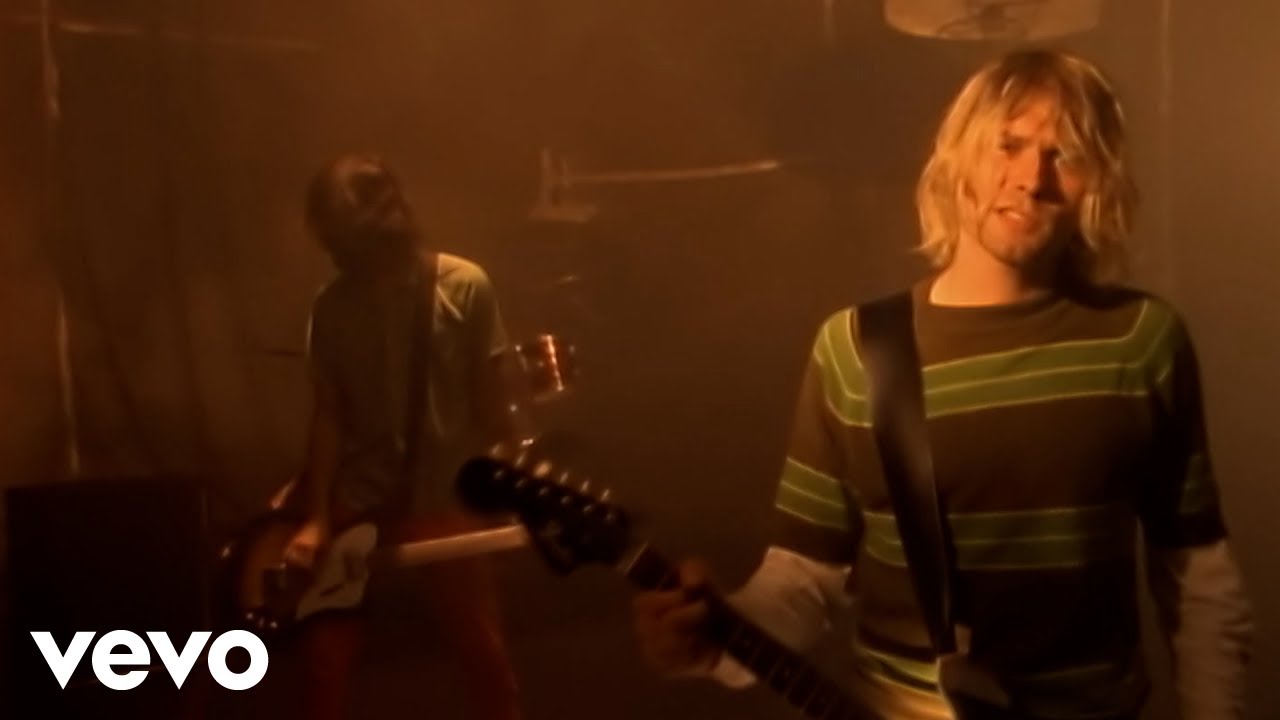
Kurt Cobain, Krist Novoselic, and Dave Grohl didn't invent grunge—but their 1991 album Nevermind accidentally blew it up worldwide, displacing Michael Jackson from #1 and making flannel shirts and angst the uniform of the decade.
![Video thumbnail — Third Eye Blind - Jumper (Official Music Video) [HD]](https://i.ytimg.com/vi/gRYZijLZR-Q/maxresdefault.jpg)
Third Eye Blind
Stephan Jenkins' San Francisco hit machine: one self-titled 1997 debut that just would not stop producing singles — "Semi-Charmed Life," "Jumper," "How's It Going to Be," "Graduate" — all sunshine on the surface and something much darker underneath.

The Offspring
The Orange County lifers who took punk from the underground to total radio domination in one 1994 stroke. Smash became one of the best-selling albums ever released on an independent label, with "Come Out and Play" and "Self Esteem" detonating on modern-rock radio. A second, goofier peak followed with Americana and "Pretty Fly (for a White Guy)." Decades later, frontman Dexter Holland finished a PhD in molecular biology—and the band never stopped touring.
![Video thumbnail — Goo Goo Dolls – Iris [Official Music Video] [4K Remaster]](https://i.ytimg.com/vi/NdYWuo9OFAw/maxresdefault.jpg)
Goo Goo Dolls
Buffalo bar-band punks turned the kings of the late-90s radio ballad: Johnny Rzeznik and Robby Takac spent a decade in the van before "Name" and then "Iris" made them one of the biggest acts in America — and "Iris" sat on top of the airplay chart so long it set a record that stood for over two decades.