Mr. Bones

A candy skeleton in a coffin. Each little plastic casket from Fleer held fruit-flavored pieces shaped like bones that snapped together, jigsaw-style, into a full skeleton, if you were lucky enough to get all the parts. It first sold in 1977 and by most accounts was still around in the 1990s, and the empty coffins were kept long after the candy was eaten.
The story
The coffin was the work of Vero Ricci, a designer of plastic candy containers who had already given Topps a candy-filled trash can. His next client was Fleer, the Philadelphia company that had been the first to make bubble gum successfully. Ricci proposed a hinged plastic coffin filled with bone-shaped candy, and by his account a Fleer executive, Thomas A. Tegan, took the idea a step further: Tegan bought the costly machinery and had dies made to press dextrose tablets with interlocking ends, so that "a human form could be assembled similar to a Jig-Saw puzzle." Fleer's trademark filing gives November 24, 1977 as the first sale.
The coffins came in red, black, blue, white, pink, green and yellow, with a diagram of the finished skeleton under the lid and a loop at one end so the whole thing could be worn on a string. The candy was a pressed, fruit-flavored tablet, somewhere between Pez and a SweeTart. One account counts fifteen pieces in a complete Mr. Bones, and a single coffin did not always have them all. You might get extra skulls and no hand, which was the reason to buy another.
This is a 1970s candy, and most of the people who write about it met it in the late 1970s or early 1980s. But it stayed on the rack: Fleer was still making it in the 1980s and, by the accounts that exist, the 1990s, while a nearly identical candy called Bone Shaker was sold in Britain and Canada. Those accounts are vague about the end. One says Fleer sold it "well into the 90s," another that production continued "until the 1990s." Marvel bought Fleer in 1992, Fleer closed its Philadelphia plant in 1995, and the Mr. Bones trademark registration was allowed to expire.
The coffins kept the memory going. Emptied, they held action-figure weapons and served as props in other toys' adventures. A collector and historian of candy packaging, Jason Liebig, later acquired the rights to the brand, and the toy company Super7 has sold Mr. Bones as a retro-style action figure in a package with a coffin-shaped bubble.
Bring it back
More like this

Ouch! Bubble Gum
1989–c. 2010 (revived 2025)
Bubble gum sold in a little metal tin made to look like a box of adhesive bandages, with every stick wrapped as a bandage. Grape, watermelon and strawberry. The flavor faded fast; the tin was what people kept.
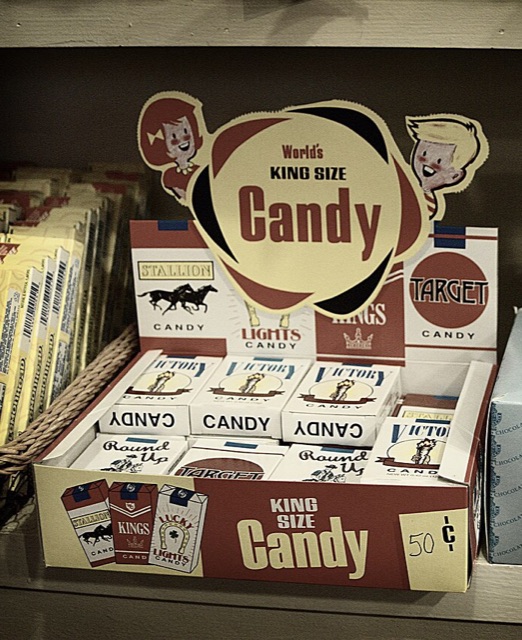
Candy Cigarettes
1880s–present
Chalky sugar sticks with a painted red tip, sold in cigarette-style packs straight to kids at the corner store — plus bubble-gum versions whose paper wrappers let you puff out powdered-sugar "smoke." The most "you had to be there" candy of the entire era.

Ring Pop
1977–present
The giant faceted candy gem you wore on your finger all recess — jewelry you were allowed to lick. Invented to break one kid's thumb-sucking habit, it became the engagement ring of every 90s playground.

Push Pop
1986–present
The lollipop you didn't have to finish: push it up, lick it sticky, cap it, and slide it back into your pocket for third period. Topps' retractable candy cylinder was half treat, half gadget — and the cap made it feel like contraband you were licensed to carry.