Merry-Go-Round (the mall store)

The mall store where you bought the Beat It jacket, the parachute pants and then the Cross Colours: a Baltimore chain that rode every fad from 1968 to nearly 1,500 stores and a billion dollars in sales, bet on hip-hop just as the mall went grunge, and liquidated in 1996.
Leonard "Boogie" Weinglass and his high-school friend Harold Goldsmith opened the first Merry-Go-Round in 1968 on Peachtree Street in Atlanta's hippie district, selling miniskirts, tie-dyed T-shirts, Sgt. Pepper jackets and bell-bottoms. Based in Baltimore, and later in nearby Joppa, Maryland, the chain grew by chasing whatever teenagers wanted that month: Michael Jackson "Beat It" jackets in 1983, parachute pants in 1984, Madonna bustiers in 1985. It went public in July 1983, passed 200 stores the following year, and its stock rose nearly 300 percent between 1985 and 1990. By the early 1990s Merry-Go-Round Enterprises ran roughly a thousand stores, almost all of them in enclosed malls, and had added the Silverman's menswear chain.
Then the bets stopped paying. Goldsmith died in a plane crash in Aspen in February 1991, and Weinglass would later say the company would never have gone bankrupt without it. In 1993, over the objections Goldsmith had raised in life, Merry-Go-Round bought the 476-store Chess King chain from Melville, a deal expected to push its sales, $877.5 million the year before, past a billion dollars, and to take it to about 1,500 stores and roughly 15,000 employees. Weinglass's verdict, later: "It was a major, major, major, major mistake." Worse, the chain had loaded up on hip-hop fashion, it was Cross Colours' biggest retailer, just as suburban teenagers turned to grunge. "Hip-hop sold well in places like Newark and Detroit," a former buyer told Fortune. "But you went to Beaumont, Texas, and everyone just laughed." Unsold inventory became a cash crisis, and in January 1994 the company filed for Chapter 11.
The reorganization went badly: four chief executives in eighteen months, a first year in bankruptcy that lost $186 million, and turnaround advice from Ernst & Young that the bankruptcy trustee later sued over, a case that ended in what Wikipedia records as the largest single-defendant settlement in Maryland history. On February 2, 1996, Groundhog Day, the company announced it was going out of business, with about 536 stores, more than 6,000 employees and something like $200 million lost since the filing; creditors recovered nothing. Cross Colours' founders say they were left owed $10 million. Weinglass, who had built a billion-dollar company on knowing what kids wanted, told Fortune he had no aspirations to create the next chain of anything. For the kids, it is the store at the mall that had the thing before anyone else did, until it didn't.
Similar items
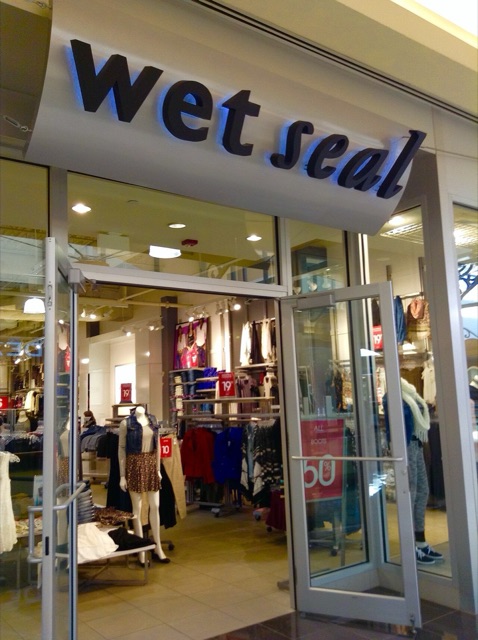
Wet Seal
The juniors racks where a going-out top cost almost nothing and lasted one dance. Wet Seal was fast fashion for teenage girls — trend pieces bought cheap, worn once, and replaced next weekend. The 2000s mall uniform came off these racks.

Cross Colours
Color-blocked jeans, bold-lettered tees, and a message stitched into every garment: "Clothing Without Prejudice." Cross Colours dressed the Fresh Prince, half of early-90s hip-hop, and every kid who wanted to look like MTV — then vanished almost overnight when its biggest retailer went bankrupt.

Babbage's & Electronics Boutique
The two little mall stores where 90s kids pressed their faces to the glass: Babbage's with its wall of shrink-wrapped PC boxes and Nintendo cartridges, Electronics Boutique with the demo kiosk and the clerk who had already beaten everything. Both of them became GameStop.

Woolworth's
The five-and-dime with the lunch counter, the sewing notions, the greeting cards and the china, the store downtown that had been there since your grandmother's day. In July 1997 the company announced it was closing the last 400 U.S. stores, and downtown never quite got them back.