Funbug.com
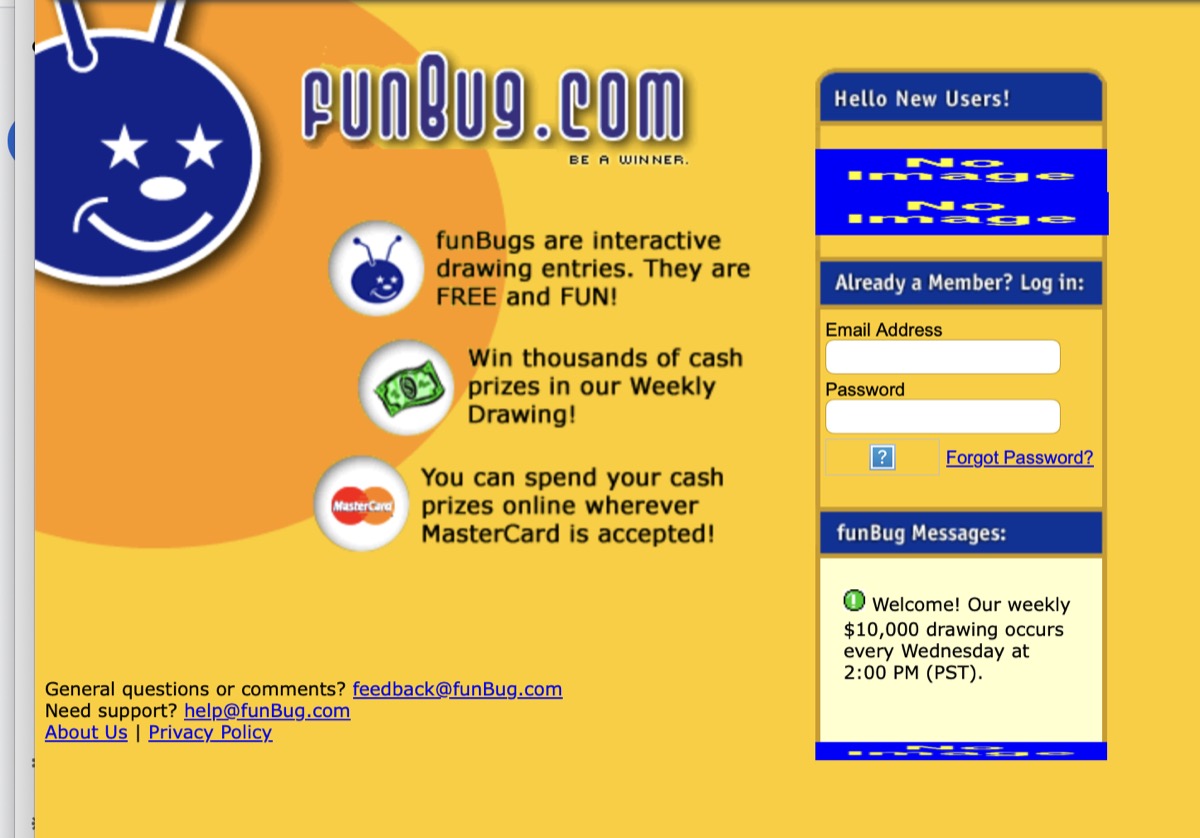
A turn-of-the-millennium site where you played games for a shot at cash, with a $10,000 drawing every Wednesday afternoon and winnings that landed on a funCard MasterCard. It was live by early 2000, folded in the dot-com bust of 2001, and is remembered now mostly as the $3.9 million failure Nick Woodman had before he built GoPro.
Nick Woodman graduated from UC San Diego in 1997 and started two companies in quick succession. EmpowerAll.com tried to sell electronics at no more than a $2 markup; Funbug was, in Wikipedia's words, "a gaming and marketing platform that let users win cash prizes," and Forbes later described it simply as an online gaming service. Woodman's father, an investment banker, put $235,000 into his son's early ventures, and Funbug went on to raise $3.9 million from investors. It was part of the same get-paid-to-be-online economy as the AllAdvantage-era paid-to-surf programs, with games and sweepstakes instead of a banner bar.
The site itself survives only in the Internet Archive, whose first capture of funbug.com dates from March 2000. An October 2000 snapshot of the homepage shows a login box and one line of copy: "Welcome! Our weekly $10,000 drawing occurs every Wednesday at 2:00 PM (PST)." Winnings were paid onto a "funCard" MasterCard, which is the detail the site's final notice spends most of its words on. The owner of this site remembers it as a raffle site with weekly drawings, which is exactly what the archive shows.
It did not last long. By spring 2001 the homepage had been replaced by a notice headed "Greetings Friends of funBug": "Due to current market conditions, we are no longer able to provide you with the fun and excitement that you've come to enjoy at funBug.com. There are a few organizations that are interested in bringing funBug.com back online for your enjoyment, but for now we can only ask for your patience." Holders of a funded funCard account were promised an email the week of April 23 explaining how to restore access to their accounts. Forbes' 2013 profile of Woodman put it more bluntly: Funbug "went belly-up in the dotcom crash of 2000-01, taking with it $3.9 million of investors' money." "I'd never failed at anything before except computer science engineering classes," Woodman told the magazine.
What came next is the famous part. Woodman planned one last big surf trip through Australia and Indonesia before getting a conventional job, and brought along a homemade rig: a broken surfboard leash and rubber bands holding a Kodak disposable camera to his wrist. Five months later he was back in California, building prototypes in a house in Moss Beach at 27 with $30,000 of his own money, $35,000 from his mother and two $100,000 investments from his father. The first GoPro, a $3.05 film camera from a Chinese supplier in a strap and case of his own design, sold in September 2004 at an action-sports trade show in San Diego. Funbug became the cautionary first act of that story, which is the only reason anyone still types the name.
Similar items

Get Paid to Surf
The dot-com fantasy made real: companies would literally pay you to browse the web. Millions signed up for the Viewbar, watched ads while surfing, and actually got checks—until the ad market crashed and the dream evaporated in 2001.
CashWars
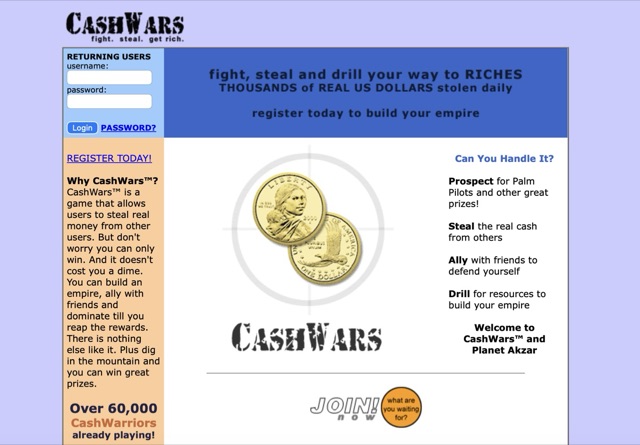
A browser-based play-to-earn game where you built an empire in the fictional world of Akzar, drilled for oil barrels, raised stats by spending resources, and raided rival players — with the wild promise that you could cash out and receive a real cheque in the mail.
Early eBay
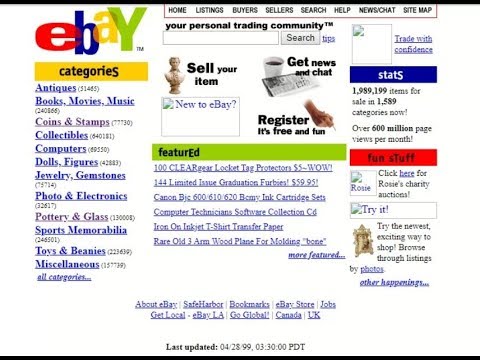
The person-to-person auction era before storefronts and one-click checkout. You photographed your own stuff with a grainy digital camera, hand-wrote the listing in janky HTML, and mailed a check to a stranger whose feedback score was the only thing telling you they could be trusted. Half the thrill was a last-second bidding war; the other half was the box arriving at all.
Friendster
The social network you joined before you even knew what a social network was. Millions made their first-ever online "profile" on Friendster — then MySpace came along, and the site that started it all became the cautionary tale.