CashWars
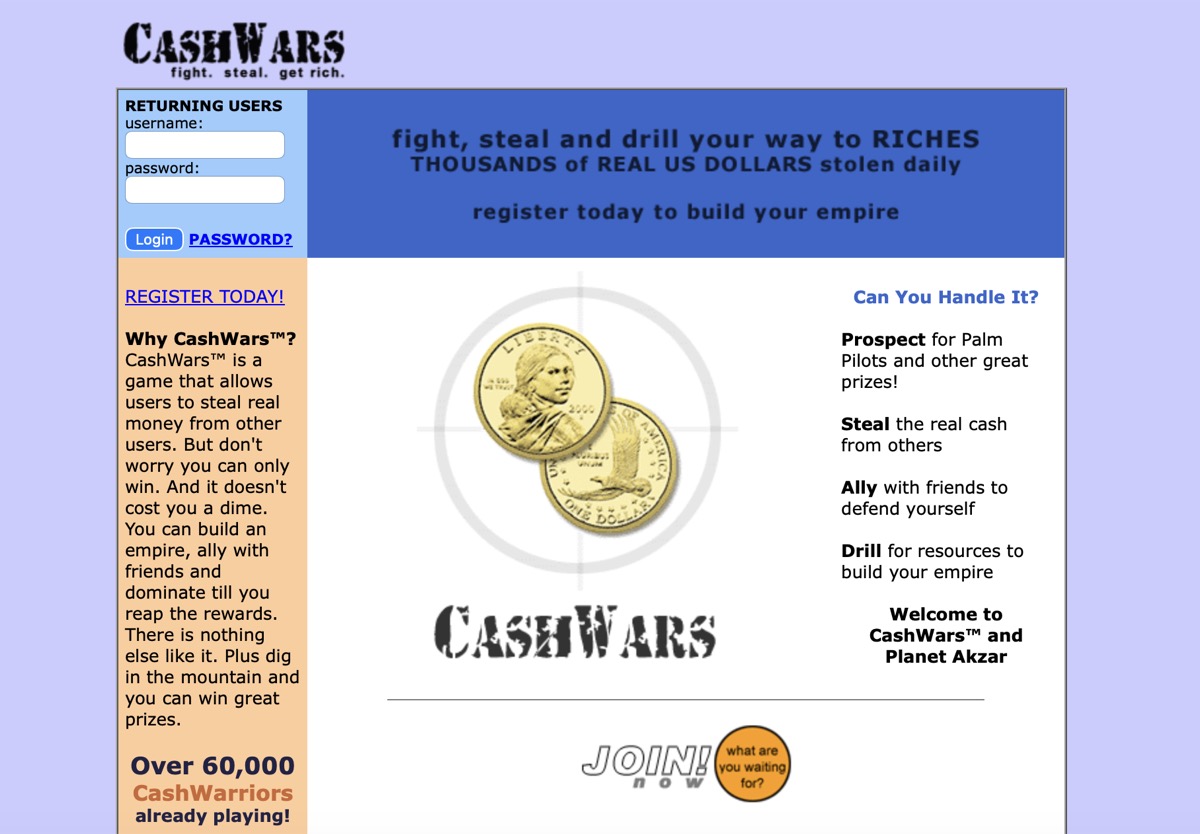
A browser-based play-to-earn game where you built an empire in the fictional world of Akzar, drilled for oil barrels, raised stats by spending resources, and raided rival players — with the wild promise that you could cash out and receive a real cheque in the mail.
CashWars (circa 1999–2001) was the dream game of the early internet era: a strategy browser game that let you make actual money. Set in the fictional nation of Akzar, you logged in each day with a limited number of MOVES to navigate a map grid. Each square could be an oil field, another player's base, or empty terrain. Find an oil field and DRILL for a random number of oil barrels; spend those barrels to raise one of four stats — Fortification, Strength, Stealth, or Security — then raid other players' bases to steal their Akzar Cash. Combat was chance-based: higher stats meant better odds of winning, but nothing was certain.
The hook was the cash-out. If you had enough money at the end of the month, you could request a real CHEQUE sent to your address. One documented player cashed out $21 in December 2001 — proof that it was real, that you could actually extract money from pixels. The game became instantly rampant with exploitation. Players ran bot networks running automated moves 24/7, and multi-account referral chains funneled earnings toward one account destined to cash out. The entire economy collapsed under the weight of fake engagement.
CashWars died the death of the whole "get paid to surf" ecosystem. The real problem was the advertisers funding the payout: they were paying for impressions, but the only eyes seeing ads were bots, not human eyeballs. CashWars, along with entries like Paid-to-Surf and countless dot-com schemes, withered when the ad market finally accepted it was being defrauded. The game shut down as suddenly as it had appeared, another relic of the dot-com bubble's gullible optimism.
Similar items

Get Paid to Surf
The dot-com fantasy made real: companies would literally pay you to browse the web. Millions signed up for the Viewbar, watched ads while surfing, and actually got checks—until the ad market crashed and the dream evaporated in 2001.

Angelfire
The free web host where the internet got weird and stayed that way. Angelfire grew into one of the "big three" free-hosting services of the late 90s, offering bare-bones page building for personal fan sites, rants, and niche collections—all with guestbooks, hit counters, and clashing backgrounds.

AOL
The dial-up gateway that wired up America. AOL's "You've Got Mail" voice, aggressive free-trial CD carpet-bombing, and shift to unlimited $19.95/month pricing triggered the legendary busy-signal crisis — millions of Americans' first taste of the internet.
AOL Private Chat Rooms
The hidden rooms where 90s internet culture actually lived. Capped at 23 people, joinable only if you knew the name, and greeted by universal "A/S/L?" — private rooms were where friendships, flirtations, and warez trades quietly thrived.