Freewebs
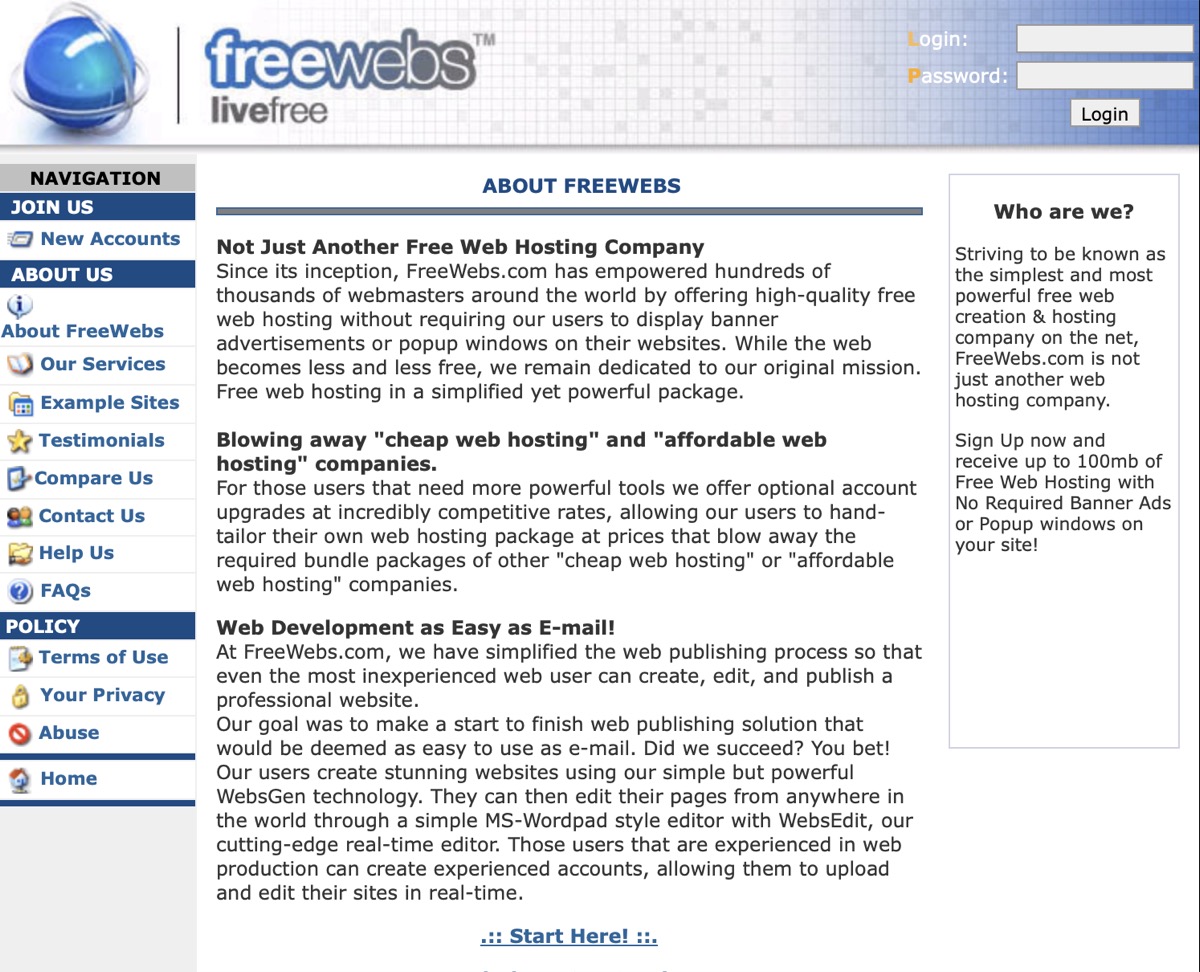
Before anyone had heard the word "platform," there was Freewebs — the place where a twelve-year-old could build a real website in an afternoon. Guestbooks, glitter cursors, tiled backgrounds, an autoplay MIDI you couldn't turn off: if you had a fan site, a clan page, or a shrine to your Neopets in the mid-2000s, there's a decent chance it lived at freewebs.com slash something.
Freewebs was founded in 2001 by brothers Haroon and Zeki Mokhtarzada — with help from their younger brother Idris — while finishing up at the University of Maryland. The pitch was disarmingly simple: anyone should be able to make a website for free, no code required. Pick a template, drag in a photo gallery or a blog or a guestbook, and you were live on the internet with a freewebs.com address you'd be writing on your binder by lunch.
It became the successor to GeoCities' throne just as that empire faded — the default home for the web's amateur builders. Band pages with three songs and a Shows tab that said TBA. Fan sites for anime, wrestlers, and boy bands. RuneScape clan rosters. AND MY AWARDS pages with animated trophy GIFs. The aesthetic was pure mid-2000s maximalism — glitter graphics, hit counters, chatboxes, marquee text scrolling past a starfield — and the growth was real: by April 2007 the service was drawing 18 million unique visitors a month. For countless kids, a Freewebs site was the first thing they ever published to the world, the training-wheels version of the personal internet that MySpace was simultaneously perfecting next door.
On November 14, 2008, Freewebs grew up and shortened its name to Webs, chasing the small-business market; the printing giant Vistaprint acquired the company at the end of 2011 for $117.5 million. The old free sites lingered on for a remarkably long time — the last freewebs subdomains weren't switched off until 2023 — meaning a generation's Inuyasha shrines and skate-crew pages quietly outlived the decade that built them. The name never stopped meaning what it meant, though: somewhere between a toy and a printing press, and for a lot of people, the first time the internet felt like theirs.
Similar items

GeoCities
The free web hosting empire where the internet learned to be chaotic. GeoCities gave millions of people their first webpage, organized into themed neighborhoods, and established the visual language of under-construction GIFs, MIDI soundtracks, and blinking text that defined the early web.

MySpace
MySpace launched in August 2003 and became the social network that swallowed the mid-2000s internet — where everyone's first friend was Tom. Top 8 rankings sparked drama, profile songs played on auto-load, and DIY HTML customization meant glitter graphics and autoplay music ruled. Bands broke careers there; it was the most-visited website in the US by 2006.
Photobucket
The image host that decorated the entire early internet — MySpace profiles, forum signatures, eBay listings. Photobucket's ten billion images were invisible infrastructure, right up until June 2017, when a paywall turned millions of embedded pictures into upgrade-nag placeholders all at once.

Angelfire
The free web host where the internet got weird and stayed that way. Angelfire grew into one of the "big three" free-hosting services of the late 90s, offering bare-bones page building for personal fan sites, rants, and niche collections—all with guestbooks, hit counters, and clashing backgrounds.