D.A.R.E.

Drug Abuse Resistance Education — the program that sent a uniformed police officer into your elementary classroom to talk about saying no to drugs. You watched slideshows, filled out a workbook, maybe met a police dog, and graduated with the T-shirt everyone in the '90s wore. The message was simple; the results, it turned out, were complicated.
D.A.R.E. — Drug Abuse Resistance Education — was created in Los Angeles in 1983, a joint project of LAPD Chief Daryl Gates and Harry Handler, the superintendent of the Los Angeles Unified School District. The concept was to put a real, uniformed police officer in front of schoolkids for a series of lessons on resisting drugs, alcohol, gangs, and peer pressure. It spread fast. Backed by federal money through the Drug-Free Schools and Communities Act of 1986, D.A.R.E. rode the era's war on drugs into classrooms across the country, and at its height it ran in roughly 75% of American school districts.
For a '90s kid, D.A.R.E. was a whole experience. The officer became a semi-regular fixture for a few weeks, handing out workbooks, pens, and rulers, running through scenarios about peer pressure, and sometimes rolling up in a seized sports car as a prop. It culminated in graduation and, above all, the merch — the D.A.R.E. T-shirt became one of the most recognizable pieces of clothing of the decade, worn long after anyone remembered the lessons. The program was earnest, well-funded, and, for a lot of kids, the first time a police officer was a friendly regular presence in their school.
The trouble was that it didn't seem to work. A string of studies through the 1990s found little to no effect on actual drug use, and a 1998 report backed by the National Institute of Justice concluded flatly that D.A.R.E. did not reduce substance use; some research even found no advantage, or worse, for kids who'd been through it. Under mounting evidence, the organization overhauled its approach — in the early 2010s it adopted "Keepin' it REAL," an evidence-based curriculum developed by researchers at Penn State and Arizona State that emphasizes interactive decision-making over lectures. D.A.R.E. still exists, but for millennials it lives on mostly as a memory: the officer, the workbook, and that unkillable T-shirt.
Keep talking about it (Reddit)
Similar items

The Presidential Physical Fitness Test
Once a year, gym class turned into a testing gauntlet: the pull-up bar, the sit-and-reach box, the shuttle run, and the curl-ups counted out by a partner. Do well enough across all of it and you earned the Presidential Physical Fitness Award. Come up short on the pull-ups in front of everyone and you just prayed for it to be over.

School Field Day
The end-of-year outdoor blowout when class got canceled for a day of sack races, tug-of-war, three-legged races, and water-balloon tosses out on the field. Everybody went home sunburned and clutching a ribbon — even if it just said "Participant."

Writing Your Name in the School Textbook
A grid stamped inside the front cover: ISSUED TO / YEAR USED / CONDITION. On the first day you wrote your name in the column alongside every kid who'd had your copy before — sometimes going back a decade. You scanned the list for older siblings, anyone you recognized, anyone famous. The condition column warned: New, Good, Fair, Poor — and you'd pay the difference.
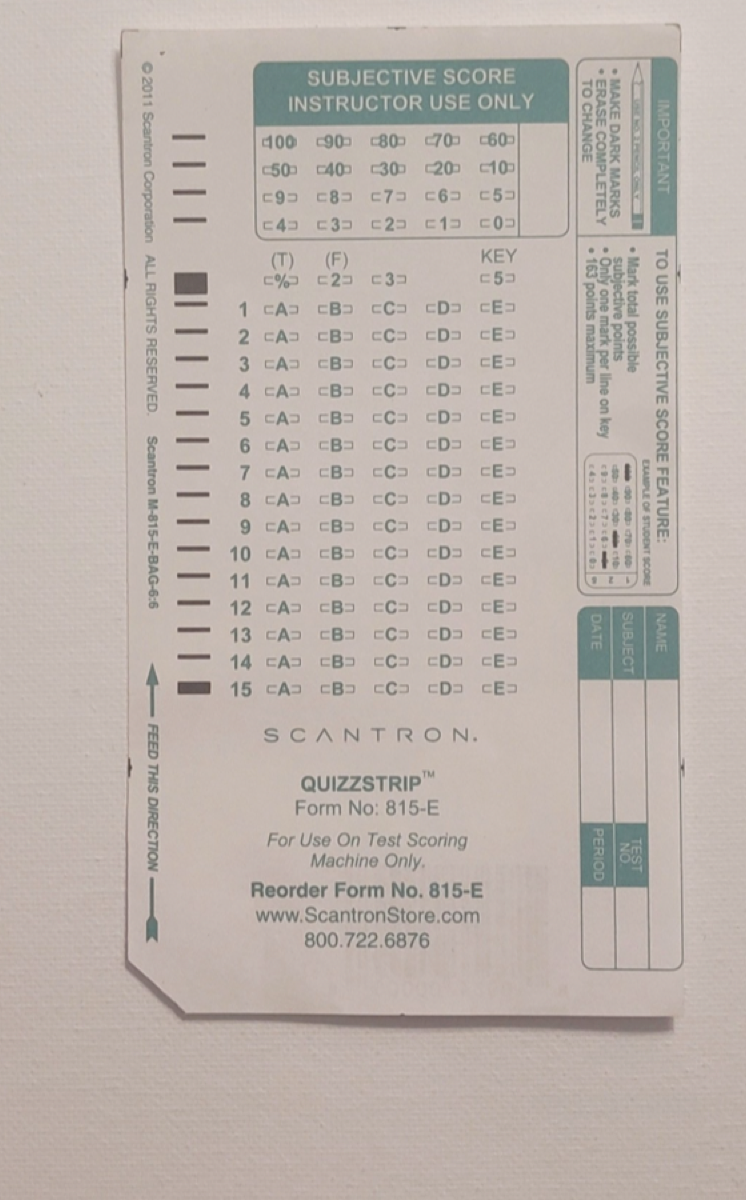
Scantron
The green (or blue, depending on your school) bubble sheet that turned testing into a ritual of dread. The Scantron form—with its perfectly aligned bubbles and #2-pencil-only mandate—wasn't just a testing tool; it was a rite of passage, complete with the terror of erasure shadows and red hash marks on the returned sheet.