Bust-a-Move (Puzzle Bobble)
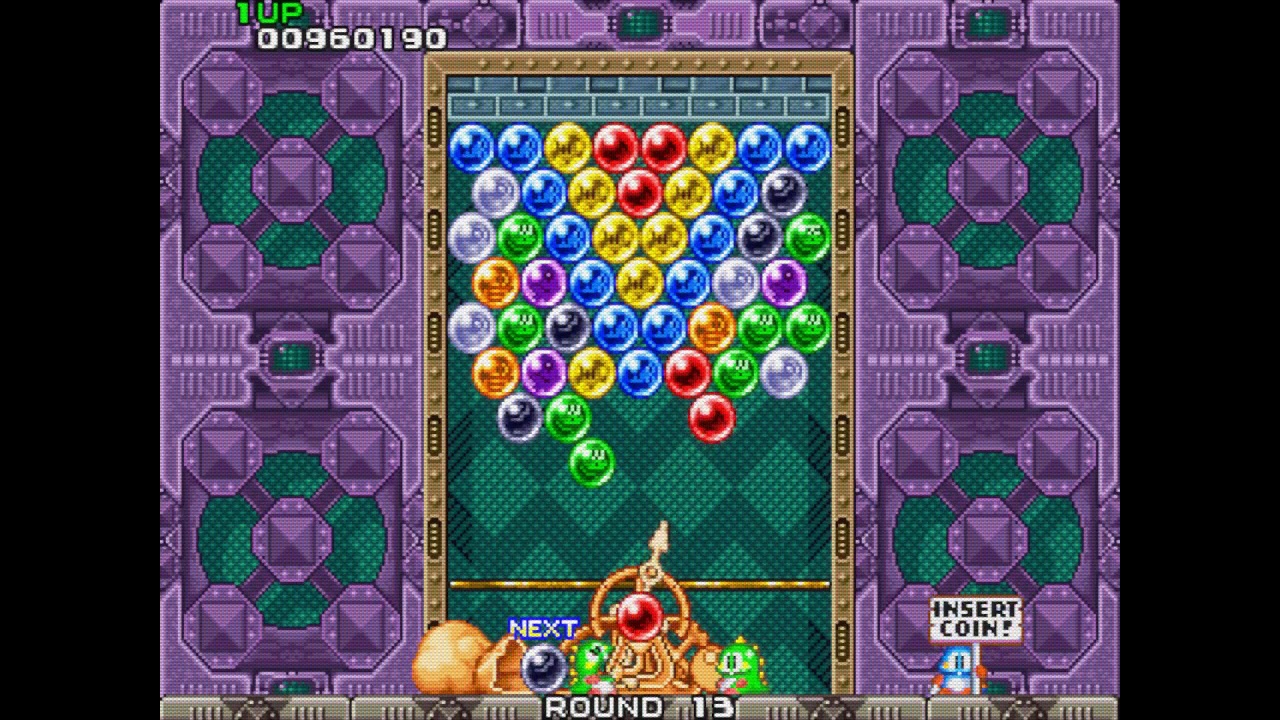
The cabinet at every bowling alley, skating rink, and pizza place: cute dinosaurs working a bubble cannon, three-of-a-color pops, and a slowly descending wall of doom. Bust-a-Move was the arcade game everybody's mom was secretly great at — and the formula was so good it never stopped being made.
Taito released Puzzle Bobble in Japanese arcades in June 1994, and it reached North America that December retitled Bust-a-Move. The premise was instantly legible from across the room: a cannon at the bottom of the screen, a ceiling of colored bubbles above, aim and fire to match three or more and pop them before the mass crosses the line. Working the cannon were Bub and Bob, the bubble-blowing dinosaurs from Taito's 1986 classic Bubble Bobble — cute mascots, bouncy music, zero intimidation. This was the arcade game for people who never played arcade games.
It was a smash — in Japan it ranked as the second-highest-grossing arcade software of 1995 — and unlike the fighting games it shared arcades with, its natural habitat was the casual venue: bowling alleys, skating rinks, pizza places, movie-theater lobbies. Puzzle Bobble 2 hit arcades in 1995 (in North America, Bust-A-Move Again) and came home as Bust-A-Move 2: Arcade Edition on PlayStation and Saturn in 1996, with a Nintendo 64 version following in 1998 — and the head-to-head two-player mode made it a couch staple. The series simply never stopped: sequels and ports kept coming through the 2000s and beyond, with new entries still releasing in the 2020s (Puzzle Bobble Everybubble! arrived in 2023).
Bust-a-Move defined casual arcade culture years before "casual games" was an industry term, and proved the match-three loop long before the mobile era ran away with it. Its formula was so irresistible that a geology professor built a shareware homage — Snood — that ran the college computer labs of the next decade. No story, no stakes, just a loop so clean that three decades later, someone at a bowling alley is still lining up a bank shot off the wall.
Similar items

Snood
Launch goofy grimacing faces up the board, match three, and watch the ceiling ratchet down — while your AIM away message covered for you. Snood was the shareware puzzler installed on every dorm and computer-lab machine at the turn of the millennium, and it was written by a geology professor as a gift for his wife.
Street Fighter II
The 1991 arcade fighting game that singlehandedly revived the arcade industry and invented the competitive fighting-game community. Capcom's Street Fighter II featured eight selectable characters with unique movesets, and combos—initially discovered as glitches—became the foundation of an entirely new genre. From the SNES port to EVO championships decades later, this game's influence on gaming culture is immeasurable.
Mortal Kombat 4
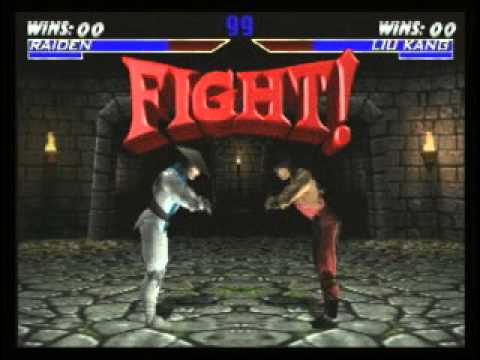
The first Mortal Kombat in 3D, the last one to hit arcades—and the first where you could pull a weapon mid-fight. Polygonal fatalities were the playground whisper of 1997.
![Video thumbnail — [Nintendo 64] NFL Blitz TV Commercial](https://i.ytimg.com/vi/KwSb_-1bsFo/hqdefault.jpg)
NFL Blitz
The arcade football game that threw the rulebook in the trash: seven-on-seven, 30 yards for a first down, no penalties, and late hits actively encouraged — you could body-slam a guy well after the whistle. From the NBA Jam bloodline, with the same announcer energy: "DA BOMB!"