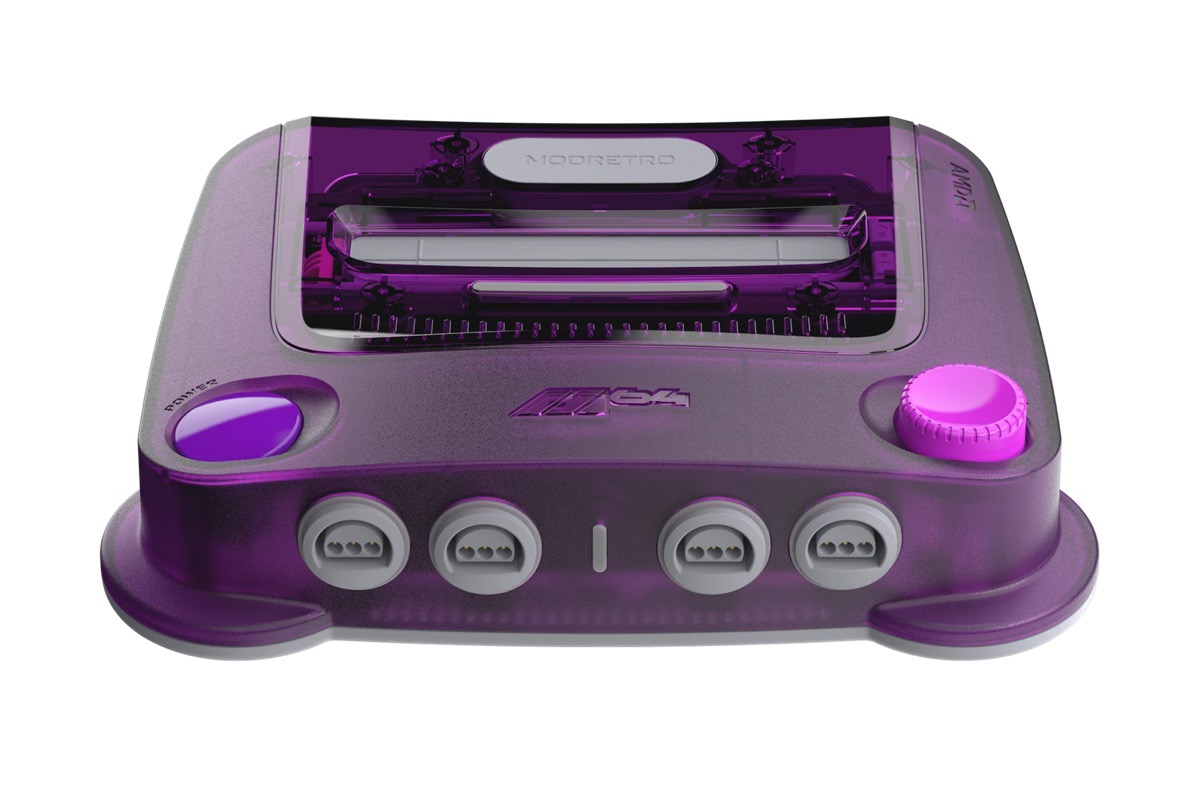
The Nintendo 64 reached American stores in September 1996 at $199.95, with two games on the shelf beside it. Thirty years later a company called ModRetro is selling a new machine built to play those same gray cartridges. The M64 launched on July 28, 2026. It is not a Nintendo product. It has a cartridge slot on top and four controller ports on the front, and it expects you to bring the games.
This is a side-by-side of the two consoles, built from ModRetro’s published specifications and the record of the original Nintendo 64. We have not used an M64. Where a detail comes from someone who has, we say who.
The short version, going by ModRetro’s specifications: the M64 takes the same cartridges and the same controllers as the original N64, sends the picture over HDMI at up to 4K, plays games from any region, and has the Expansion Pak and Controller Pak built in. It costs $229.99, and a controller is extra.
ModRetro M64 vs. N64 at a glance
Swipe the table sideways to see both consoles.
| Nintendo 64 (1996) | ModRetro M64 (2026) | |
|---|---|---|
| Released | June 23, 1996 in Japan; September 29, 1996 in North America, though stores began selling it on the 26th | July 28, 2026 |
| Price | $199.95 at launch | $229.99 |
| Controller in the box | One | None. The M64 Pro Controller is $89.99 |
| What runs the games | A 93.75 MHz NEC processor and 4 MB of memory | An FPGA, a chip set up to behave like the original's circuits |
| TV connection | Composite or S-Video | HDMI |
| Picture | Most games ran at 320×240 | 720p, 1080p, 1440p or 4K, with optional scanline and CRT filters |
| Cartridges | N64 cartridges made for your own region | Original N64 cartridges from any region |
| Controller ports | Four | Four, and they take original N64 controllers |
| Expansion Pak | Sold separately, or bundled with Donkey Kong 64 | Built in |
| Controller Pak | A memory card that plugged into the controller | Built in, since a September 2026 update |
| Rumble | The Rumble Pak, from 1997, on two AAA batteries | A motor inside the M64 Pro Controller |
| Transfer Pak | Came with Pokémon Stadium | Planned for a future update, through ModRetro's Chromatic handheld |
| Size and weight | About 10.2 × 7.5 × 2.9 in, 2.4 lb | 8.5 × 6.5 × 2.2 in, 1.6 lb |
| Colors | Charcoal gray as standard, plus colored editions | Four see-through shells on ModRetro's store: Clear, Purple, Green and AMD Red |
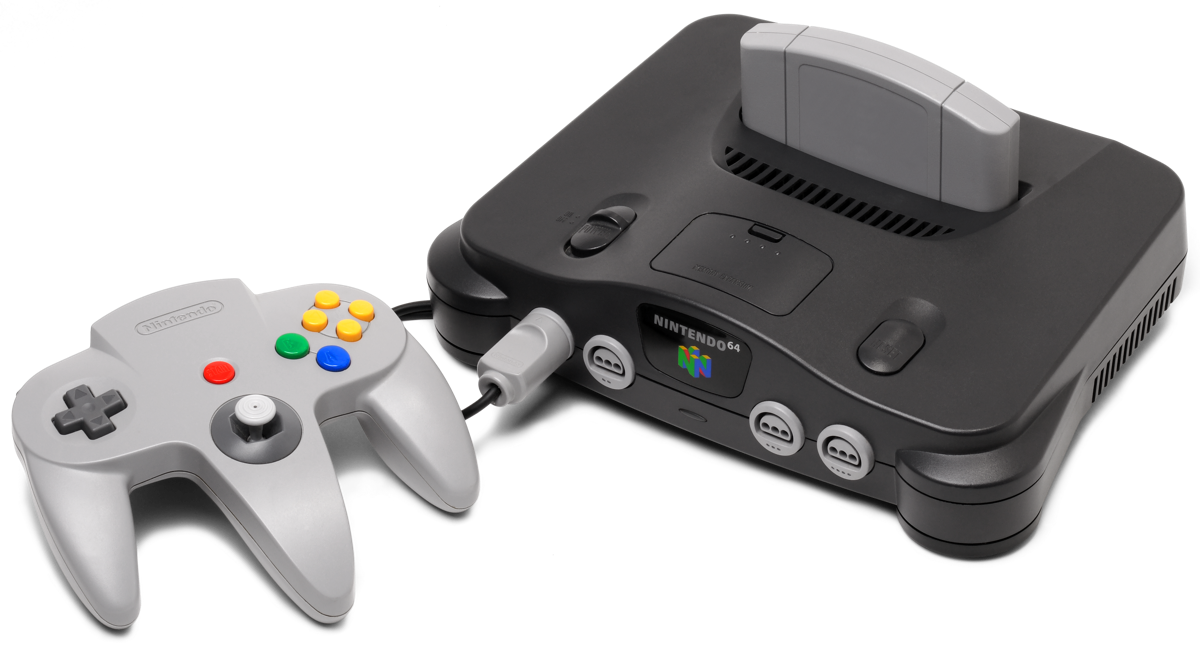
What’s the same on the M64
The cartridges. The M64 is built around the cartridge slot. ModRetro promises “full compatibility with original cartridges and controllers,” so the copy of Super Mario 64 you got in 1996 is the game you play. It also keeps score in public: of the 294 North American games on its compatibility list when we checked, 275 were marked compatible.
The controller ports. There are four of them on the front, and they accept original N64 controllers.
Turning it on. There is no home screen to get through. GamingTrend’s reviewer, who tested a retail unit, wrote: “There aren’t menus to navigate or games to choose on a dashboard: just whatever game you inserted starting up.”
The ritual. The same reviewer found that older games took a moment to load: “You might have to re-seat the game a few times, but eventually, I got it all working.” Anyone who spent the ’90s blowing into cartridges knows that one. Re-seating was always the part that worked.
What’s new on the M64
One HDMI cable. The N64 sent its picture out over composite or S-Video, and most games ran at 320×240. The M64 outputs 720p, 1080p, 1440p or 4K over HDMI, with optional scanline and CRT filters for anyone who misses the look of a tube TV.
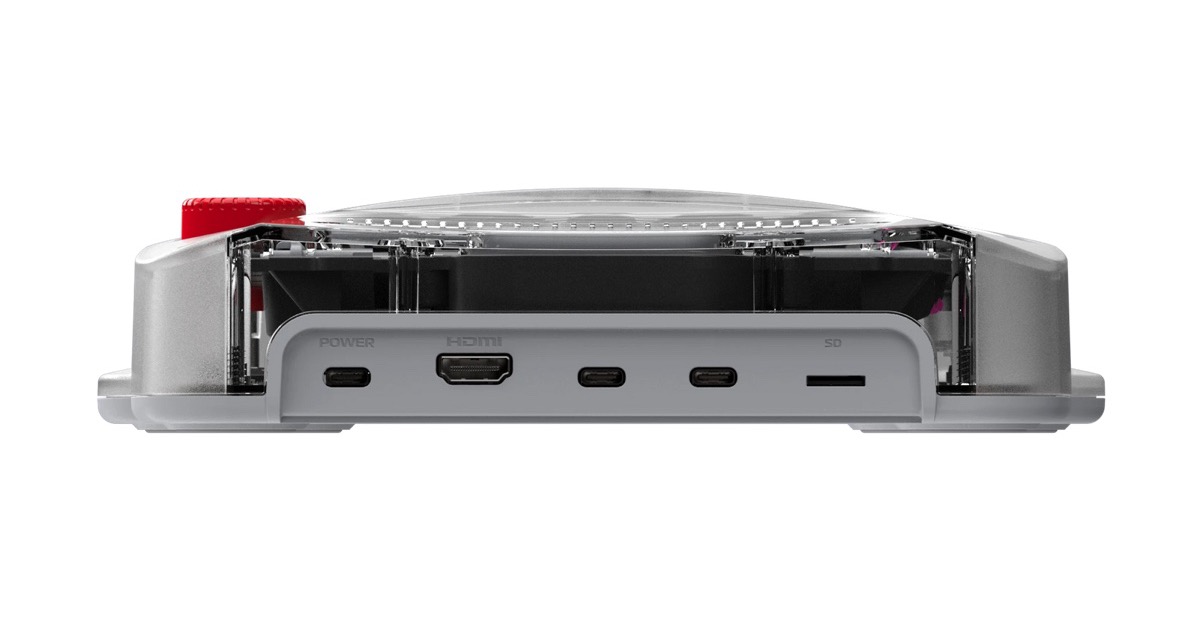
Any region’s games. The original was region-locked. Cartridge shells were notched differently by market and the consoles carried lockout chips, so a game from one region was not meant to play on a console from another. ModRetro lists the M64 as region free, for games bought in Europe, Japan or North America.
The paks are inside. On the original, more memory meant an Expansion Pak, sold separately or bundled with Donkey Kong 64, which required it. So did The Legend of Zelda: Majora’s Mask. Some games saved to a Controller Pak, a memory card that plugged into the underside of the controller. ModRetro lists both as built in. The Controller Pak arrived in a firmware update dated September 29, 2026, thirty years to the day after the N64’s official American launch.
Smaller and silent. The M64 is 8.5 by 6.5 by 2.2 inches and 1.6 pounds. The original was about 10.2 by 7.5 by 2.9 inches and 2.4 pounds. ModRetro describes a fanless design that “runs completely silent.”
A controller without a cord. The M64 Pro Controller keeps the three-pronged shape, has a rumble motor and replaceable thumbsticks, and connects by Bluetooth or by cable. It is sold separately at $89.99.
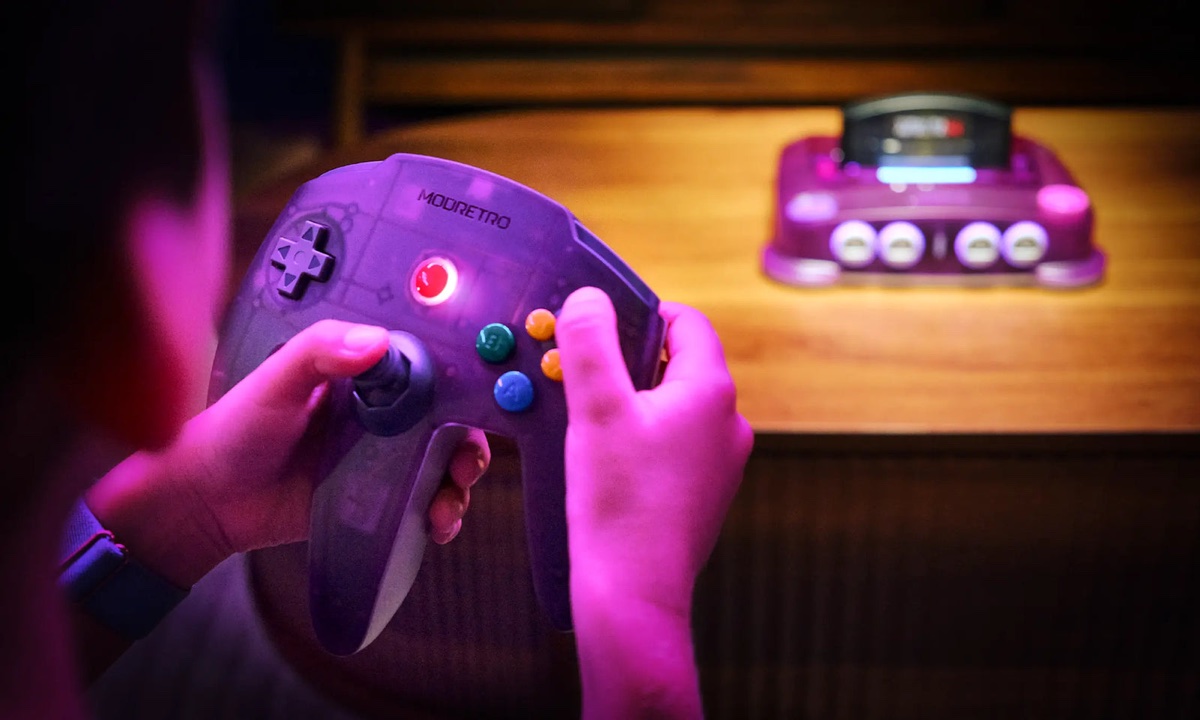
Updates. New features arrive over Wi-Fi. ModRetro describes the console’s core and firmware as open source. When we checked, it had published the hardware designs, and its software repository read “Coming soon!”
A faster setting. The M64 includes an overclocking mode. In ModRetro’s words, it “helps reduce the frame rate drops sometimes experienced on original cartridges.”
New cartridges. ModRetro also publishes games on cartridge at $49.99 each. The launch lineup includes Buck Bumble (“The Argonaut classic is officially back,” its blog says) and a brand-new shooter, Xibalba 64.
How the M64 works: what an FPGA is
The original N64 ran on a 93.75 MHz NEC processor, a graphics chip from Silicon Graphics and 4 MB of memory. An emulator is a program that imitates chips like those on a different processor. The M64 uses an FPGA instead: a chip whose internal wiring can be configured, set up here to behave like the N64’s circuits.
Robert Peip, whom ModRetro calls its core development partner, explains the appeal in a technical post on the company’s blog. FPGAs can do the console’s many jobs “with true parallelism, like the original hardware did.” Peip is also frank that it is not magic: “A fully accurate emulator is easier to write in software than to build in an FPGA. The catch is execution speed, not correctness.”
The post has a detail any N64 owner will enjoy: no two original consoles kept perfect time with each other. Their timing parts varied slightly from unit to unit, enough that “two N64s running side by side could drift apart up to one second every five hours.”
What the M64 costs, and what the N64 cost in 1996
Nintendo had planned to charge about $250 for the N64 and launched it at $199.95 instead, in line with what the Saturn and PlayStation cost that summer. In July 2025 ModRetro announced early-bird pricing of $199.99 for the M64, within a nickel of the original. By the time it shipped, the price on ModRetro’s store was $229.99. The box holds the console, a pre-installed 16 GB card, a power adapter and a power cable. A controller and an HDMI cable are extra, and with one M64 Pro Controller a first setup comes to about $320.
For scale, $199 in 1996 works out to about $410 in 2025 money, and the original’s price included a controller.
Classic N64 games on the M64: what changes
- Super Mario 64 was one of only two games on sale at the American launch, alongside Pilotwings 64. It was also one of the cartridges GamingTrend’s reviewer tried on the M64, writing that “it’s like I’m back in the late 90s.”
- The Legend of Zelda: Ocarina of Time and Banjo-Kazooie save to the cartridge itself, as Retro Dodo’s reviewer points out, so saving works the way it always did.
- GoldenEye 007 is why four controller ports matter, and ModRetro’s product page knows it, promising you can still “fight over who gets Oddjob.” In a ModRetro blog post about the overclocking work, Torin Herndon also brings up an old flaw: “As you may remember from the 90’s, rocket launchers in GoldenEye result in quite a bit of slowdown.”
- Mario Kart 64 saved its ghost data to a Controller Pak and used 121 of the card’s 123 pages to do it. On the M64, by ModRetro’s account, that pak is now part of the console.
- Star Fox 64 came bundled with the Rumble Pak in 1997, and the pak ran on two AAA batteries. The M64 Pro Controller has its rumble motor inside.
- Pokémon Stadium comes with an asterisk. It reached North America in March 2000 with the Transfer Pak, which read your Game Boy cartridge. ModRetro’s own answer is to let the Chromatic, its handheld for Game Boy cartridges, do that job, and it says the feature “will become available in a future firmware update.” Retro Dodo’s reviewer, who had a pre-production unit, wrote that an original controller plugged into a front port can use original Rumble, Transfer and Controller Paks. We could not confirm that for the consoles on sale now.
What the M64 doesn’t do yet
ModRetro is open about what is still coming. Its product page names HDMI passthrough, Transfer Pak support and a more advanced overclocking mode as future updates, and its controller page says the same about a Controller Pak inside the M64 Pro Controller. The adapter for tube TVs, with composite, component, S-Video and RGB outputs, is a separate accessory that is on preorder. A roadmap the company shared before launch, reported by Retro Dodo, also lists save states.
The compatibility list is candid too. Alongside the 275 games marked compatible, 15 are listed with issues and 4 as playable. Donkey Kong 64 is one of the four, with the note “Fails vine swing.” Peip’s post, as it happens, uses a vine jump in that game’s intro to explain why timing is so hard to get right.
Reviews have ranged widely. Retro Dodo gave a pre-production unit 9.5 out of 10 in July, GamingTrend scored a retail unit 90 in October, and Tom’s Guide gave it 3 out of 5 in August under a headline calling it “an unfinished remake of the Nintendo 64.” All three are linked below.
M64 or original N64: which one should you plug in?
If you still have a working N64 and a tube TV to connect it to, you already own the real thing, and nothing here replaces it. The M64 is for a different situation: the cartridges survived and the console did not, or the television in the living room only takes HDMI.
ModRetro’s own page describes what the original was for: “Late night pizza parties, begging parents to rent from Blockbuster, the beginning of the great philosophical debate on the legitimacy of screen-peeking…” If your cartridges still work, there is now a second machine to put them in.
Sources
- M64 product page: specifications, what's in the box and FAQ · ModRetro
- M64 Pro Controller product page · ModRetro
- M64 game compatibility list · ModRetro
- M64 console firmware release notes · ModRetro
- Nintendo 64 launch-day press release, September 29, 1996 (reprinted with Super Mario 64's ad blurbs) · Nintendo of America, via MobyGames
- FPGA Development Deep Dive (June 2, 2026) · ModRetro
- M64 Performance and Accuracy Update (June 26, 2026) · ModRetro
- Diving Into Our M64 Launch Lineup & Future Game Library Plans! (July 29, 2026) · ModRetro
- M64 console firmware repository · ModRetro on GitHub
- ModRetro M64 console and Pro Controller review (retail unit) · GamingTrend
Show all 18 sources Show the first 10 only
- ModRetro M64 Review (pre-production unit) · Retro Dodo
- I played the ModRetro M64 — and it's an unfinished remake of the Nintendo 64 · Tom's Guide
- ModRetro Officially Reveals M64 Update Roadmap · Retro Dodo
- ModRetro's New N64 Priced At $199.99, The Same As The Original Console Back In 1996 · Retro Dodo
- ModRetro launches M64 retro game console w/pro controller for $320 (updated) · GamesBeat
- Nintendo 64 · Wikipedia
- Nintendo 64 accessories · Wikipedia
- Nintendo 64 Game Pak · Wikipedia
In this article

Nintendo 64
1996–2002
Nintendo's leap into three dimensions, the N64 brought 3D polygon gaming into living rooms with its quirky three-pronged controller and a cartridge library anchored by Super Mario 64 and The Legend of Zelda: Ocarina of Time. Its rumble pak added tactile feedback, while its four controller ports made it the console of couch multiplayer legends.
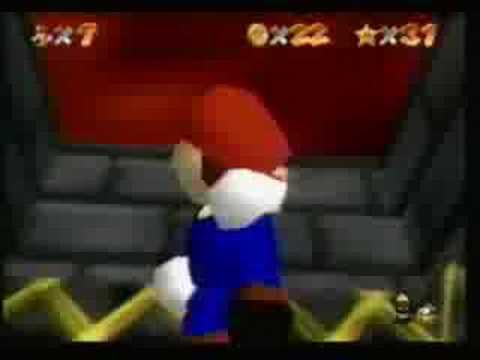
Super Mario 64
1996–1997
The game that showed the world what 3D could be. Super Mario 64 launched the Nintendo 64 by dropping Mario into an open, explorable castle, and its analog-stick control and swooping camera quietly wrote the rulebook every 3D platformer would follow.

Pilotwings 64
1996
The Nintendo 64's launch-day counterweight to Super Mario 64: a flight sim that asked you to slow down. Hang glider, rocket belt, gyrocopter — drift through rings, snap photographs of the scenery, stick the landing. For a lot of households it was the second cartridge in the drawer, and secretly the most peaceful thing in the house.

The Legend of Zelda: Ocarina of Time
1998–2001
The first three-dimensional Legend of Zelda launched the Nintendo 64 into mythic status. Shigeru Miyamoto's masterpiece introduced the Z-targeting lock-on system that became the industry standard for 3D action games, sold 7.6 million copies, and holds a Metacritic score of 99 — still the highest ever recorded.

Banjo-Kazooie
1998–2000
A bear with a bird living in his backpack collecting jiggies across Gruntilda's lair: the 3D collect-a-thon platformer perfected. Rare's masterpiece paired note-perfect googly-eyed humor with Grant Kirkhope's unforgettable score on the Nintendo 64.

GoldenEye 007
1997–2001
The Nintendo 64 first-person shooter that redefined console multiplayer: four players split-screen deathmatch, and an iron-clad house rule banning Oddjob because his short stature slipped under auto-aim. Rare's landmark game sold over 8 million copies and owned living rooms until Halo arrived.

Mario Kart 64
1996–2001
The first 3D Mario Kart brought four-player split-screen racing to the Nintendo 64, turning every sleepover and dorm room into a competitive battleground. Shells flew, friendships were tested, and players argued eternally about which character had a hidden advantage.

Star Fox 64
1997–1999
"Do a barrel roll!" Nintendo's on-rails space shooter gave the world Peppy's immortal advice, branching routes that made every run different, and the Rumble Pak — the accessory that made your controller shake with every explosion. Over 4 million copies later, it stands as one of 1997's biggest games.
N64 Rumble Pak
1997–2002
The plastic cartridge that made you feel explosions in your palms. Nintendo's rumble accessory turned a memory-card slot into a motor, powered by batteries, and changed what players expected from their hardware.

Pokémon Stadium
1999–2001
Your own Pokémon, in 3D, on the television. You slid your Game Boy cartridge into an adapter plugged into the N64 controller, and the team you had raised in Red, Blue or Yellow appeared on screen and fought while an announcer shouted about it. It reached North America in March 2000 and was the best-selling console game there that year.
Blowing Into Cartridges
1985–1999
The universal remedy for a glitching NES, SNES, or N64 game: pull the cartridge, blow hard across the contacts, and pray. It never actually worked—the real fix was just reseating the cart—but the ritual of blowing was so universal that every gamer swore by it, confirmation bias at its finest.

Blockbuster Video
1985–2010
The blue-and-yellow torn-ticket empire where Friday nights meant wandering the new-release wall, hoping the big movie wasn't rented out, and dreading the late fees. At its peak in 2004, Blockbuster dominated home entertainment with 9,094 stores worldwide—until Netflix and streaming dismantled the whole business model.