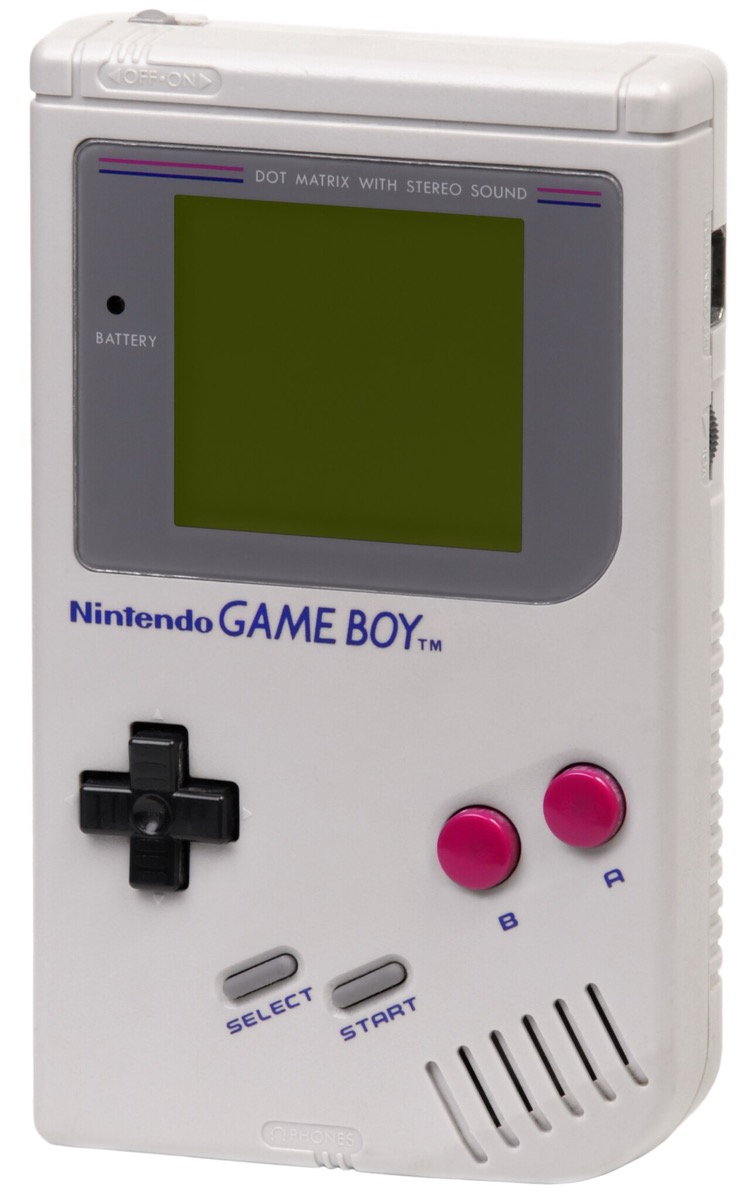
Ask what the Game Boy cost when it reached American stores in 1989 and you get two answers, four cents apart: $89.95 and $89.99. Wikipedia’s Game Boy article has both, one in the fact box at the side and the other in the text. Ars Technica’s history of the handheld has both as well, further down the same page.
Four cents is not much, but the two cannot both be the price reported when the Game Boy was unveiled. So we went looking for things printed at the time: reports from the trade show where Nintendo first showed the Game Boy in the United States, magazines from that summer, and the store catalogs and newspaper advertisements that followed.
The short version: $89.95. That is the price reported in June 1989 from the trade show where Nintendo unveiled the Game Boy, and the Los Angeles Times printed it again that November. Stores then set their own price. Sears had the Game Boy at $89.47 in its 1989 Christmas catalog, Kmart advertised it at $89.88 in June 1990, and JCPenney’s 1990 Christmas catalog had it at $89.99.
What sites say the Game Boy cost in 1989
Swipe the table sideways to see every column.
| Price given | Who gives it | What the page says |
|---|---|---|
| $89.99 and $89.95 | Wikipedia (the version of November 7, 2026, current when we read it) | The fact box lists $89.99. The text says the Game Boy "debuted in North America on July 31, 1989" at a retail price of $89.95. |
| $89.99 and $89.95 | Ars Technica (republished April 21, 2019; first published in April 2009) | "the Game Boy hit the US at $89.99", and later, "The Game Boy retailed for $89.95 at launch in the US." |
| $89.99 and $89.95 | Video Game Console Library (page updated September 15, 2026) | The summary panel has a launch price of "89.99 USD". The text has "The North American launch on July 31, 1989 at $89.95 USD". |
| $89.99 | Nintendo Life (July 30, 2009) | "hit the video game scene in North America in 1989 at a retail cost of $89.99" |
| $89.99 | The Christian Science Monitor (December 13, 2011) | "its cheap price ($89.99, compared to $189.95 for the Lynx)" |
| $89.99 | IGN (October 15, 2013) | "The original Game Boy, launched in 1989 for a mere $89.99" |
| $89.99 | ABC News, Good Morning America (April 21, 2014) | "Just $89.99" |
| $89.95 | TechRadar (April 21, 2014) | "it retailed for $89.95 at launch" |
| $89.95 | Polygon (April 19, 2019) | "a planned price of $89.95" |
| $89.95 | Pocket Tactics (July 30, 2026) | "Nintendo's original handheld launched for $89.95" |
| $90 | Mental Floss (August 7, 2025) | "For $90, consumers got the Game Boy, four AA batteries, and something Japanese consumers didn't get right away: Tetris." |
We read each of these pages on November 17, 2026. Three of them give both prices on the same page.
What was printed about the Game Boy’s price in 1989
Nintendo first showed the Game Boy in the United States at the Summer Consumer Electronics Show in Chicago, in June 1989. A month before, the games newsletter Computer Entertainer told its readers that the handheld was coming to the show and that “Suggested retail pricing of the GAME BOY and cartridges was not available at press time”.
A price was reported from the show. On June 6, 1989, the Los Angeles Times carried a Reuters report from Chicago:
“Competitor Nintendo of America Inc., a subsidiary of Nintendo Co. Ltd. of Japan, unveiled its new portable video system, Game Boy. Its lightweight device will feature monochrome graphics and sell for $89.95, with shipments set to begin in August.”
Two magazines that reported on the show printed the same figure. Atari Interface, a magazine for owners of Atari computers, wrote in its July issue that the Game Boy “will retail for $89.95 and be on sale August 1, 1989”. COMPUTE! had it in September: “Game Boy will retail for $89.95, which includes headphones, a Tetris game cartridge, and the Video Link accessory.”
In November, with the Game Boy in stores, the Times gave the price again. A story by Jube Shiver Jr. on November 20 compared Atari’s color handheld, the Lynx, with “Nintendo’s $89.95 paperback book-size Game Boy unit”. Four days later another Times story rounded it off: “Game Boy ($90)”. Rounding was common. ST-Log, another Atari magazine, wrote that October that the Game Boy “will retail for $90”.
The same November 20 story reported that Nintendo planned to ship about 1 million Game Boys to U.S. retailers, and it quoted Michael Goldstein, the chief financial officer of Toys “R” Us: “We could sell out the whole production”.
Not every 1989 figure agrees. The same issue of Atari Interface has a looser one in its news column: “the Nintendo is suggested at close to $80”. And Computer Entertainer’s June issue, the one with its report from the show, puts “(MSR $109.95)” after the Game Boy’s name and prices the first four games at $24.95 each, where the other reports said $19.95 or about $20. We found $109.95 nowhere else.
In the 1989 reports we were able to read, nobody printed $89.99. Polygon’s 2019 account of the American launch, which quotes Don Coyner, marketing manager at Nintendo of America at the time, speaks of “a planned price of $89.95”.
What Sears, Kmart and JCPenney charged for a Game Boy
A price reported from a trade show is not the price on a shelf tag. Stores set their own, and three of their printed pages show what they charged.
Swipe the table sideways to see every column.
| Store | Game Boy | Where it was printed |
|---|---|---|
| Sears | $89.47 | The 1989 Christmas catalog, the Wish Book |
| Kmart | $89.88 | An advertisement in The Sea Coast Echo of Bay St. Louis, Mississippi, June 10, 1990 |
| JCPenney | $89.99 | The 1990 Christmas catalog, page 450 |
We read all three as scans of the printed pages.
Sears introduced “the GameBoy”, spelled as one word, at “Now $89.47”. The listing says the Tetris game is included and that the four AA batteries are not. The same page has an AC adaptor and rechargeable battery pack at $29.77, a hard plastic carrying case at $9.97, and four games at $19.77 each: Super Mario Land, Alley Way, Baseball and Tennis.
Kmart’s advertisement calls $89.88 its “Everyday Low Price” and lists what was in the box: “Includes Tetris game pack, headphone, video link cable, batteries”.
JCPenney’s page has the Game Boy at $89.99, Super Mario Land at $19.99 and, lower down, the Atari Lynx at $169.99. Like Kmart’s advertisement, it says batteries come in the box; the Sears listing says they do not.
The cents belong to the stores. On the Sears page every price ends in 47, 77 or 97 cents. Kmart’s advertisement is full of prices ending in 88. On the JCPenney page every price ends in 99. So $89.99 is a real 1990 price for a Game Boy: it is what JCPenney’s catalog charged. It is not the figure reported from the Game Boy’s unveiling.
Where $89.99 and $89.95 come from on Wikipedia’s Game Boy page
Wikipedia keeps the earlier versions of its articles. We did not read all of the Game Boy article’s versions. We searched the history for the edits that produced today’s two figures, and read those.
- December 28, 2006. The oldest version we checked already had a price. Its opening said the Game Boy was “released in 1989 at $89.95”.
- September 7, 2015. An anonymous edit adds a launch price to the fact box: $89.95, citing the Ars Technica article in the table above at its 2009 address. Its note reads “Upgraded sidebar type, included launch price of Game Boy with source citation”.
- August 28, 2020. An edit changes the fact box to $89.99. Its note reads “See source.” The citation beside it is still the Ars Technica article, which today has both figures. Six minutes later the same editor adds a second citation, IGN’s 2013 article, with the note “IGN may be a more known (and maybe more reliable) source.” IGN’s article says $89.99.
- May 14, 2025. An edit noted “moved refs into body, add link” takes the IGN citation out of the fact box and puts it in the text, adding the words “at a retail price of” $89.99 to the sentence about the North American debut. The fact box keeps its $89.99, with no source.
- April 29, 2026. An edit changes the $89.99 in the text to $2.99.
- May 1, 2026. An edit noted “Fixed US retail price” changes $2.99 to $89.95. The citation beside it is still the IGN article, which says $89.99.
So the two figures on the page today got there by different routes. The fact box’s $89.99 goes back to the 2020 edits, which ended with IGN’s article cited for it, and the May 2025 edit left it without a source. The $89.95 in the text matches what was printed in 1989, but it arrived as the repair of a bad edit, and the article cited for it says $89.99. The history does not show where the $89.95 in that repair came from.
$89.95 in today’s money, and the Game Boy’s price after 1989
The Reuters report said shipments would begin in August. By the Bureau of Labor Statistics’ inflation calculator, $89.95 in August 1989 had the buying power of $243.65 in October 2026.
Later Nintendo prices that we can source end in 95 cents as well. In January 1992, UPI reported, the company cut the suggested retail price of the Game Boy to $79.95 and of the Super Nintendo to $179.95. Treat that report with some care. We could read it only through a tool that summarises pages, and we found no second report of the Game Boy cut. It also says both prices had been about $20 higher. That fits the Super Nintendo, which the Los Angeles Times had going from $200 to $180 that week, and it would put the Game Boy near $100. In 1996 Nintendo’s launch-day press release put the Nintendo 64 at $199.95; that price is in our comparison of the N64 with ModRetro’s M64.
Our own Game Boy entry gives $89.95.
Sources
- Gadgets, Gizmos, Gear Debut at Consumer Electronics Show (Reuters, June 6, 1989) · Los Angeles Times
- Hardly Playing Games (Jube Shiver Jr., November 20, 1989) · Los Angeles Times
- 1989 Sears Christmas Wish Book (the Game Boy is on the page facing page 408) · Sears, Roebuck and Co., via the Internet Archive
- 1990 JCPenney Christmas catalog (page 450) · J.C. Penney Company, via the Internet Archive
- The Sea Coast Echo, June 10, 1990 (Kmart advertisement) · The Sea Coast Echo, Bay St. Louis, Mississippi, via the Internet Archive
- COMPUTE!, September 1989: Small-Game Hunter Bags Two (Peter Scisco) · COMPUTE! Publications, via the Internet Archive
- Atari Interface Magazine, July 1989: Summer CES '89 · Atari Interface Magazine, via the Internet Archive
- Computer Entertainer, May 1989: Nintendo to Debut GAME BOY Portable Game System at Electronics Show · Computer Entertainer, via the Internet Archive
- Computer Entertainer, June 1989: New Hand-Held Game Systems Shown at CES by Nintendo and Atari (page 10) · Computer Entertainer, via the Internet Archive
- Nintendo cuts retail prices on video games (January 9, 1992) · UPI
Show all 34 sources Show the first 10 only
- Nintendo Lowers Price, Will Offer CD Device (Jonathan Weber, January 10, 1992) · Los Angeles Times
- CPI Inflation Calculator ($89.95 in August 1989, in October 2026 dollars) · U.S. Bureau of Labor Statistics
- Toy Scouting (David Larsen, November 24, 1989) · Los Angeles Times
- ST-Log, October 1989 (issue 36) · ST-Log, via the Internet Archive
- Computer Entertainer, September 1989 · Computer Entertainer, via the Internet Archive
- Nintendo 64 launch-day press release, September 29, 1996 (reprinted with Super Mario 64's ad blurbs) · Nintendo of America, via MobyGames
- Game Boy: the article as of November 7, 2026, the current version on November 17 · Wikipedia
- Game Boy: the version of December 28, 2006 · Wikipedia
- Game Boy: the edit of September 7, 2015 that added a launch price to the fact box · Wikipedia
- Game Boy: the edit of August 28, 2020 that changed the fact box from $89.95 to $89.99 · Wikipedia
- Game Boy: the edit of August 28, 2020, six minutes later, that added the IGN citation · Wikipedia
- Game Boy: the edit of May 14, 2025 that moved the IGN citation into the text and added $89.99 there · Wikipedia
- Game Boy: the edit of April 29, 2026 that changed $89.99 to $2.99 in the text · Wikipedia
- Game Boy: the edit of May 1, 2026 that changed $2.99 to $89.95 in the text · Wikipedia
- The Real Cost of Gaming: Inflation, Time, and Purchasing Power (Colin Moriarty, October 15, 2013) · IGN
- Happy 30th B-Day, Game Boy: Here are six reasons why you're #1 (April 21, 2019; first published April 20, 2009) · Ars Technica
- How Nintendo introduced the Game Boy, Tetris, and Pokémon to the West (April 19, 2019) · Polygon
- Game Boy Release Date, Models & History (updated September 15, 2026) · Video Game Console Library
- Game Boy 20th Anniversary Special (July 30, 2009) · Nintendo Life
- Hot toys through the ages: Nintendo Game Boy (1989) (December 13, 2011) · The Christian Science Monitor
- 25 Things We Forgot About Game Boy on Its 25th Anniversary (April 21, 2014) · ABC News, Good Morning America
- The Nintendo Game Boy turns 25 (April 21, 2014) · TechRadar
- I figured out how much each Nintendo handheld would cost if it launched today (July 30, 2026) · Pocket Tactics
- When Nintendo's Game Boy Helped Video Games Grow Up (August 7, 2025) · Mental Floss
In this article

Game Boy
1989–1998
The grey brick: four AA batteries, a pea-green screen you had to angle toward a lamp, and Tetris in the box. It was outgunned on paper by every colour handheld it faced, and it buried all of them. Nintendo kept the line it started alive until 2003.

Sears Wish Book
1933–2010s
It showed up in late summer, thick as a phone book, and you went straight to the toy pages with a pen: circle, initial, dog-ear, repeat, until the list for Santa was basically the whole section. The Sears Christmas catalog had been doing this to kids since 1933 — 90s kids caught the last years of the big one, right before it started to shrink.

Toys "R" Us
1957–2018
The cathedral of childhood shopping. Charles Lazarus's toy superstore — the backwards "R," aisle upon aisle of Christmas lists waiting to happen, and Geoffrey the Giraffe's unmissable jingle — defined how kids experienced wanting. Then a leveraged buyout, five billion in debt, and a 2018 collapse ended the era.

Nintendo 64
1996–2002
Nintendo's leap into three dimensions, the N64 brought 3D polygon gaming into living rooms with its quirky three-pronged controller and a cartridge library anchored by Super Mario 64 and The Legend of Zelda: Ocarina of Time. Its rumble pak added tactile feedback, while its four controller ports made it the console of couch multiplayer legends.