Wolfenstein 3D

May 1992: Apogee uploads id Software's free first episode to the bulletin boards and the PC learns to run and gun in first person. Escape Castle Wolfenstein as B.J. Blazkowicz, shoot everything in a uniform, find the hidden Pac-Man level, order the rest by mail. The "grandfather of 3D shooters" and the game that proved shareware was a business.
After Commander Keen, John Carmack spent 1991 chasing a fast 3D engine by cheating: walls on a flat grid, a single plane, and ray casting that drew only what the player could see. In November 1991, with Tom Hall pushing for a third Keen trilogy and Adrian Carmack sick of drawing cute, John Romero proposed a 3D remake of Muse Software's 1981 Castle Wolfenstein. The pitch was "loud" and "cool" and fast. Id later tracked the lapsed trademark to someone in Michigan and bought it for $5,000 in April 1992.
Work began December 15, 1991. Carmack wrote the engine core in a month, Romero cut anything that slowed the pace, including the original idea of looting bodies, and Adrian Carmack drew the sprites at eight angles in Deluxe Paint II. Bobby Prince recorded the gun sounds at a shooting range, the developers and Apogee's Scott Miller voiced the guards, and the grid-based maps paid homage to Pac-Man with a hidden level. The team left out references to Nazi atrocities to avoid controversy; the Nazis themselves were the point, with Hitler as a boss.
Apogee uploaded the free first episode on May 5, 1992 and sold the rest of the trilogy by mail, with a second trilogy, The Nocturnal Missions, soon after and a retail episode, Spear of Destiny, through FormGen that September. Id had hoped for $60,000 in the first month; the first royalty check was $100,000. Wolfenstein averaged $200,000 a month for a year and a half, and id estimated a million shareware copies in circulation worldwide by mid-1994. Sierra's Ken Williams offered $2.5 million for the company; Romero asked for $100,000 of it in cash up front, Williams refused, and id stayed independent.
Germany banned the game in 1994 over its Nazi symbols, and a 1998 Frankfurt court ruling on Wolfenstein kept such imagery out of German-rated games until 2018. Everywhere else it was the "grandfather of 3D shooters," the first shareware title to win a Codie award, and the game Computer Gaming World said "almost single-handedly" proved shareware could be a business. Id released the source code in 1995 and never made another Wolfenstein itself; by then Doom had already made it look quaint.
Similar items
Doom
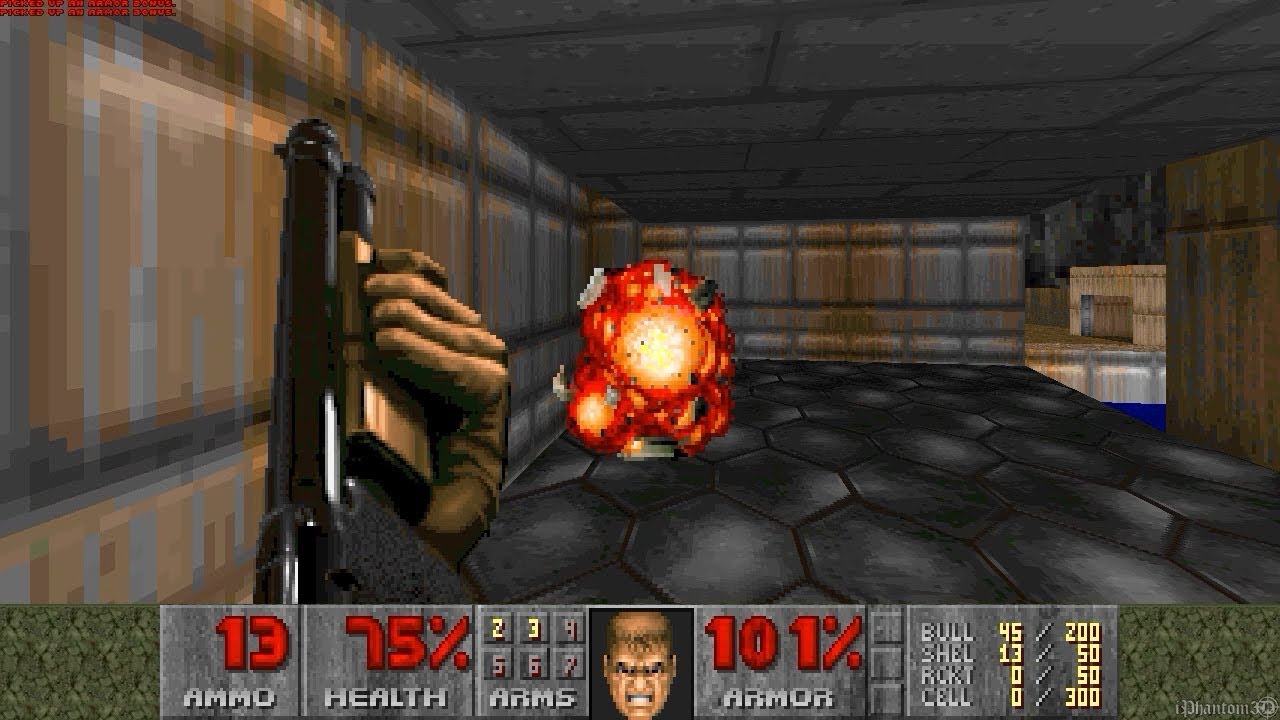
The shooter that defined the genre, released by id Software as shareware in 1993 and instantly crashing the network when thousands tried to download it at once. Fast, brutal, moddable to the extreme, and the game that turned "fragging" into a verb — by late 1995 it was estimated to be on more computers than Windows 95.

Quake
id Software followed Doom by throwing out the second dimension entirely: Quake was true real-time 3D, drenched in a Nine Inch Nails soundscape, and built to be torn apart by its players — who invented rocket jumps and whole art forms inside it, and turned internet deathmatch into a culture.

Commander Keen
Billy Blaze, age eight, in a football helmet and red sneakers, pogo-sticking across Mars in the 1990 shareware platformer that gave the PC the smooth, console-style scrolling it had never managed. The team that made it at night on borrowed Softdisk computers used the royalty checks to found id Software.

Duke Nukem
"Hail to the king, baby." PC gaming's most gleefully crude action hero started as a 1991 shareware platformer and exploded with 1996's Duke Nukem 3D — 3.5 million copies of one-liners, aliens, strippers, and moral panic. Then came Duke Nukem Forever, the most legendary vaporware in gaming history.