Wayside School

Louis Sachar's school that was supposed to be one story with 30 classrooms but got built 30 stories tall with one classroom per floor, and no 19th story. The first book is from 1978; the sequels followed in 1989 and 1995.
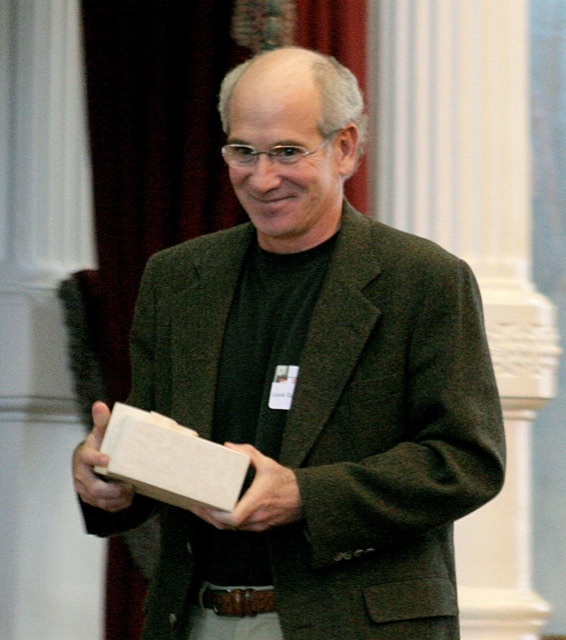
Louis Sachar found Wayside School on a playground. As a student at UC Berkeley in the 1970s he signed up to help in a second- and third-grade class at Hillside Elementary for college credit, and he also became the noontime supervisor, known to the kids as "Louis the Yard Teacher." "It became my favorite college class, and a life changing experience," he said. He wrote Sideways Stories from Wayside School at night over nine months while working days in a Connecticut sweater warehouse, named the students after the Hillside kids, and put himself in as Louis. The warehouse fired him, he started law school, and the book came out in 1978. It wasn't widely distributed and didn't sell well, but it slowly built a following among young readers.
The premise is the first joke. The school was supposed to be one story with 30 classrooms in a row, but the builder put it up 30 stories tall with one classroom on each floor, and there is no 19th story. Each chapter covers one person in Mrs. Jewls' class on the 30th floor. The first is about the class's previous teacher, Mrs. Gorf, who turns misbehaving students into apples until Jenny holds up a mirror and Mrs. Gorf turns herself into one. Louis the yard teacher, not knowing, polishes the apple on his shirt and eats it. When Mrs. Jewls arrives she thinks the children are monkeys, because she's never seen kids so cute. Joe can't count but always gets the right answer anyway, and once he learns he counts the hairs on his head: 55,006. Todd keeps getting sent home early on the kindergarten bus.
Most of the series came later. Wayside School Is Falling Down and Sideways Arithmetic from Wayside School both came out in 1989, the year Sachar's books began selling well enough for him to write full-time. More Sideways Arithmetic followed in 1994 and Wayside School Gets a Little Stranger in 1995. His novel Holes arrived in 1998. The books were adapted as an animated movie in 2005 and a Nickelodeon series from 2007 to 2008, and Sachar went back to the 30th floor one more time with Wayside School Beneath the Cloud of Doom in 2020.
Similar items
Holes
A puzzle-box novel that shouldn't have worked, a film adaptation that shouldn't have worked, and somehow both did. Louis Sachar's Holes won the 1998 National Book Award and the 1999 Newbery Medal — then became an honest-to-god good movie.

Scholastic Book Fairs
The ritual: your school gym transforms overnight into a pop-up bookstore of rolling display cases, and you wander the aisles with a wish list and a budget. Scholastic Book Fairs dominated the 90s market, though what kids actually bought — glittery gel pens, novelty pencils, poster books — often had nothing to do with the Goosebumps stacks they wandered past.

Goosebumps
R.L. Stine's mass-produced horror series for kids, where every book's drippy cover could stop your heart in the school library. Goosebumps sold roughly 4 million copies a month at its mid-90s peak and by 1996 accounted for nearly 15% of Scholastic's entire revenue.

The Baby-Sitters Club
The Baby-Sitters Club was the series you grabbed by the stack at the book fair — one wasn't enough, you needed the whole shelf about Kristy and Mary Anne and Claudia running a babysitting business out of a Connecticut suburb. More than 190 million copies sold. That's not an exaggeration; that's a cultural fact.