Virtua Tennis
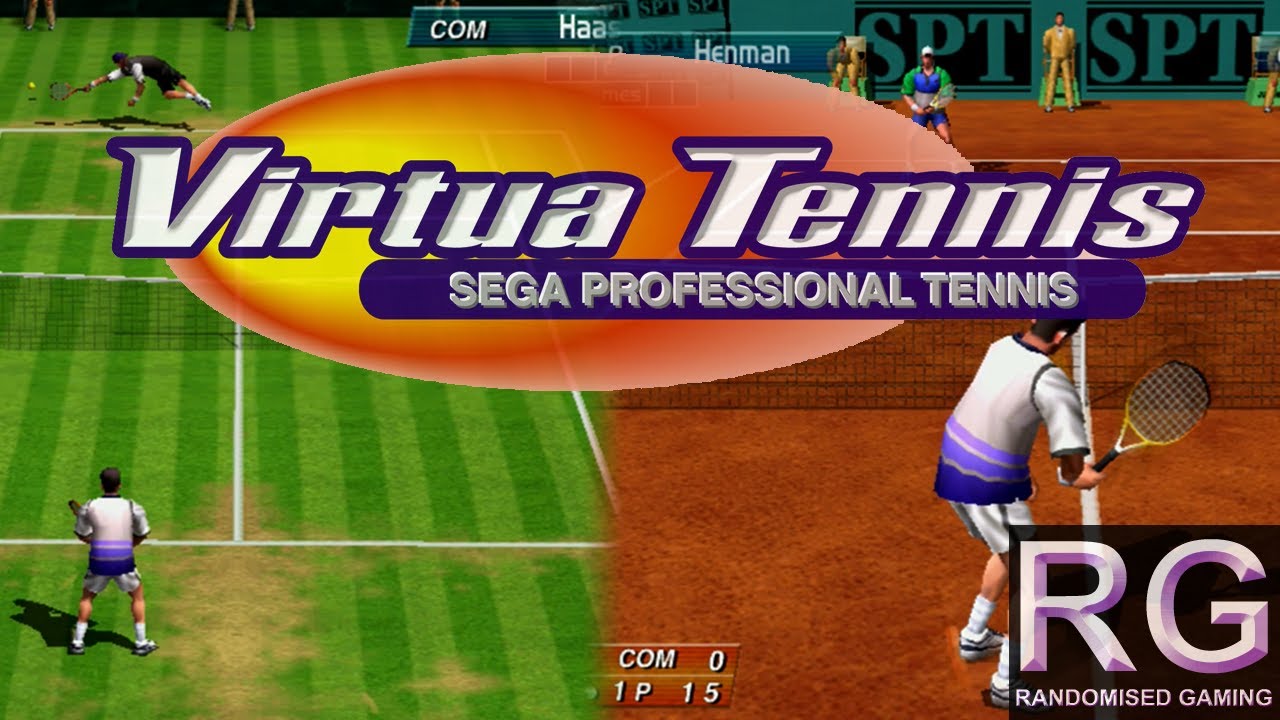
Two buttons: one to hit, one to lob. Sega's tennis game asked almost nothing of you and gave back the best rallies on the console — an arcade cabinet's worth of instant playability on a Dreamcast disc. It remains one of the machine's most fondly remembered games a quarter-century later.
Virtua Tennis came out of Sega's AM3 division — formally Sega Software R&D Department 3 — with Mie Kumagai producing under AM3 head Hisao Oguchi. Kumagai's brief was to make something with broader appeal than the one-on-one fighting games clogging Japanese arcades at the time, and tennis was an unglamorous, inspired answer. An early prototype tried a twisting paddle controller to switch between forehand and backhand; it was scrapped as impractical, and the game reverted to a joystick and buttons. It reached arcades on Sega's NAOMI hardware in December 1999 with eight real male pros on the roster — among them Tim Henman, Yevgeny Kafelnikov, Carlos Moyá and Mark Philippoussis — and was a hit in Japanese arcades immediately.
The control scheme is the whole design. A hits the ball and the game works out which stroke you meant; B lobs. You aim with the d-pad while the swing is happening, pushing up or down for topspin or backspin, and you serve by tapping A to start a meter and A again to hit. That is it. The trade-off was real and reviewers said so at the time — hand the stroke selection to the computer and it will occasionally give you a volley when you wanted a backhand — but the exchange bought something rarer: anyone could pick up the pad and have a decent rally inside ten seconds.
The Dreamcast port is the version people actually remember, and it is emphatically a 2000 artifact. It reached the US on 11 July 2000 and Europe that September; Japan got it last, on 23 November 2000, under the title Power Smash. It settled at a Metacritic score of 92 from twenty-three critics. It was a runner-up in GameSpot's 2000 awards for best multiplayer and best traditional sports game rather than a winner, but the long verdict has been kinder than the trophies: it has turned up on best-of-Dreamcast lists continuously from 2006 to the present day.
There is a small piece of corporate history fossilized in the game's own credits. Sega broke its arcade studios into semi-autonomous companies in 2000, and AM3 was spun off as Hitmaker that spring — after the arcade game had already shipped, and before the console port did. So the 1999 arcade cabinet credits no studio at all, just "Presented By: Sega." The Dreamcast version, finished on the other side of the reorganisation, reads "© Sega/Hitmaker, 2000." By the sequel, Hitmaker had the credit to itself.
That sequel — Virtua Tennis 2, sold as Tennis 2K2 in the States and Power Smash 2 in Japan — hit arcades in 2001 and the Dreamcast later that year, and it is the one that added women to the roster: Monica Seles, Lindsay Davenport, and Venus and Serena Williams. The original had none, a gap a 2000 reviewer complained about at the time. The first game itself got a thinner second life in 2002, ported to PC and the Game Boy Advance, and the series carried on for another decade across other consoles — but the two Dreamcast discs are the ones that get remembered, and the first one is why.
Similar items

Sega Dreamcast
Sega's last console, a gorgeous white system with a built-in modem that promised arcade quality straight to living rooms. It shipped with one of the most inventive libraries in gaming: Sonic Adventure, Crazy Taxi, Jet Set Radio, and the impossibly niche masterpiece that is Shenmue. The Dreamcast launched with mythical marketing (9/9/99) and died a hero when the PlayStation 2 juggernaut made the economics of console competition impossible.

NBA Jam
"BOOMSHAKALAKA!" Midway's two-on-two arcade basketball threw out the rulebook — players leapt three times their own height, shoved each other to the floor, and burst into flames after three straight buckets. It was loud, ridiculous, and impossible to walk past without feeding it a quarter.
![Video thumbnail — [Nintendo 64] NFL Blitz TV Commercial](https://i.ytimg.com/vi/KwSb_-1bsFo/hqdefault.jpg)
NFL Blitz
The arcade football game that threw the rulebook in the trash: seven-on-seven, 30 yards for a first down, no penalties, and late hits actively encouraged — you could body-slam a guy well after the whistle. From the NBA Jam bloodline, with the same announcer energy: "DA BOMB!"
NFL Street
Seven-on-seven football with no penalties, no injuries, and no uniforms — just NFL players in street clothes talking trash on a concrete lot. Taunt the defense while you run and you fill the Gamebreaker meter. EA Sports BIG's 2004 answer to the question of what football looks like with all the rules taken out.