Scrye Magazine
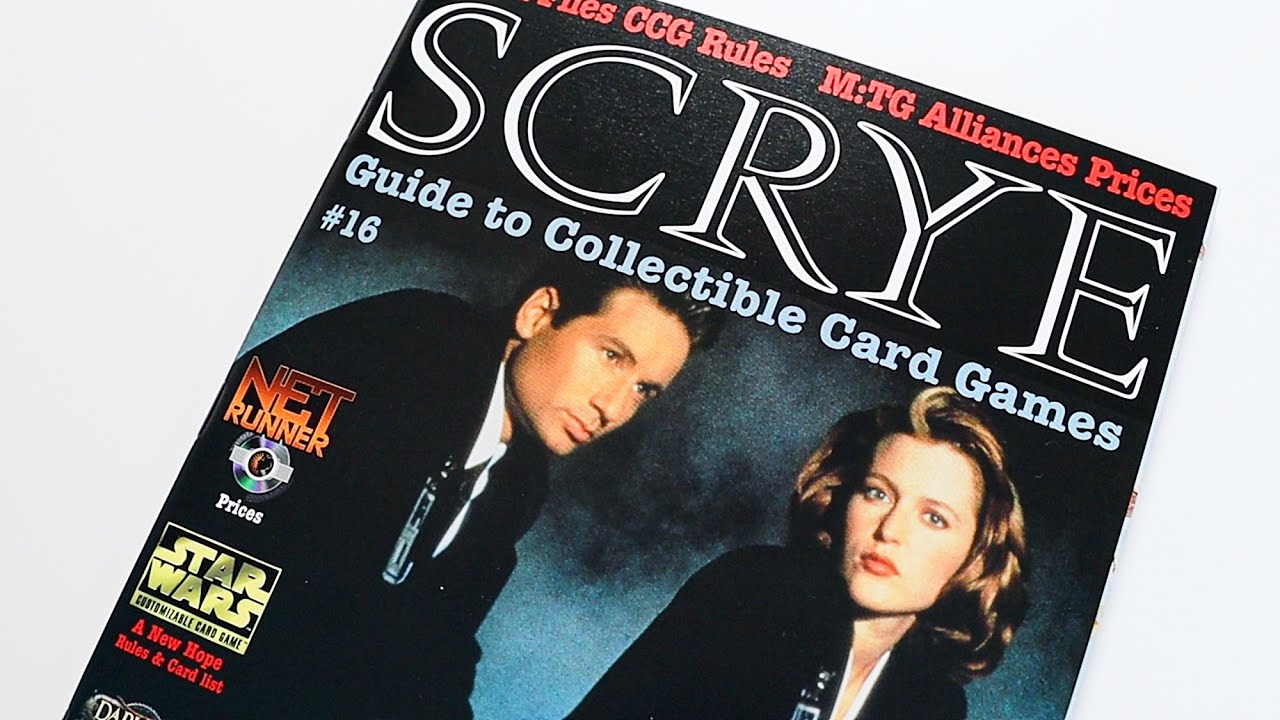
The magazine that told you what your Magic cards were actually worth. Scrye was the price-guide bible of the trading-card-game boom — the fold-out list of secondary-market values you scoured to see if your rare was your ticket to riches.
Scrye was founded in 1994 by Joanne White and quickly became the leading print price guide for the Magic: The Gathering secondary market — the authority collectors and players trusted to know what a card was really worth. Its heart was the pull-out price list, a dense grid of card values that turned every shoebox of commons and rares into a spreadsheet of hope.
As the collectible-card-game craze exploded, Scrye expanded well beyond Magic, covering other CCGs, collectible miniatures games like Mage Knight, and adding Japanese Pokémon card translations when that phenomenon hit in 1999. It also tracked the flood of licensed games — the X-Files Collectible Card Game, its cards carrying the actors' likenesses, is likely the source of many readers' memories of Mulder and Scully in its pages.
White sold the magazine to Krause Publications in 1999, and it continued until its final issue, number 131, in April 2009, a casualty of the collapse of print hobby publishing after the 2008 downturn. In its prime, though, Scrye was how you settled the schoolyard argument over exactly how much that holographic rare was worth.
Similar items

Yu-Gi-Oh! Cards
Konami's trading card game swept US schoolyards in the early 2000s, rivaling Pokémon for card-game dominance. Players dueled with powerful monsters — Blue-Eyes White Dragon, Dark Magician, and the feared five-piece Exodia combo — and the phrase "It's time to duel!" echoed through lunch periods. Teachers confiscated decks, and schools debated bans.

Pokémon Trading Card Game
Trading cards that turned every backpack into a vault and every playground into a market. Pokémon cards hit US schools in 1999 and became instant contraband — the holographic Charizard was the mythical grail, and somehow every kid in your class claimed to have a mint copy.

Magic: The Gathering — Ice Age
The frostbitten 1995 Magic: The Gathering expansion — snow-covered lands, the punishing "cumulative upkeep" mechanic, and 383 cards of an ice-locked world. It was the first Magic expansion you could play with no other product, and it launched the game's first named block.

Magic: The Gathering — Revised Edition
The third Magic core set — the white-bordered 1994 reprint, famous for its washed-out, pale printing. With around 500 million cards produced, Revised was the set that finally put Magic on shelves everywhere, and the one most early players actually opened.