Scorched Earth
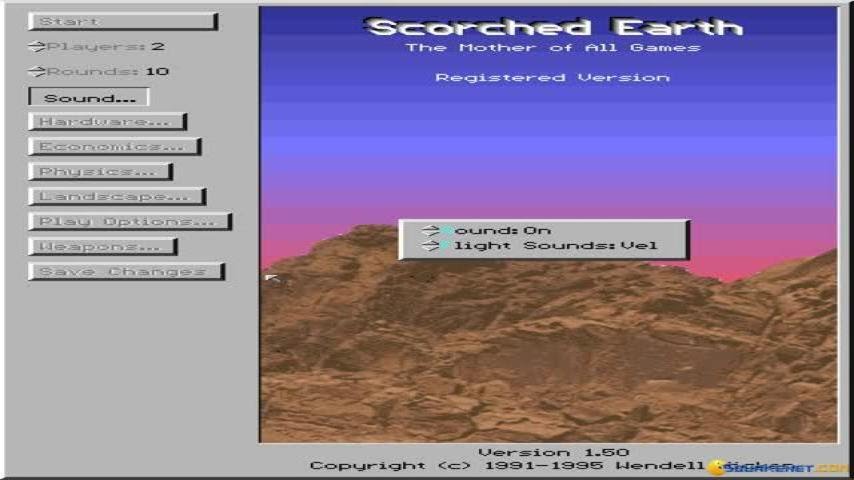
"The Mother of All Games"—a turn-based artillery tank battler where physics, wind, and an absurd weapon shop turned a single shared keyboard into hours of hot-seat chaos and sudden laughter.
Scorched Earth arrived on MS-DOS in 1991, written by Wendell Hicken. It was subtitled "The Mother of All Games," a claim that felt true to anyone who played it. The core mechanic was simple: up to 10 players (human or AI) took turns, each adjusting a tank's angle and power to lob projectiles across a destructible 2D mountainous landscape, accounting for wind and gravity. Between rounds, you spent your earnings in a shop stocked with ordinary weapons (Baby Missile, Napalm) and gloriously absurd ones (MIRV, Death's Head, Funky Bomb, Tracer Rounds), plus defenses like shields and parachutes.
The game distributed via shareware—BBSes, floppy disks, and eventually the early internet. No installation, minimal system requirements, and infinite replayability made it a cultural touchstone for PC gaming in the early 1990s. The destruction model was revolutionary for its era: terrain deformed permanently, turning the map into a scarred battlefield as the game went on.
Scorched Earth is the spiritual ancestor of Worms and the direct heir to earlier artillery games like Tank Wars, and a contemporary of QBasic's Gorillas. But it was the weapon shop and the sheer comedic payload variety that made it legendary. A single match could run for hours with eight players bickering over angles and wind, firing off a Napalm strike into someone's tank, and erupting into arguments about whose turn it really was.
The game's legacy in multiplayer PC gaming is immense: it proved that a simple mechanic, executed with polish and humor, could create something endlessly replayable. Decades later, people still fire up Scorched Earth emulated copies for a single nostalgic night of hot-seat chaos.
Similar items

Age of Empires II
Age of Empires II was the medieval real-time strategy game that defined the genre for a generation. Released in 1999, it put 13 civilizations at your command across historical campaigns spanning Joan of Arc to Genghis Khan. The Conquerors expansion (2000) became the definitive version, adding five new civilizations and cementing the game's legacy. Nearly three decades later, HD remasters and competitive esports tournaments prove this masterpiece never went out of style.

Asheron's Call
The cult favorite of the first big three MMORPGs — never EverQuest's equal in numbers, but beloved for what it dared. Asheron's Call ran through Microsoft's gaming service, its classless characters and famous monthly story updates drip-feeding new life into one seamless world that stayed open for over seventeen years.

Counter-Strike
The free Half-Life mod that conquered every LAN party and cybercafé of the 2000s. Terrorists versus counter-terrorists, five on five, one life per round, buy your weapons and don't miss — for a whole generation, Counter-Strike means version 1.6.

Dark Age of Camelot
A fantasy MMORPG that replaced chaotic open-world ganking with Realm vs. Realm warfare—three mythologically themed nations (Albion, Midgard, Hibernia) fighting over contested keeps and relics in structured, large-scale PvP.