Salad Fingers

A thin green man with lettuce for fingers who loves the feel of rusty spoons, speaks in a whisper, and lives alone in a dead, bleached world. David Firth posted the first Salad Fingers episode to Newgrounds in July 2004, and a generation of kids who watched it in a computer lab has never quite recovered.
Salad Fingers started as an inside joke. David Firth was playing guitar one day when his friend and collaborator Christian Webb remarked that he had "salad fingers," meaning the way he fretted a C chord. Firth and Webb built a series around the phrase: a gaunt green figure with leaf-like hands, a soft, cracked voice and a fixation on rusty spoons, wandering an empty landscape. The first episode, "Spoons," went up on Newgrounds on July 1, 2004, and was ignored until the site featured it on its front page; from there it spread the way Flash cartoons spread then, by link. Firth has said the first episode took him "one day and one night." Later ones took six months to a year.
Firth voices the character himself. He has said the voice was inspired by his grandmother's and by Michael Jackson's speaking voice, and that it came out so soft because he did not want to wake his parents while recording. The influences he names are David Lynch, Tim Burton, Chris Morris, The League of Gentlemen and South Park, and the episodes borrow music credited to Sigur Rós, Aphex Twin and Boards of Canada. Fans have spent two decades building theories about a nuclear fallout, hidden anagrams in character names and an overarching plot; Firth says none of it was ever mapped out and that he never intended an underlying meaning.
The San Francisco Chronicle put it on a top-ten list of pop-culture phenomena in 2005. When the series moved from Newgrounds to YouTube it reached an audience Flash never could: by 2020 the episodes had been viewed 110 million times there, 36 million of them for "Spoons" alone, and The Guardian has called it one of the first animations to go "fully viral."
It never ended. Episodes kept arriving at Firth's own pace, "Shore Leave" in 2006, "Cupboard" in 2007, "Letter" in 2011, on to a fourteenth, "Crows," in September 2025, with Firth crowdfunding the work once YouTube's content rules made the videos hard to monetize. In 2019 a Canadian high-school teacher was suspended after showing students a batch of videos they called "weird, creepy and inappropriate," Salad Fingers among them. Firth's response, on Twitter, was that viewings should be "mandatory" for children.
Similar items

Newgrounds
The birthplace of internet culture's raw, unfiltered edge — where amateurs published bold Flash creations with no gatekeeper between them and millions of eyes. A tank logo, the dreaded "blam" vote, and the night-before anxiety: did your submission survive judgment?

The End of the World (End of Ze World)
"H'okay, so here's the Earth." Jason Windsor's crude Flash cartoon walks through which country nukes which, in funny accents, until the whole planet is gone. It hit Albino Blacksheep in 2003, and "fire ze missiles" and "I am le tired" followed a generation of kids through middle school.
Homestar Runner
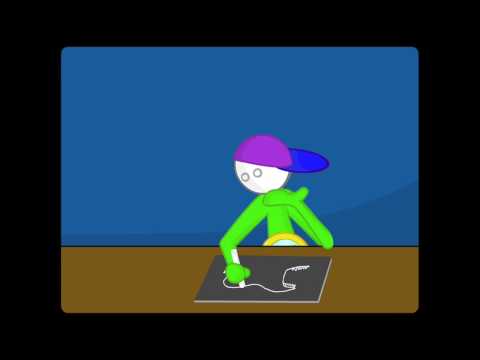
The Flash cartoon empire that ran on merch and goodwill — no ads, ever. The Chapman brothers' site built its voice through Strong Bad's absurd email replies, one of which spawned Trogdor the Burninator, a scribbled one-armed dragon that became internet legend.

eBaum's World
The early-2000s comedy and media dump every kid browsed instead of doing homework. Flash cartoons, prank-call soundboards, funny clips, and simple games — all stamped with the site's inescapable watermark, which became the running joke and the scandal at once.