Prodigy (online service)

The online service with an ad on nearly every screen: news, weather, Zagat, shopping and message boards in chunky vector graphics, for a flat $9.95 a month, from IBM and Sears. It was the biggest service in America in 1993 and lost to AOL anyway.
Prodigy was founded on February 13, 1984, as Trintex, a joint venture of CBS, IBM and Sears. CBS left in 1986, and the service launched under the Prodigy name in Atlanta, Hartford and San Francisco in 1988, then nationally on September 6, 1990. Its pitch was a flat $9.95 a month for unlimited use, at a time when CompuServe still ran on a command line, and the plan was to make the real money from advertising and shopping: a graphical service, drawn in NAPLPS vector art over 1,200 bit/s modems, with ads on its screens and a 24-hour newsroom of editors, writers and artists building news, weather, sports, syndicated columnists, Zagat surveys, Consumer Reports, games, airline reservations and grocery ordering.
Bundled with IBM's PS/1 and PS/2 and with Hayes modems, it passed a million subscribers, was the second-largest service in 1990 with 465,000 against CompuServe's 600,000, and the largest by 1993; The New York Times called it family-oriented and one of the Big Three. Its problem was that people liked the wrong parts. Email and the message boards, built mostly to support shopping, became the most popular features, and members stayed connected far longer than the business model assumed. In January 1991 Prodigy limited free email to 30 messages a month and charged 25 cents for extras; in the summer of 1993 it put hourly charges on the boards, and tens of thousands of members quit. It was slow to add the anonymous handles and real-time chat that made AOL feel alive.
In 1994 it became the first of the old dial-up services to offer full access to the World Wide Web, but its own browser compared poorly. IBM and Sears, having put more than a billion dollars into it, sold in 1996 for $200 million to a group that turned the company into an ordinary internet provider called Prodigy Internet. The original service, renamed Prodigy Classic, was shut down on October 1, 1999, because the aging software could not be made Y2K-compliant; 209,000 members were still on it. SBC bought the company outright in November 2001 and folded it into SBC Yahoo!.
Similar items

AOL
The dial-up gateway that wired up America. AOL's "You've Got Mail" voice, aggressive free-trial CD carpet-bombing, and shift to unlimited $19.95/month pricing triggered the legendary busy-signal crisis — millions of Americans' first taste of the internet.

CompuServe
The online service before AOL was AOL. CompuServe numbered its users with octal digits, ran tight moderated forums instead of chaotic chat rooms, and invented the GIF. By 1995 it claimed 3 million subscribers — then AOL's cheap flat-rate marketing machine ran it over.
Dial-Up Internet
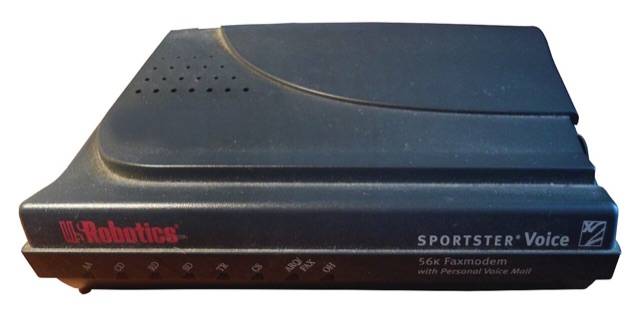
That modem squeal. The frozen phone line. "Get off the internet, I need to make a call." Dial-up was the sound and the ritual of getting online for a generation of American homes — peaking in the dot-com years, overtaken by broadband around 2004, and lingering until AOL finally hung up in 2025.

AltaVista
The search engine everyone used before Google — fast, powerful, and the first with a full-text, boolean-searchable index of the web. It also gave the world Babel Fish, the free page-translator named after the fish from The Hitchhiker's Guide to the Galaxy.