Dial-Up Internet

That modem squeal. The frozen phone line. "Get off the internet, I need to make a call." Dial-up was the sound and the ritual of getting online for a generation of American homes — peaking in the dot-com years, overtaken by broadband around 2004, and lingering until AOL finally hung up in 2025.
Commercial dial-up internet arrived in 1989, when Software Tool & Die launched The World in the US — the first public internet service reachable through the ordinary phone line in your home. But that phone line came with a constraint: while the modem was connected, nobody in the house could make or receive a call, and picking up an extension could knock the connection offline. That trade-off — the whole household surrendering its telephone for the duration — became the ritual's defining tension. The modem announced itself with a sound everyone from the era can still hum: the squeal-and-static of the handshake as it negotiated with the ISP's line. Busy signals at peak hours were part of the texture too — sometimes the connection itself had to wait in line.
Through the 1990s, modem speeds climbed the ladder: 14.4k, then 28.8k and 33.6k, then the race to 56k. With each step the connection got faster, but downloads still unfolded at a pace you could measure in dinner-lengths. By the height of the dot-com bubble, dial-up was how America got online — in the early 2000s about 40% of Americans used it. For millions of households it arrived in the form of an AOL disc, and the two became nearly synonymous.
The road to 56k had its own drama. In 1997, major modem makers split into rival camps marketing two incompatible 56k technologies, dividing the market for almost a year. The ITU's V.90 standard resolved the standoff — the technical spec was agreed in February 1998 and formally approved that September — and any 56k modem could finally talk to any provider.
Broadband had been gaining ground through the early 2000s, and the crossover came in 2004: by that October, Nielsen/NetRatings measured broadband at 53% of American home web users — the always-on connection had overtaken the dial-up ritual for good. The fade was long. By 2008 only about 10% of US adults still used dial-up; by 2013, 3%. AOL only shut down its dial-up service on September 30, 2025, after thirty-four years — the last hang-up on a technology that froze the family phone, screeched its way online, and wired a generation into the internet one negotiated connection at a time.
Similar items

AOL
The dial-up gateway that wired up America. AOL's "You've Got Mail" voice, aggressive free-trial CD carpet-bombing, and shift to unlimited $19.95/month pricing triggered the legendary busy-signal crisis — millions of Americans' first taste of the internet.
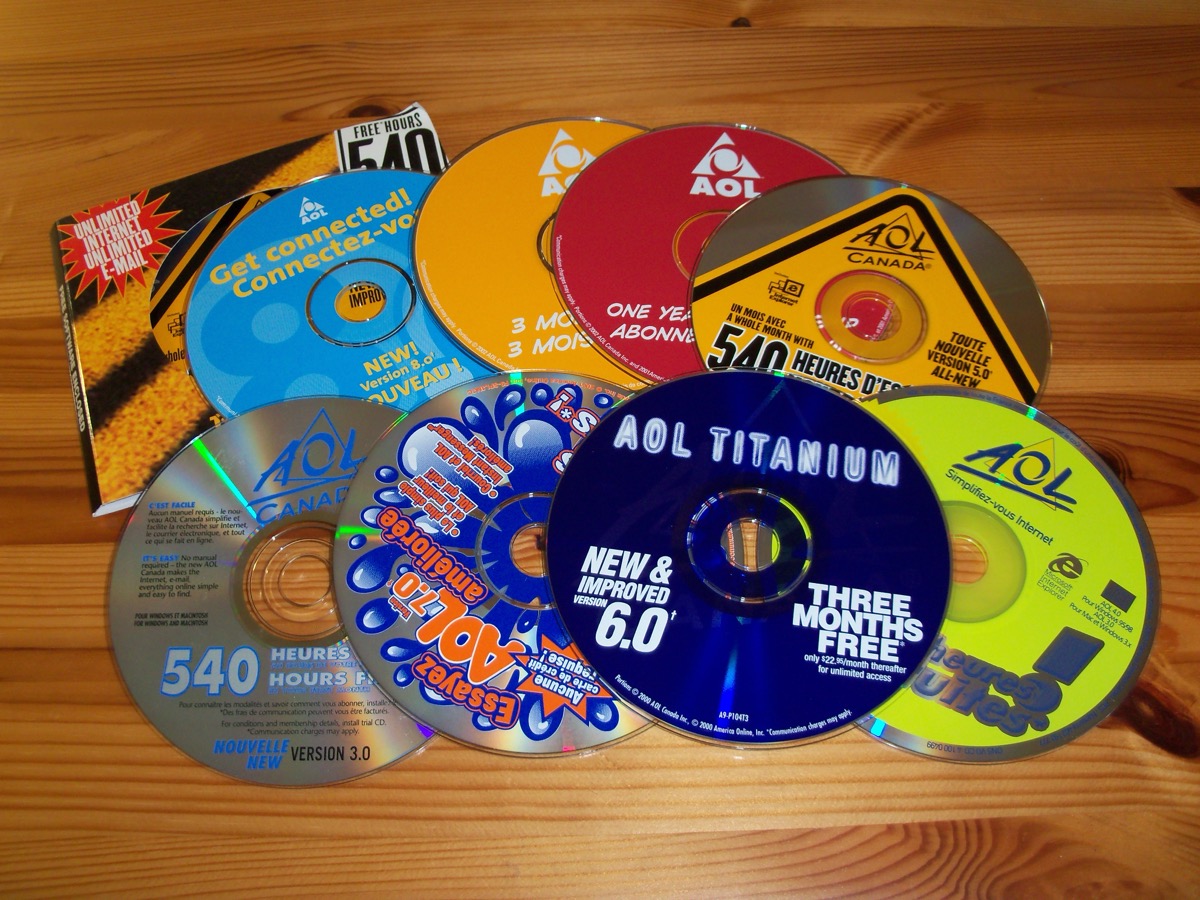
AOL Free-Trial CDs
AOL's marketing chief Jan Brandt carpet-bombed America with free-trial discs—in magazines, mailboxes, at Blockbuster and Best Buy, even in Omaha Steaks shipments. At peak saturation — by Brandt's own estimate — roughly half of all CDs manufactured worldwide bore the AOL logo, a $300 million marketing gambit that made the "You've Got Mail" sound the most iconic audio cue of the 1990s.

CompuServe
The online service before AOL was AOL. CompuServe numbered its users with octal digits, ran tight moderated forums instead of chaotic chat rooms, and invented the GIF. By 1995 it claimed 3 million subscribers — then AOL's cheap flat-rate marketing machine ran it over.

AIM & MSN Messenger
The after-school ritual: logging on to a dial-up modem, scanning your buddy list, typing AIM away messages packed with song lyrics and veiled drama, and knowing your 12-year-old screen name would haunt you forever. AIM and MSN Messenger were the social nervous system of the '90s and 2000s — instant, informal, and utterly addictive.