Payless ShoeSource

The yellow-sign discount shoe chain where you found your own size on the self-service racks. By the late '90s it was in all 50 states, with thousands of stores, and it lasted long enough to prank influencers with a fake luxury boutique.
Payless was self-service from the start. Cousins Louis and Shaol Pozez opened the first Pay-Less stores in Topeka, Kansas, in 1956, selling budget shoes in former supermarkets on plain, unpainted wooden shelves, many of them built by the store managers. A store needed only a manager and one or two clerks, and at the first stores a pair of shoes averaged under $3. Women's and children's shoes made up most of the business. The company went public in the early 1960s, and by 1975, now called Volume Shoe, it was the largest chain of family shoe stores in the U.S. The May Department Stores Company bought it in 1979, when it had 739 stores. By then 40 percent of them were in malls, and the bold yellow logo was becoming familiar.
In the late '80s and early '90s the chain opened about 200 stores a year. It had 1,662 stores in 1985 and 3,295 by 1991, when the corporate name changed from Volume Shoe to Payless ShoeSource. It added Payless Kids stores next door to regular locations, and in the '80s it was known for Pro Wings sneakers, which often had Velcro straps instead of laces. Since the 1960s Payless had its shoes made to its own specifications, and by the early '80s it relied more and more on Asian factories. May spun Payless off as an independent company in 1996. That year it opened its first stores in Alaska, which put Payless in all 50 states, and in 1997 it opened its first stores in Canada. The chain peaked at about 5,100 stores. By the 2000s it was advertising "BOGO" sales: buy one pair and get a second of equal or lesser value for half price.
In 2018 Payless pulled a stunt. It set up a pop-up store in Santa Monica, stocked it with its own $20-to-$40 shoes under the fake luxury name "Palessi," invited influencers, and watched them pay hundreds of dollars a pair, markups of up to 1,800 percent. They got their money back and kept the shoes. The chain was already struggling. It filed for bankruptcy in 2017 and closed 673 stores, then filed again in February 2019 and closed all of its roughly 2,100 U.S. stores by that May. Its Latin American stores stayed open, and the brand came back online in 2020 as simply Payless.
Similar items

KB Toys
The cramped, stacked-to-the-ceiling toy store tucked into every American mall — smaller and more chaotic than Toys "R" Us, with clearance bins spilling into the aisles. It was the impulse-buy toy stop on any mall trip, right up until it liquidated for good in 2009.

L.A. Gear Light-Up Sneakers
Red lights flashing in your heels with every step — L.A. Gear's light-up sneakers were playground royalty in the '90s. Parents couldn't resist the pitch, and kids couldn't stop stomping.
Kmart Blue Light Special
"Attention, Kmart shoppers." A rotating blue police light on a pole, a voice on the PA, and a stampede toward whatever aisle it was parked in. It ran from 1965 until 1991, so early-90s kids caught the tail end, and then Kmart spent the next two decades trying to bring it back.
Jelly Shoes
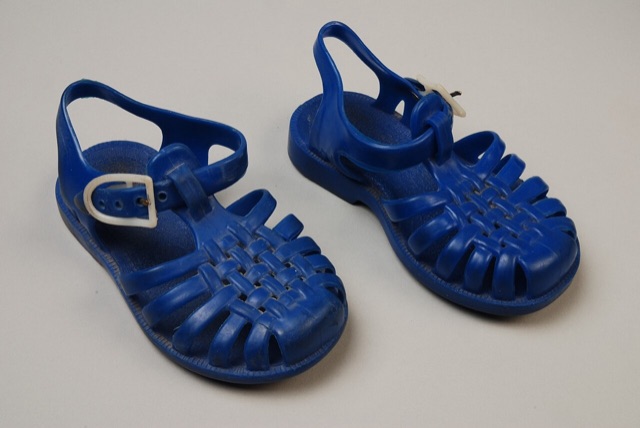
Translucent plastic sandals in candy colors, often with glitter suspended inside like a treat you could wear. Jellies squeaked, pinched, and blistered every summer foot in America — and everybody just kept wearing them, because they were cheap and they sparkled.