PaRappa the Rapper

A paper-thin dog raps his way through karate class, a driving test and a bathroom line to win over a flower-like girl named Sunny Funny — "Kick! Punch! It's all in the mind!" Sony's U.S. arm had a rule against 2D games and released it anyway, and it set the template for a whole genre.
PaRappa the Rapper was designed by Masaya Matsuura, a musician in the Japanese band PSY.S who hated appearing in music videos and had turned to interactive software instead. Development began in 1994, before the PlayStation was even out, inside a Sony Computer Entertainment Japan group that the game's artist, Rodney Greenblat, described as the division that "just did whatever." Matsuura was fascinated by sampling and especially by sampled voices, so he built the game around rap. Greenblat, an artist already popular in Japan for his CD-ROM Dazzeloids, drew the characters; making them flat was Matsuura's idea, and the name plays on a Japanese word for paper-thin. PaRappa was first designed as a shrimp, and when Greenblat drew the karate teacher as an onion, the character became Chop Chop Master Onion.
The game is six songs. PaRappa, trying to win the heart of a flower-like girl named Sunny Funny away from the rich show-off Joe Chin, learns karate, takes a driving test, works a flea market after crashing his father's car, bakes a cake off a TV cooking show, raps his way to the front of a bathroom line, and finally takes the stage at Club Fun. Each teacher raps a line and the player answers with button presses on the beat, graded by a "U Rappin'" meter from Awful to Cool. It came out in Japan on December 6, 1996, sold 761,621 copies there in 1997, and passed a million in Japan by May 1998.
Sony's American division had a strict policy against 2D games, and many at Sony doubted PaRappa counted as a game at all, but it released the title in North America on November 17, 1997, marketing it mostly to kids — who, Greenblat noted, would struggle to finish it. Critics loved it anyway. Electronic Gaming Monthly named it the most original game of 1997, gave it best music, and made PaRappa its best mascot over Lara Croft and Crash Bandicoot, and it won the design and sound awards at the first Interactive Achievement Awards in 1998. It sold 1.47 million copies in Japan and about 214,000 in the U.S. by 2003, but it set the basic template for the rhythm games that followed, from Konami's Beatmania and Dance Dance Revolution to Harmonix's Guitar Hero and Rock Band. A guitar spin-off, Um Jammer Lammy, came in 1999, PaRappa the Rapper 2 in 2001, a PSP version for its tenth anniversary, and a PS4 remaster in 2017.
Similar items
PlayStation
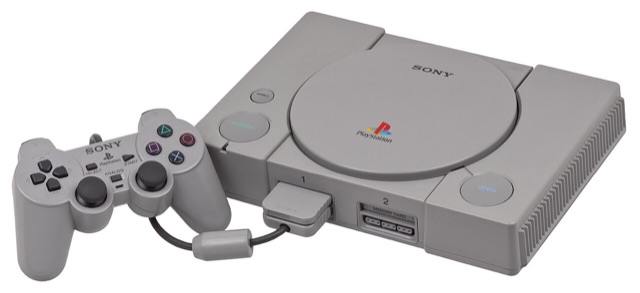
The grey box that took gaming off the cartridge and onto the CD — and took it away from Nintendo and Sega while it was at it. Sony's first console arrived in Japan at the end of 1994 and in America the following September, and it made a generation fluent in memory cards, load screens, and demo discs. It started as a Nintendo project that Nintendo walked away from.

Crash Bandicoot
The spinning, crate-smashing marsupial who became the PlayStation's unofficial mascot and Mario's cheeky rival. Naughty Dog's 1996 platformer sent Crash bouncing through jungle levels and dodging boulders — and defined a generation's PS1 afternoons.

Dance Dance Revolution
Konami's iconic rhythm game where players step on a four-arrow dance pad in time with on-screen cues and music. Debuting in Japanese arcades in 1998, DDR became a global phenomenon—from arcade halls to living rooms—defining an entire genre of music-timing games.
Guitar Hero
The plastic guitar controller that turned living rooms into rock venues and made you feel like you could shred—Guitar Hero arrived in November 2005 with just five fret buttons and a strum bar, playing note-scrolling highways to licensed rock songs. It became a living-room phenomenon. Guitar Hero III (2007) and its brutal finale 'Through the Fire and Flames' defined the genre's peak before the plastic-instrument bubble burst from over-saturation around 2010.