Oddworld: Abe's Oddysee

Abe, a stitch-mouthed floor waxer at the RuptureFarms meat plant, overhears that his people are the next product and runs, chanting, possessing guards and leading 99 fellow Mudokons to safety. The PlayStation puzzle-platformer of 1997 that let you talk to the level, and killed you constantly.
Oddworld: Abe's Oddysee began in January 1995 at Oddworld Inhabitants, the studio Lorne Lanning and Sherry McKenna founded, under the working title Soul Storm. Its hero is Abe, a meek Mudokon floor waxer at RuptureFarms, a meat-processing plant on a world where his species is the slave labor and his mouth is sewn shut. When he learns that he and his fellow Mudokons are to be slaughtered for a new product, he escapes and tries to free as many of them as he can, 99 in all, with a secret ending in the original PlayStation release for anyone who saved every one.
What made it odd was GameSpeak. Holding a button, Abe could talk to the Mudokons around him, telling them to follow, stay put or work a switch, and by chanting he could possess the Slig guards and turn their guns on each other. Lanning has said the mechanic was partly inspired by the audio puzzles of Loom, and McKenna, whose background was in communications and psychology, pushed for it on the principle that "the cure to everything is communication"; the game rewarded peaceful play as much as destruction. It was a cinematic platformer, screen by screen, with checkpoints instead of saves and a difficulty that reviewers argued about. Lanning later said he gave Abe infinite lives "because I wanted you to never give up."
GT Interactive picked up publishing in September 1996 and put a $10 million marketing campaign behind it, after an executive who wanted the project killed showed footage to his boss and the boss loved it. It reached stores on September 18, 1997, for PlayStation and PC, with more than 500,000 units in the first shipment; it passed a million by January 1998, with Europe outselling the United States, and reached 3.5 million by 2012. In Japan the Mudokons were redrawn with three fingers after a group objected that four-fingered meat-packers echoed an old slur against the burakumin caste, and the change became canon. Abe's Exoddus followed in 1998, and a remake, New 'n' Tasty!, in 2014.
Similar items
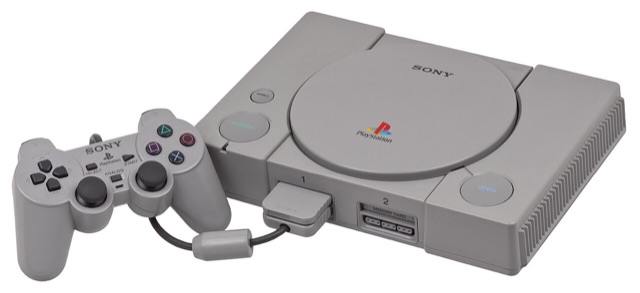
PlayStation
The grey box that took gaming off the cartridge and onto the CD — and took it away from Nintendo and Sega while it was at it. Sony's first console arrived in Japan at the end of 1994 and in America the following September, and it made a generation fluent in memory cards, load screens, and demo discs. It started as a Nintendo project that Nintendo walked away from.

Crash Bandicoot
The spinning, crate-smashing marsupial who became the PlayStation's unofficial mascot and Mario's cheeky rival. Naughty Dog's 1996 platformer sent Crash bouncing through jungle levels and dodging boulders — and defined a generation's PS1 afternoons.

Tomb Raider
The 3D adventure that sent archaeologist Lara Croft leaping across ancient ruins, solving puzzles and blasting wildlife. It made Lara one of gaming's first true icons.
Gex
The wisecracking, TV-obsessed gecko who cracked one-liners while wall-crawling through the 'Media Dimension.' In the era of mascot wars — Mario, Sonic, Crash — Gex was the snarky one, voiced by an actual stand-up comedian. It's tail time.