MediEvil

Sir Daniel Fortesque, a one-eyed, jawless skeleton hailed as the Hero of Gallowmere after dying to the first arrow of the battle, gets a second chance when the sorcerer he supposedly killed returns a hundred years later. Sony's 1998 PlayStation hack-and-slash looked like a Tim Burton Halloween special and let Dan rip off his own arm to club things with.
The legend says that in 1286 Sir Daniel Fortesque led the King of Gallowmere's army against the sorcerer Zarok and his undead horde and killed him before dying of his wounds. In truth Dan was struck down by the first arrow fired, and the king covered it up. A century later Zarok returns, plunges the kingdom into eternal night, steals the souls of the living and raises the dead, and in doing so accidentally revives Dan, now missing his jaw and left eye, who was never admitted to the Hall of Heroes. The player fights through Gallowmere collecting a Chalice of Souls in each level, which earns Dan an audience with the real heroes. With no weapon in hand, Dan tears off his arm and swings it. It ends with Zarok turning himself into a dragon-like monster, his lair collapsing on him, and Dan, if every chalice was collected, at last allowed into the Hall.
Development began in late 1995 at Millennium Interactive in Cambridge under the working title Dead Man Dan, pitched by James Pond creator Chris Sorrell as Capcom's Ghosts 'n Goblins crossed with the look of The Nightmare Before Christmas. Lead artist Jason Wilson pushed it toward a Zelda-style adventure, script doctor Martin Pond supplied the idea that Dan had been a pompous failure in life whose resurrection was his one shot at redemption, and Wilson later recalled that female players found the skeleton endearing and that he was "considered a sex symbol in France." Millennium, short of money, was building it for Windows and the Saturn as well until a demo persuaded Sony to sign it as a PlayStation exclusive; in 1997 Sony bought the team outright and it became SCE Cambridge. The team had never made a 3D game, so they studied beta builds of Super Mario 64 and Crash Bandicoot, and Sony's request for analogue-stick support turned out to be, in Sorrell's words, "particularly fortuitous." Composers Paul Arnold and Andrew Barnabas were told to write a Danny Elfman-style score and faked an orchestra and organ on synthesizers.
It shipped in Europe on October 9, 1998, and in North America on October 21, to mostly warm reviews: an 80 percent GameRankings average, praise for the Halloween atmosphere and humor, and complaints about the camera and controls, with Game Revolution calling it "one of the cleverest platform games ever made." It was a finalist for console game of the year at the second Interactive Achievement Awards and went Platinum in Europe in 1999, meaning at least 400,000 copies. MediEvil 2 followed in 2000, a PSP reimagining called Resurrection in 2005, and a full PlayStation 4 remake by Other Ocean in 2019 that unlocks the original 1998 game if you finish its side objectives.
Similar items
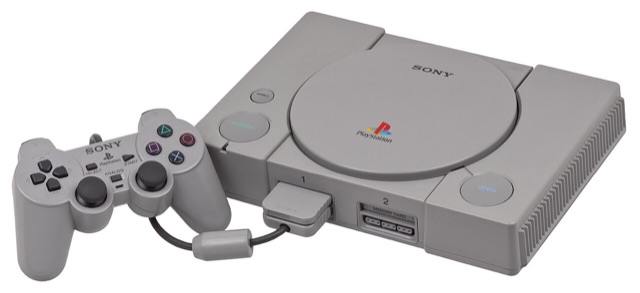
PlayStation
The grey box that took gaming off the cartridge and onto the CD — and took it away from Nintendo and Sega while it was at it. Sony's first console arrived in Japan at the end of 1994 and in America the following September, and it made a generation fluent in memory cards, load screens, and demo discs. It started as a Nintendo project that Nintendo walked away from.

Crash Bandicoot
The spinning, crate-smashing marsupial who became the PlayStation's unofficial mascot and Mario's cheeky rival. Naughty Dog's 1996 platformer sent Crash bouncing through jungle levels and dodging boulders — and defined a generation's PS1 afternoons.

Spyro the Dragon
A cocky little purple dragon gliding and flame-breathing through bright pastel worlds with his dragonfly sidekick Sparx. Spyro was the PlayStation's other mascot platformer alongside Crash — collect gems, free trapped dragons, charge headfirst into everything.

Oddworld: Abe's Oddysee
Abe, a stitch-mouthed floor waxer at the RuptureFarms meat plant, overhears that his people are the next product and runs, chanting, possessing guards and leading 99 fellow Mudokons to safety. The PlayStation puzzle-platformer of 1997 that let you talk to the level, and killed you constantly.