Cassette Adapter

A fake cassette with a cord hanging out of it: push it into the car's tape deck, plug the other end into your Discman, and the CD played through the speakers until the next pothole made it skip. The cassette adapter bridged the CD era and the tape-deck car for two decades.
The cassette adapter exists because portable CD players arrived years before cars had anywhere to plug them in. Larry Schotz, an American electrical engineer, filed a patent for a "cassette adapter for playback device, such as a compact disk player" on July 25, 1986, and it was granted on March 29, 1988. Recoton, the company that held the patent, brought it to market. The trick was simple: instead of tape, the shell held a small recording head that pressed against the deck's playback head, so whatever came down the headphone cord was turned into a magnetic signal the car stereo read as if it were a tape. A set of gears inside spun a wheel to fake tape movement, so decks with auto-reverse would not keep flipping sides looking for the end.
The competition was the FM transmitter, and a 1986 Popular Mechanics review that tested a Recoton prototype against one found the sound from the two about the same. The adapter won on convenience: nothing to install, no hunting for an empty frequency. Through the 90s it was the standard road-trip rig, a Discman wedged into the cupholder or balanced on a lap, the CD binder open on the passenger seat, the cord snaking into the dash. Sony, Panasonic, Maxell and Belkin all made one. Every driver knew the two failure modes: the deck ejecting the adapter with a clunk, and the faint whir of the gears under the quiet parts of a song.
The adapter outlived the Discman by carrying iPods into old cars through the 2000s, while FM transmitters took over in cars that had CD decks but no tape slot. The end came from the other direction. The 2010 Lexus SC 430 was the last new car sold in the United States with a factory tape deck, and the fleet-only Ford Crown Victoria kept one through 2011. ION Audio put a Bluetooth receiver inside a cassette shell in 2014, a gadget for the last tape-deck holdouts and the exact shape of a 90s memory.
Similar items
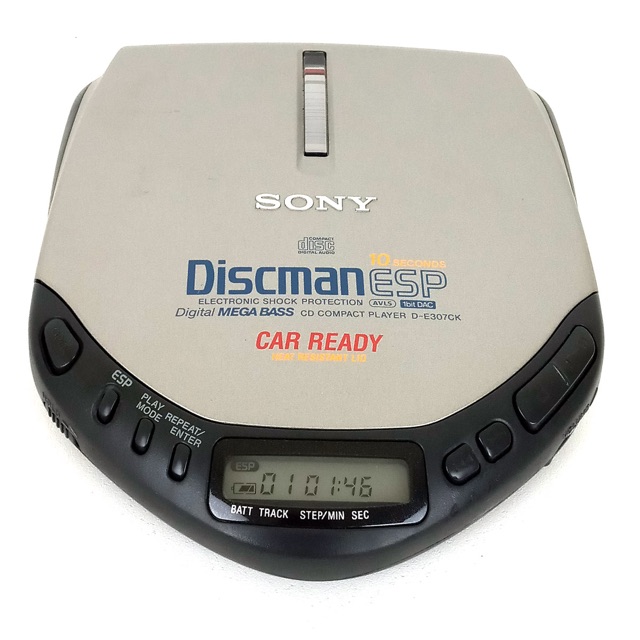
Discman & CD Binders
The ritual of portable CD life: a Sony Discman clipped to your waist or backpack, Electronic Skip Protection bragged on the box, and a zip-up CD binder holding exactly 24 discs — the ones that defined you. CD binders like Case Logic wallets replaced jewel cases, turning your music taste into curated, tangible proof of personality.

Walkman
Sony's cassette player made music something you carried: foam-pad headphones, a belt clip, and a pocketful of AA batteries it drained by the week. Born in 1979, it was such a default fact of 90s life that 'Walkman' had long since stopped meaning Sony and started meaning the whole idea.
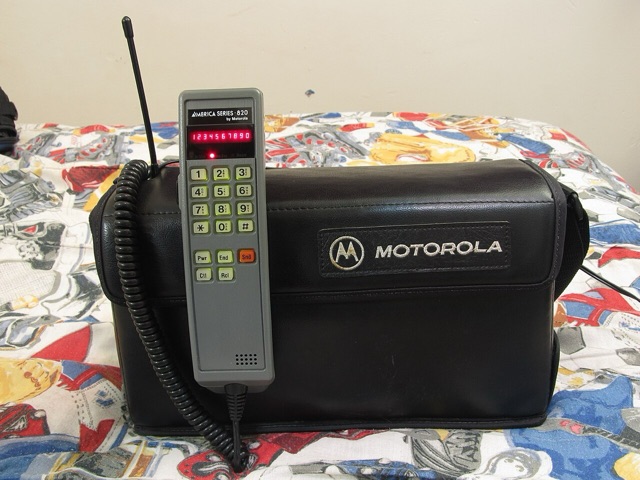
Bag Phones and Car Phones
Before the family had a cell phone, the family car had one: a curly-cord handset in the console, or a three-watt Motorola in a leather bag that lived in the trunk and plugged into the cigarette lighter. You called from it only in emergencies, because every minute cost real money and Dad said so.

MapQuest
Before your phone knew where you were, you printed directions from MapQuest and prayed you didn't miss step 14. The pre-GPS road-trip ritual, in a stack of warm printer paper.