Battleship
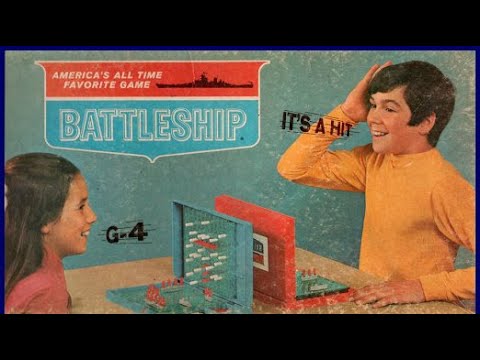
B-4. Miss. E-7... hit. The two-player naval standoff of gray plastic ships, red and white pegs, and the flip-up case that hid your fleet from your opponent — capped, if you were lucky, by getting to crow the line from the commercials: "You sank my battleship!"
Long before the plastic pegs, Battleship was a pencil-and-paper game: players around the World War I era were already sketching hidden fleets on gridded paper and calling out coordinates, and the first commercial version, Salvo, was published in the United States in 1931. The game everyone actually remembers arrived in 1967, when Milton Bradley turned the old paper duel into a molded-plastic battle station — two hinged cases, miniature gray ships pegged into 10×10 grids, red pegs for hits and white for misses.
The genius was the format. Each player's flip-up lid doubled as a radar screen for tracking shots, so the game folded secrecy, bookkeeping, and drama into one satisfying object. The fleet was standardized — carrier, battleship, cruiser, submarine, destroyer, from five holes long down to two — and the ritual never changed: call a coordinate, wait a beat, learn your fate. Milton Bradley's commercials drilled the game's catchphrase into the culture; "You sank my battleship!" became shorthand for defeat far beyond the toy aisle. The franchise kept upgrading with the times, adding Electronic Battleship with sound effects in 1977 — a pioneering microprocessor-based toy — and Electronic Talking Battleship in 1989.
By the 90s, Battleship was a fixture of the family game shelf, the rainy-day standby you played across the kitchen table or head-to-head on long car rides, half strategy and half pure poker face. It has never gone away since: the brand was big enough to get a Hollywood alien-invasion movie loosely based on it in 2012, and in 2025 the game was inducted into the National Toy Hall of Fame — permanent recognition for the little gray fleet that taught generations of kids grid coordinates, probability, and the sting of hearing that last peg go in.
Similar items

Connect Four
The upright blue grid, the clack of checkers dropping down the slots, and the gasp when someone spots a diagonal you didn't. Connect Four was the fastest fight you could pick at a kitchen table — and losing meant watching your opponent yank the release bar and rain your defeat onto the floor.

Guess Who?
Two players staring across identical boards of cartoon faces, taking turns asking yes-or-no questions and flipping down the eliminated suspects. Deduction distilled to its purest form: the click-clack of a plastic tile, the rush of a question that erases half the board, the smug certainty of "I know who it is." A 90s rainy-recess and family-game-night ritual.

Operation
Tweezers, a naked patient named Cavity Sam, and the angry red-nose BUZZ that made the whole table jump. Steady hands won you $1,000 for the Bread Basket; shaky ones built a generation's first real relationship with performance anxiety.

Mouse Trap
Nobody ever played Mouse Trap by the actual rules. You built the glorious crank-gear-boot-bucket contraption, dropped the cage on somebody's mouse, and called it a night — exactly as every 90s kid intended. A Rube Goldberg machine in a box, on toy shelves since 1963.