Connect Four

The upright blue grid, the clack of checkers dropping down the slots, and the gasp when someone spots a diagonal you didn't. Connect Four was the fastest fight you could pick at a kitchen table — and losing meant watching your opponent yank the release bar and rain your defeat onto the floor.
Milton Bradley first sold Connect Four in February 1974. Toy inventor Howard Wexler created the game — with Ned Strongin also credited on the design — around one brilliant change to the old four-in-a-row idea: turning the board vertical. Gravity became a rule. Checkers drop to the lowest open slot in each of the seven columns, so every move is constrained, visible, and satisfyingly loud, and a finished game ends with the best reset mechanism in board-game history — slide the bar, and the whole battle crashes out the bottom.
Milton Bradley's TV commercials planted the phrase that still follows the game around: a little brother groaning 'Pretty sneaky, sis' at a win he never saw coming. The game sold on being simple enough for a five-year-old and mean enough for anyone — a round takes two minutes, rematches are compulsive, and by the 90s the yellow-and-red checkers were rattling around toy closets, classrooms, and pizza-parlor game shelves everywhere.
The deepest twist came from computer science. In October 1988, researcher James Dow Allen solved Connect Four completely — and just two weeks later Victor Allis solved it independently — proving that the first player can always force a win by starting in the center column, while opening anywhere else lets a perfect opponent escape or win. Almost nobody at the kitchen table knew that, which is exactly why the game survives: against actual humans, Connect Four is still decided by who's paying attention. Hasbro, which absorbed Milton Bradley, keeps it in print to this day, essentially unchanged.
Similar items

Operation
Tweezers, a naked patient named Cavity Sam, and the angry red-nose BUZZ that made the whole table jump. Steady hands won you $1,000 for the Bread Basket; shaky ones built a generation's first real relationship with performance anxiety.

Mouse Trap
Nobody ever played Mouse Trap by the actual rules. You built the glorious crank-gear-boot-bucket contraption, dropped the cage on somebody's mouse, and called it a night — exactly as every 90s kid intended. A Rube Goldberg machine in a box, on toy shelves since 1963.
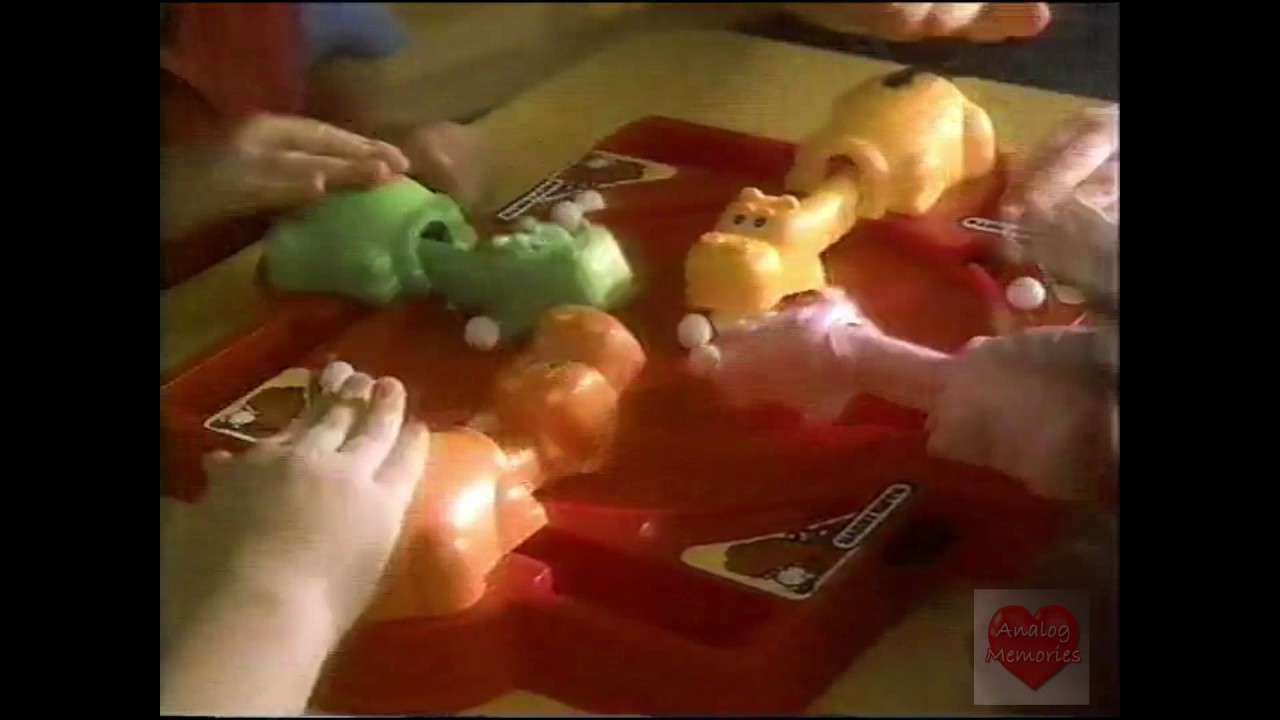
Hungry Hungry Hippos
Four plastic hippos, a pile of marbles, zero strategy — just lever-slamming chaos and the loudest thirty seconds in the toy closet. Milton Bradley's 1978 classic was every 90s kid's first taste of pure competitive frenzy.

Guess Who?
Two players staring across identical boards of cartoon faces, taking turns asking yes-or-no questions and flipping down the eliminated suspects. Deduction distilled to its purest form: the click-clack of a plastic tile, the rush of a question that erases half the board, the smug certainty of "I know who it is." A 90s rainy-recess and family-game-night ritual.