Mouse Trap

Nobody ever played Mouse Trap by the actual rules. You built the glorious crank-gear-boot-bucket contraption, dropped the cage on somebody's mouse, and called it a night — exactly as every 90s kid intended. A Rube Goldberg machine in a box, on toy shelves since 1963.
Mouse Trap was published by the Ideal Toy Company in 1963 and stands as one of the first mass-produced three-dimensional board games. The concept came from Marvin Glass and Gordon Barlow of the famed toy-design studio Marvin Glass and Associates, who received a patent for it in 1967, with Ideal's Hank Kramer filling in the details of the published version. Glass freely admitted the game was greatly influenced by Rube Goldberg's cartoon contraptions — though he refused to pay Goldberg a licensing fee for the resemblance.
The trap itself is the whole show. Turn the crank and two gears push a lever, which swings a shoe into a bucket, sending a ball bouncing down a rickety staircase and through a gutter, setting off a chain of increasingly ridiculous events until — if the plastic gods are willing — a cage wobbles down its pole and drops over an opponent's mouse. On paper, players race their mice around the board and build the trap piece by piece as they go. In practice, generations of kids skipped the board entirely: the building was the game, the trap ran once or twice, a piece went missing, and the box went back in the closet until the urge struck again.
Milton Bradley — and eventually Hasbro — took over publishing and has kept Mouse Trap in production for six decades, with TV commercials hammering its ramshackle chain reaction into the brains of every 80s and 90s kid. It remains the purest example of a game where spectacle beat strategy, and no one ever complained.
Similar items
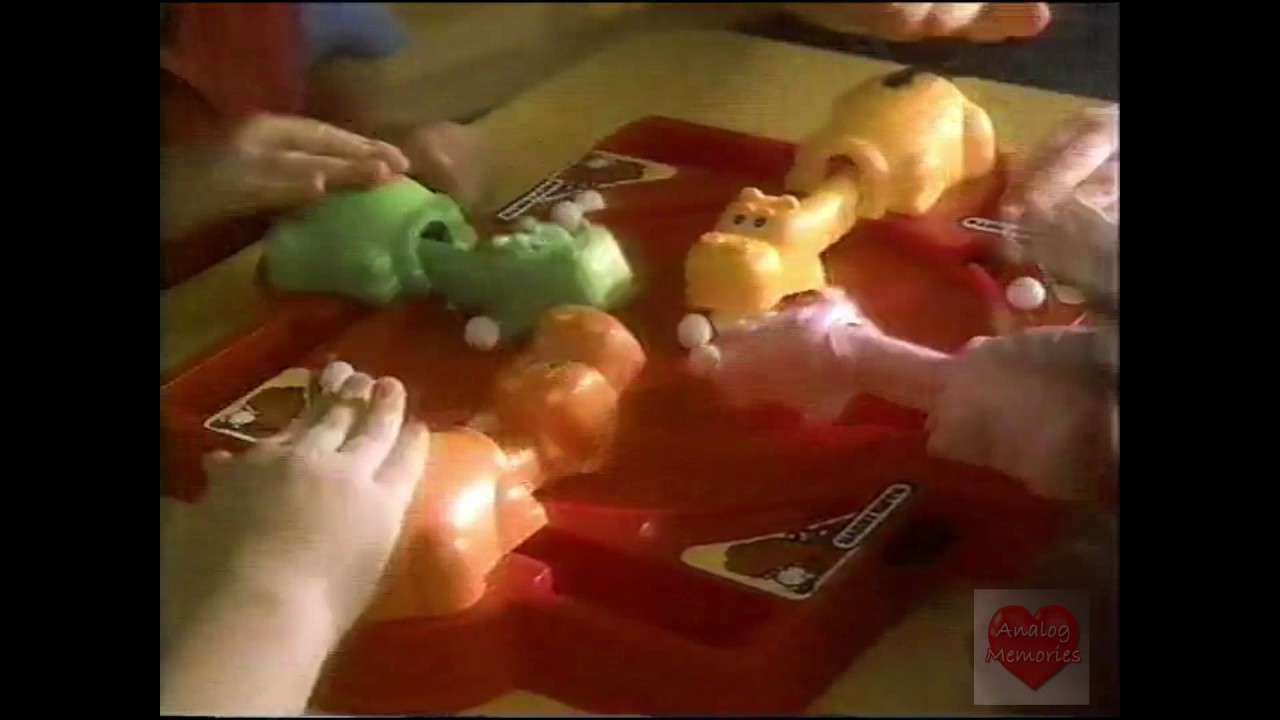
Hungry Hungry Hippos
Four plastic hippos, a pile of marbles, zero strategy — just lever-slamming chaos and the loudest thirty seconds in the toy closet. Milton Bradley's 1978 classic was every 90s kid's first taste of pure competitive frenzy.
Crossfire
The frantic two-player shootout board game where you fired steel ball bearings from spring-loaded guns, trying to knock the pucks into your opponent's goal. The game was fine — but it was the over-the-top early-90s TV commercial and its rock jingle that burned it into a generation's memory.

Guess Who?
Two players staring across identical boards of cartoon faces, taking turns asking yes-or-no questions and flipping down the eliminated suspects. Deduction distilled to its purest form: the click-clack of a plastic tile, the rush of a question that erases half the board, the smug certainty of "I know who it is." A 90s rainy-recess and family-game-night ritual.

Operation
Tweezers, a naked patient named Cavity Sam, and the angry red-nose BUZZ that made the whole table jump. Steady hands won you $1,000 for the Bread Basket; shaky ones built a generation's first real relationship with performance anxiety.