Water Talkies

A plastic cone with a snorkel mouthpiece that let kids shout at each other underwater from fifteen feet away, invented in 1996 by an eleven-year-old from Moraga, California, who couldn't tell his dad about the fish while they snorkeled in Hawaii. He pitched Toys "R" Us from a fish tank, got an order for nearly 50,000, and sold the company at thirteen.
Richie Stachowski Jr. was eleven, in fifth grade in Moraga, California, when a family snorkeling trip to Hawaii in the summer of 1996 gave him the problem. "My dad and I were snorkeling. It was really awesome," he said later. "I was seeing all these beautiful fish but I couldn't tell my dad about them." He started sketching at the hotel, read up on underwater acoustics online, and built prototypes out of recycled plastic. The finished Water Talkie was a small plastic cone with a blow valve, a snorkel-style mouthpiece and a membrane to keep the water out, and it carried a voice about fifteen feet underwater. It took him about thirty days and $267 of his savings.
He named his company Short Stack, after his favorite meal, and took the toy to Toys "R" Us, where he pitched the buyers with a fish tank in the room and asked the question from underwater: "Will you give me a purchase order?" They agreed to take nearly 50,000 Water Talkies at a suggested $11.99, and the toy hit stores in May 1997. Within six months the company was doing several hundred thousand dollars in annual revenue. By 1998 Short Stack was a three-person operation stocked in Target and Kmart and selling in six other countries, with a line that had grown to include the Scuba Scope, a periscope face mask, and the Bumper Jumper and Paddle Pumper, and its president was limited by his parents to seven to ten hours of business a week.
In February 1999, at thirteen, he skipped a seventh-grade history class so he and his parents could sign the papers selling Short Stack to Wild Planet Toys of San Francisco, a deal announced at the New York Toy Fair. The terms were undisclosed but ran to several million dollars, on a product line that would pass a million units sold by the end of the year. His allowance at the time was five dollars a week; everything but $350 of the proceeds went into a trust he could not touch until 35, and the $350 bought a surfboard. Wild Planet kept him on as a freelance designer with first refusal on any new water toy he came up with. For a few summers around the turn of the century they were the pool toy that made the deep end sound like a walkie-talkie war, muffled and gurgling and perfectly clear if you were the one shouting.
Similar items

Super Soaker
Engineer Lonnie Johnson's pump-action water blaster that transformed backyard warfare from squirt guns to soaked supremacy. The Super Soaker could drench opponents from across a yard and hold enough water for extended campaigns, making it the must-have weapon of every 1990s summer.
Slip 'N Slide
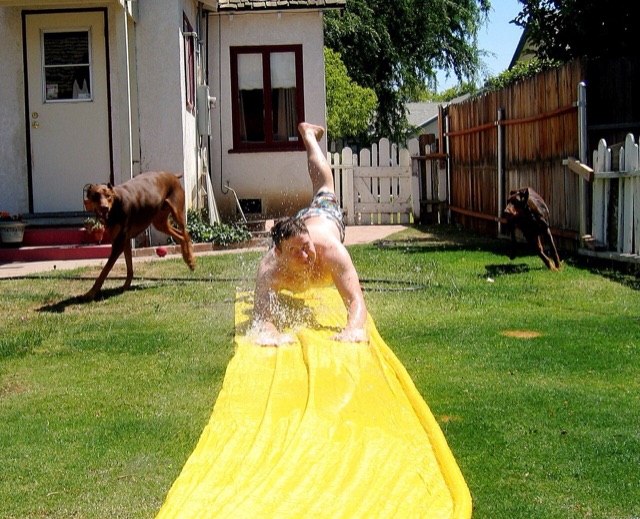
A strip of yellow plastic laid out on the grass with a garden hose attached — the simplest recipe for a perfect summer afternoon. You ran, you flew, you belly-flopped into grass and chlorine-smelling joy, and by August it had worn through entirely.

Toys "R" Us
The cathedral of childhood shopping. Charles Lazarus's toy superstore — the backwards "R," aisle upon aisle of Christmas lists waiting to happen, and Geoffrey the Giraffe's unmissable jingle — defined how kids experienced wanting. Then a leveraged buyout, five billion in debt, and a 2018 collapse ended the era.

Stomp Rocket
A foam rocket on a launch tube, a plastic air bladder on the ground, and one instruction: jump on it. The Stomp Rocket sent a rocket a couple of hundred feet up with nothing but a kid's body weight, and it has been landing on neighbors' roofs since 1993.