Syphon Filter

Gabe Logan, a virus that can be programmed to target specific groups of people, terrorists loose in Washington, D.C., and a taser that sets people on fire if you hold the button. Eidetic's 1999 PlayStation spy shooter arrived after Metal Gear Solid and GoldenEye had already defined the genre, nearly got cancelled several times, and sold more than 900,000 copies anyway.
Syphon Filter started, in creative director John Garvin's words, as "just a name" on a one-page synopsis from a producer at Sony's 989 Studios, with no plot, character or gameplay attached. Lead designer Richard Ham wanted a cinematic action game in the mode of John Woo; Eidetic gave it a third-person camera and built it around weapons, gadgets and stealth. Then the Metal Gear Solid trailer at E3 1997 showed something uncomfortably similar, and Ham steered toward a "radically different" feel, borrowing the mechanics of Rare's GoldenEye 007 for what the team called a new "super spy" genre.
The studio was not obviously equipped for it. Eidetic's only previous console game was Bubsy 3D, three years earlier, a title remembered as one of the worst ever made, and the thirteen-person team had little experience with third-person action. Garvin has admitted they "didn't know anything about making realistic shooters set in a spy world." The original story was science fiction, about kidnapped scientists forced to build a time machine, and was thrown out when Garvin came aboard; deadlines slipped, mechanics were rebuilt, and the game came close to cancellation several times. Both Metal Gear Solid and GoldenEye shipped during its three-year development.
What came out in February 1999 was a globe-trotting conspiracy: agents Gabriel "Gabe" Logan and Lian Xing chasing the terrorist Erich Rhoemer from a Costa Rican plantation to viral bombs planted across Washington, D.C., then to Kazakhstan and Ukrainian catacombs, with the pharmaceutical giant PharCom and Gabe's own Agency director tangled in the plot. The title virus can be programmed at the genetic level to target specific groups of people. The camera drops to first person for aiming with some weapons, a danger meter climbs as fights escalate, and the taser will set a screaming enemy alight if you keep the trigger down, which, as Push Square put it in a review decades later, "never really gets old."
Critics gave it universal acclaim by Metacritic's measure. IGN counted at least thirty weapons and gadgets, and GameRevolution called the enemy AI the best part of the game. It was a finalist for Console Action Game of the Year at the Interactive Achievement Awards, sold more than 900,000 units, and spawned Syphon Filter 2 in 2000, a third game in 2001, The Omega Strain on PlayStation 2 and two PSP entries. Eidetic was later renamed Bend Studio, and the original was re-released on PlayStation 4 and 5 in 2022, trophies and taser intact.
Similar items

Metal Gear Solid
Konami's PlayStation blockbuster told you NOT to shoot: Solid Snake crept through Shadow Moses ducking sightlines, hiding under a cardboard box, and answering the codec mid-mission. Hideo Kojima's stealth epic made video games feel like movies — and made one boss read your memory card out loud.

GoldenEye 007
The Nintendo 64 first-person shooter that redefined console multiplayer: four players split-screen deathmatch, and an iron-clad house rule banning Oddjob because his short stature slipped under auto-aim. Rare's landmark game sold over 8 million copies and owned living rooms until Halo arrived.

Bubsy
Accolade's answer to Sonic: an orange bobcat in a shirt with an exclamation point, a glide, a catchphrase ("What could possibly go wrong?") and, per Electronic Gaming Monthly, the most hype of any character of 1993. The first game reviewed fine. Bubsy 3D did not, and the bobcat became gaming's favorite punchline.
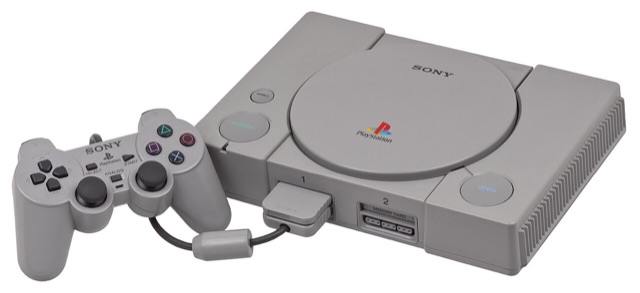
PlayStation
The grey box that took gaming off the cartridge and onto the CD — and took it away from Nintendo and Sega while it was at it. Sony's first console arrived in Japan at the end of 1994 and in America the following September, and it made a generation fluent in memory cards, load screens, and demo discs. It started as a Nintendo project that Nintendo walked away from.