Star Wars CCG

Decipher's black-bordered Star Wars card game, built from actual movie stills instead of new artwork. One player took the Light Side, the other the Dark Side, and you dueled over planets by draining each other's Force.
The Star Wars Customizable Card Game arrived from Decipher, Inc. in December 1995, just as collectible card games were exploding in the wake of Magic: The Gathering. Its signature look set it apart instantly: instead of commissioned fantasy art, the black-bordered cards used real photography from the original trilogy — grainy, atmospheric movie stills of Luke, Vader, stormtroopers, and starships. Designed by a team including Tom Braunlich and Rollie Tesh, it split the galaxy in two, with one player commanding the Light Side (the Rebels) and the other the Dark Side (the Empire).
The engine of the game was the Force. Players used a shared resource called the Force to deploy characters, activate locations, and — most memorably — 'Force Drain' opponents at contested planets, grinding down their reserves. It had a reputation for depth and complexity that rewarded serious players, and for a stretch it was genuinely huge: from 1995 to 1998 it trailed only Magic itself among collectible card games.
Decipher supported it with a steady stream of expansion sets — Premiere, A New Hope, Hoth, Cloud City, Jabba's Palace, Endor, and more — running all the way through the prequel era. The run ended when Decipher lost the Star Wars license at the end of 2001; production stopped that December and the rights passed to Wizards of the Coast, who launched a different Star Wars card game. Rather than let it die, the community formed a fan-run Players' Committee in January 2002 that has kept the game alive with tournaments and new virtual cards ever since — a devoted afterlife for the CCG that turned Star Wars into a photo album you could duel with.
Similar items

Magic: The Gathering
Richard Garfield's 1993 creation, Magic: The Gathering invented the collectible card game genre and became a phenomenon that consumed thousands of hours and dollars from basement dwellers and tournament pros alike. Casting spells, summoning creatures, and crushing opponents with clever deck construction, Magic made trading-card games respectable — and obsessive.

Pokémon Trading Card Game
Trading cards that turned every backpack into a vault and every playground into a market. Pokémon cards hit US schools in 1999 and became instant contraband — the holographic Charizard was the mythical grail, and somehow every kid in your class claimed to have a mint copy.

Yu-Gi-Oh! Cards
Konami's trading card game swept US schoolyards in the early 2000s, rivaling Pokémon for card-game dominance. Players dueled with powerful monsters — Blue-Eyes White Dragon, Dark Magician, and the feared five-piece Exodia combo — and the phrase "It's time to duel!" echoed through lunch periods. Teachers confiscated decks, and schools debated bans.
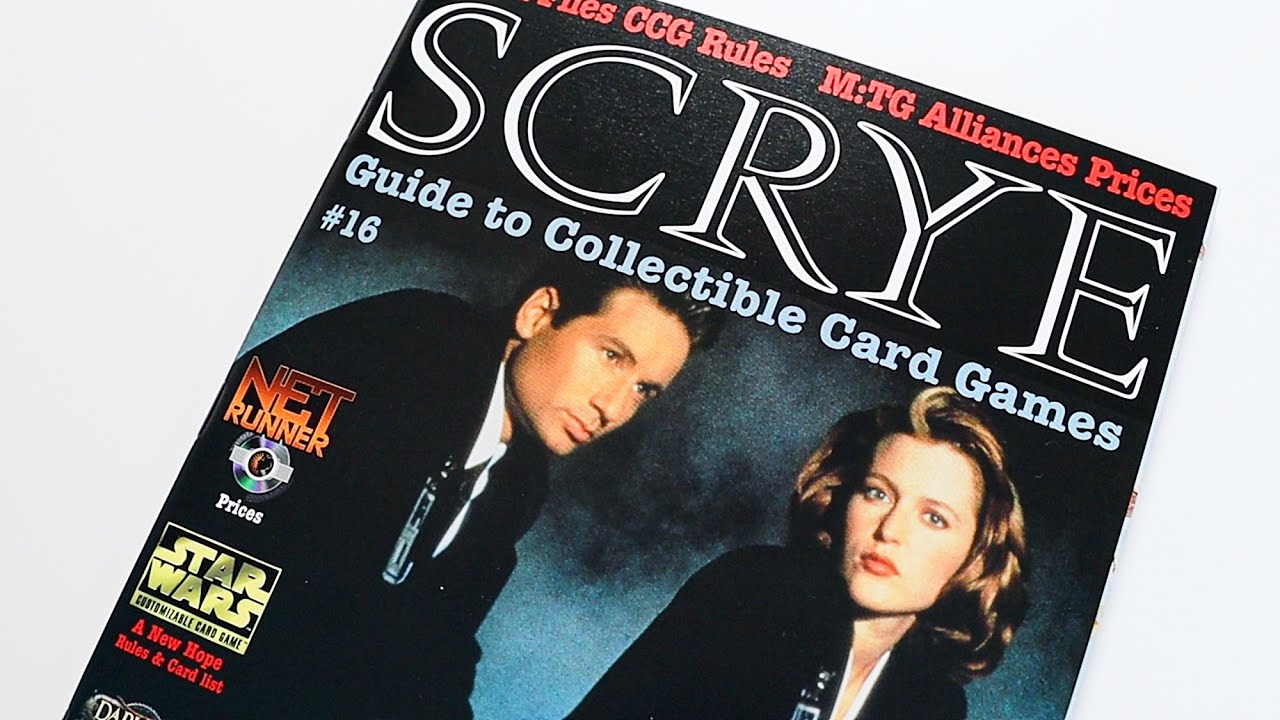
Scrye Magazine
The magazine that told you what your Magic cards were actually worth. Scrye was the price-guide bible of the trading-card-game boom — the fold-out list of secondary-market values you scoured to see if your rare was your ticket to riches.