John Cena
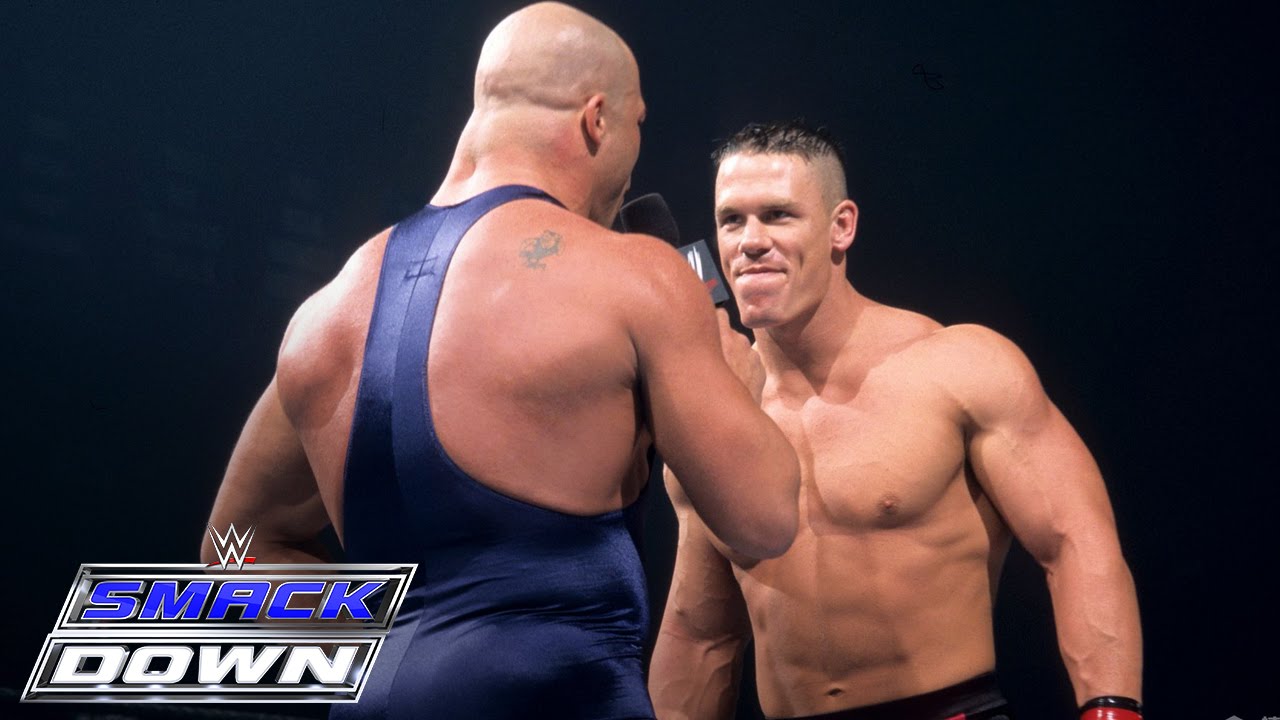
A white rapper in a throwback jersey and a padlock chain who became the face of WWE for a decade, a Make-A-Wish record holder, and the reason every kid's shirt said "Hustle, Loyalty, Respect." You can't see me.
On June 27, 2002, seven weeks after the World Wrestling Federation lost its initials to the panda people and became WWE, a muscular rookie from the Ohio Valley Wrestling farm system answered Kurt Angle's open challenge on SmackDown! and announced that what he had was "ruthless aggression." He lost, but Vince McMahon had given the post-Attitude era that exact name on Raw three days earlier, and John Cena became one of its biggest breakout stars. That October he turned heel, and after Stephanie McMahon and Paul Heyman overheard him freestyling backstage, the Doctor of Thuganomics was born: throwback jerseys, backwards caps, a padlock on a chain he occasionally swung behind the referee's back, "Word Life," and pre-match rap battles aimed at whoever was across the ring.
The crowds turned him good by the end of 2003, and from there it was a climb: the United States title at WrestleMania XX, then the WWE Championship over JBL at WrestleMania 21 in April 2005, which he celebrated with a custom spinner belt and a "Chain Gang" medallion that spun too. Two months later he was the first pick in the Raw draft and suddenly the face of the company, a rise routinely compared to Austin's and Hogan's. His rap album You Can't See Me hit number 15 on the Billboard 200 that year; the hand-wave catchphrase had started in 2003 as a dare from his little brother. The Marine (2006) turned the gimmick into a saluting soldier in dog tags and cargo shorts, and the shirts said "Hustle, Loyalty, Respect" and "Never Give Up."
Not everyone loved it. At ECW One Night Stand in June 2006 the crowd was openly hostile as he lost the title to Rob Van Dam, and critics would spend a decade complaining he won too much. He beat Triple H at WrestleMania 22 and Shawn Michaels at WrestleMania 23, held the title for 380 days until a torn pectoral in October 2007, returned months early to win the 2008 Royal Rumble as the surprise final entrant, and after WWE went TV-PG his "FU" finisher was renamed the Attitude Adjustment.
He stayed the franchise into the mid-2010s and wrestled for WWE for 24 years in all, retiring in 2025 with a record seventeen world championships. The number that follows him around is a different one: more than 650 Make-A-Wish wishes granted, the most in the foundation's history, by a margin so wide that Guinness confirmed second place at under 200. Hollywood got him next, in Trainwreck, Bumblebee, F9, and Peacemaker, and The New York Times called him "perhaps the last of the monocultural, crossover stars."
Similar items

WWE Attitude Era
When the World Wrestling Federation traded superhero theatrics for raunchy, anything-goes storylines and boundary-pushing characters, it conquered Monday night television. Stone Cold Steve Austin's catchphrase "Austin 3:16 says I just whipped your ass!" and The Rock's trash-talk became playground gospel, and a glass-shatter entrance sound defined a generation's ritual.

The Rise of the UFC
From "human cockfighting" banned in 36 states to a reality show on Spike TV that saved the company with one brawl. Griffin versus Bonnar, April 9, 2005: the night cage fighting became something you watched with your roommates.

WWF Ice Cream Bars
Vanilla ice cream backed with chocolate and fronted with a cookie embossed with a wrestler's face, on a stick, with a trading card in the wrapper. Biting Hulk Hogan's cookie face off was a formative summer experience.

XFL
Vince McMahon's smash-mouth football league lasted exactly one season in 2001 — and burned itself into memory anyway. No coin toss, no fair catches, nicknames on jerseys, and a Las Vegas running back named Rod Smart wearing the greatest jersey in sports history: HE HATE ME.