Hoberman Sphere

The rainbow ball of plastic hinges that fit in two hands and, with a pull, bloomed to the size of a beach ball. Chuck Hoberman's 1995 toy version of his expanding geodesic sphere lived in every science-museum gift shop and hung, motorized and enormous, in the museums themselves.
Chuck Hoberman studied sculpture at Cooper Union, graduating in 1979, and then mechanical engineering at Columbia, a combination that explains the sphere. His "radial expansion/retraction truss structures," filed in April 1990 and granted US patent 5,024,031 in June 1991, arranged scissor linkages, the same principle as a pantograph mirror or a folding chair, into six great circles matching the edges of an icosidodecahedron, so the whole shell could grow and shrink while keeping its shape. He formed Hoberman Associates in 1990, and the Museum of Modern Art added a Hoberman Sphere to its collection in 1994, before there was a toy.
The toy came in 1995, when Hoberman and his wife Carolyn founded Hoberman Designs to sell it. The classic version expands from about 5.9 inches (15 centimeters) to 30 inches (76 centimeters), the plastic struts snapping open in a satisfying rush, and it became a fixture of museum shops and classrooms as much as toy stores. Hoberman won the Chrysler Design Award in 1997 and was a finalist for the Smithsonian's National Design Award in 2000.
The giants are the same mechanism scaled up and pulled by cable or motor. The Liberty Science Center in Jersey City hangs one that opens to 18 feet across and weighs 700 pounds; the AHHAA Science Center in Tartu, Estonia has the largest, 5.9 meters (19 feet) and 340 kilograms of aircraft-grade aluminum, motorized and choreographed to music and lights; Switzerland's Technorama installed a smaller one as early as 1993. Hoberman's Arch was the centerpiece of the medals plaza at the 2002 Salt Lake City Winter Olympics, and his expanding video screen toured with U2's 360° shows through 2011. The toy, meanwhile, never left the shelves.
Similar items

K'NEX
A construction toy of colorful plastic rods and connectors that snapped together to build structures, vehicles, and elaborate motorized contraptions like Ferris wheels and roller coasters. Invented by Joel Glickman and launched in 1992, K'NEX was the rods-and-connectors alternative to LEGO's bricks, and it rewarded imagination and structural thinking with click-satisfying mechanical systems.
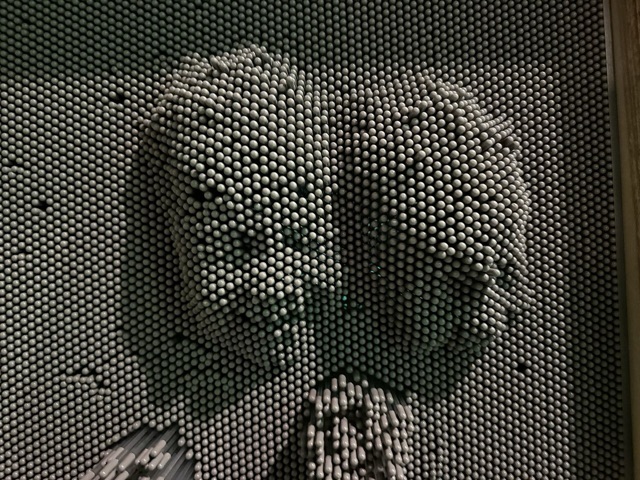
Pin Art
The boxed grid of thousands of sliding metal pins — press your hand, or your whole face, into one side and a shiny 3D relief pops out the other. The desk toy that lived on every science-museum gift-shop shelf and dared you not to make an impression of your face.

MythBusters
Adam Savage and Jamie Hyneman, two special-effects veterans and a crash-test dummy named Buster, testing urban legends with real experiments and — whenever remotely possible — explosions. MythBusters was every 2000s science class's reward day, and it convinced a generation that engineering was cooler than anything in the textbook.