Cruis'n USA & Cruis'n World

Arcade racing cabinet that promised a coast-to-coast road trip—San Francisco to Washington, D.C.—and actually delivered. You shifted and swerved your way through America's most iconic backdrops, and later the entire globe, one quarter at a time.
Cruis'n USA hit arcades in October 1994 as an instant phenomenon. TV Games Inc. developed it under arcade legend Eugene Jarvis, Midway published it, and by late 1994 it ranked as the second most popular arcade game in the country. The cabinet had a steering wheel, pedals, and a shifter you SLAMMED with genuine physicality—not a button you pressed, but a lever you worked. The concept was pure: a cross-country road race starting in San Francisco, taking you through the Grand Canyon, Iowa cornfields, Chicago, and Appalachia before finishing in Washington, D.C. Pizza parlors and arcades everywhere had lines of kids pumping quarters into it.
At the June 1994 Consumer Electronics Show, Cruis'n USA was promoted as a showcase of Nintendo's upcoming "Ultra 64" hardware—the Nintendo 64. But there was a catch: the cabinet wasn't actually running N64 technology at all. It was running a modified board using Midway's own architecture, nothing like the Silicon Graphics CPU and graphics pipeline that would power the real N64. The marketing tie-in sold kids the dream of arcade-perfect games at home—a promise that didn't quite hold up.
The N64 port launched December 2, 1996, developed by Leland Interactive Media and published by Nintendo. It was immediately obvious something was missing: the frame rate was jerky, collision detection felt floaty, and Nintendo had censored some of the arcade's rougher gags—running over animals and other chaos had been toned down for family audiences. Reviewers panned it, but it didn't matter much: every kid who'd pumped quarters into that arcade cabinet wanted the experience at home, and the N64 version scratched that itch even if it didn't match the arcade's polish.
Cruis'n World took the formula global in November 1996, hitting arcades with a new premise: Hawaii to Japan, Kenya to Egypt, Moscow to New York, finishing in Florida. It added wheelie-and-flip stunts for dodging obstacles and shaving seconds, won Most Innovative New Title at the 1996 AMOA show, and proved the arcade audience wanted more. The N64 port arrived September 28, 1998, developed by Eurocom, and became the series' best-received home version—a sign that the formula worked better on console the second time around. After 1998 the series rolled on (Cruis'n Exotica and various revivals), but the 1994–1998 run—from quarter-eating cabinet sensation to sleepover staple—defines the era everyone remembers.
Similar items

Nintendo 64
Nintendo's leap into three dimensions, the N64 brought 3D polygon gaming into living rooms with its quirky three-pronged controller and a cartridge library anchored by Super Mario 64 and The Legend of Zelda: Ocarina of Time. Its rumble pak added tactile feedback, while its four controller ports made it the console of couch multiplayer legends.

Mario Kart 64
The first 3D Mario Kart brought four-player split-screen racing to the Nintendo 64, turning every sleepover and dorm room into a competitive battleground. Shells flew, friendships were tested, and players argued eternally about which character had a hidden advantage.
Arcade Redemption Games
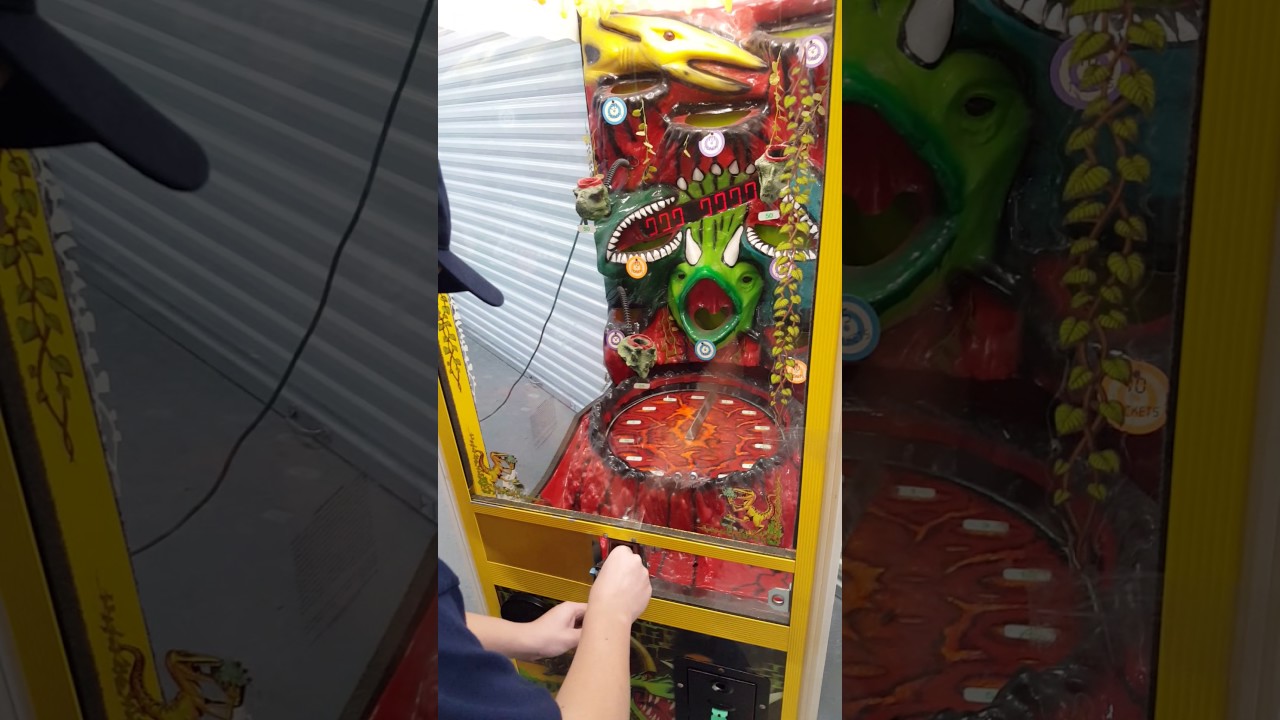
Drop in a token, play a game of skill, and win a stream of paper tickets — then trade the crumpled wad at the glass prize counter for cheap plastic junk. Rock 'N Bowl, Skee-Ball, Wheel 'Em In, Dinoscore: the ticket-frenzy floor of every '90s arcade.

Sega Menacer
A cordless infrared light gun for the Sega Genesis that could be built up from a handgun into a shoulder-mounted bazooka. It looked futuristic and felt powerful—there was just almost nothing worth shooting at.