Cingular Wireless

The orange X, the "Raising the Bar" signal bars, Rollover minutes, and a name that vanished days before the iPhone went on sale. Cingular was America's biggest wireless carrier for not quite three years.
Cingular Wireless was formed on October 5, 2000, as a joint venture of SBC Communications and BellSouth, stitching together more than 100 companies — a dozen with Bell roots, from BellSouth Mobility to Pacific Bell Wireless and Southwestern Bell Mobile Systems — into the nation's second-largest carrier overnight, under a lowercase orange mark that its own ads would later treat as a character. Its signature plan, around 2004, was Rollover: unused minutes carried into the next month instead of vanishing.
The leap came in February 2004, when Cingular outbid Britain's Vodafone for the struggling AT&T Wireless at $41 billion, more than twice the company's trading value. The deal closed on October 26, 2004, and the combined 46 million customers made Cingular the largest wireless provider in the United States. Within days BBDO's new campaign was on the air: "Raising the bar," borrowed from AT&T Wireless's "How many bars do you have?" ads, with the word Cingular now following the orange mark in AT&T Wireless blue, an animated "x" absorbing the old logo, and the network rebranded the "Allover Network." Behind the bars sat two actual networks, AT&T's "blue" and Cingular's "orange," that engineers spent 2005 welding together across some 50,000 cell sites. In 2006 Cingular advertised "the fewest dropped calls," citing a Telephia test of 350 markets — until Consumer Reports and J.D. Power said otherwise and Telephia itself remarked that "Cingular shouldn't have even mentioned the company's name to a reporter." The claim was eventually dropped.
Meanwhile the parents were changing. SBC acquired the old AT&T and took its name; AT&T then bought BellSouth, finalized on December 29, 2006, and in January 2007 announced that Cingular would become AT&T. "The New AT&T" commercials showed the orange "Jack" logo circling the AT&T globe and dragging its blue bars around it to form the globe's stripes, to the chorus of Oasis's "All Around the World." The changeover finished in late June 2007, just before the iPhone went on sale on June 29 as an AT&T exclusive. AT&T kept the orange on its storefronts until 2015.
Similar items

Motorola Razr
The Razr V3 launched in late 2004 as the world's thinnest clamshell phone at a shocking $500. Its anodized-aluminum body, laser-etched keypad, and impossible thinness made it a fashion statement. When the price dropped in 2005–2006, everyone had one—and snapping it shut after a call was the whole point.

Motorola SLVR & KRZR
The Razr's thinner siblings. The SLVR was the Razr flattened into a candybar with iTunes inside; the KRZR was the Razr stretched taller and narrower under a glossy glass face. Neither escaped the original's shadow.

Verizon Test Man ("Can You Hear Me Now?")
A man in a gray jacket and horn-rimmed glasses wanders the far corners of America, pressing a phone to his ear and asking the void: 'Can you hear me now?' 'Good.' For nine years, that was Verizon — four words that turned a network-coverage claim into a national catchphrase.
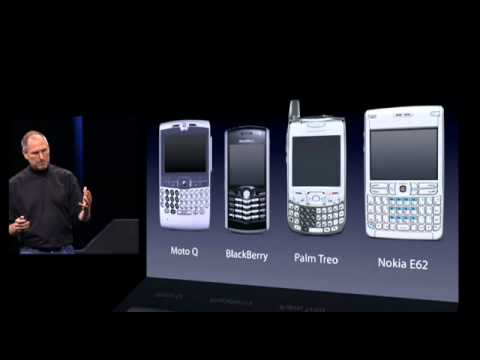
iPhone Launch (2007)
"Today, Apple is going to reinvent the phone." Steve Jobs said it on January 9, 2007, and by June 29 thousands were camped outside stores to find out if he meant it. The lines, the keynote, the $599 price tag — the moment phones changed overnight.