Bruce Willis

The everyman action hero who proved you didn't need muscles the size of tree trunks to save the day. Bruce Willis went from TV comedy to Die Hard's John McClane, rewriting what a blockbuster lead could be—and spent the next decade proving it with an eclectic run of '90s classics that kept him in the conversation.
Born March 19, 1955, in Idar-Oberstein, West Germany, Willis built his early career on Moonlighting (1985–1989) opposite Cybill Shepherd, earning an Emmy for Outstanding Lead Actor in a Drama Series. The role made him a household name as a wisecracking TV presence, so much so that Seagram's paid him $5–7 million over two years in the mid-'80s to pitch their Golden Wine Cooler. In 1987, riding the comedy-guy momentum, he released The Return of Bruno, a pop-soul album featuring the hit "Respect Yourself"—proof that he could be funny in multiple mediums and take a swing at anything.
Die Hard (July 15, 1988) changed everything. Cast as NYPD cop John McClane opposite Alan Rickman's Hans Gruber in the Nakatomi Plaza siege, Willis did many of his own stunts and embodied a new archetype: the mortal, wisecracking everyman instead of the Schwarzenegger or Stallone muscle mold. On a reported $28 million budget, the film grossed roughly $140 million worldwide and became a template that defined action cinema for decades. Through the 1990s, Willis proved the gamble paid off: Pulp Fiction (1994), 12 Monkeys (1995), The Fifth Element (1997), Armageddon (1998—the year's highest-grossing film worldwide), and The Sixth Sense (1999). He also became one of the celebrity faces of Planet Hollywood alongside Schwarzenegger and Stallone, embedding himself in '90s pop culture on every front.
In March 2022, Willis retired from acting following an aphasia diagnosis; his family later disclosed a frontotemporal dementia diagnosis in February 2023. The outpouring of affection from fans, co-stars, and filmmakers showed how deeply beloved he remained—a measure of a career not defined by muscles or invincibility, but by charm, humor, and the humanity he brought to every role. He remade the action hero in his own image, and cinema followed.
Similar items

Arnold Schwarzenegger
The Austrian bodybuilder who became the biggest action star on the planet. The Terminator made him iconic in the 80s; the early 90s — Total Recall, Kindergarten Cop, T2, True Lies — made him inescapable. The accent launched a thousand imitations, all of them affectionate.
![Video thumbnail — Die Hard - Official® Trailer [HD]](https://i.ytimg.com/vi/2TQ-pOvI6Xo/maxresdefault.jpg)
Die Hard
The film that made 'yippee-ki-yay' a holiday tradition and launched an endless argument: is it a Christmas movie? Spoiler: yes, and also no—but watching it in December became genuinely ingrained.
![Video thumbnail — The Fifth Element - Official® Trailer [HD]](https://i.ytimg.com/vi/199EvXTKucc/maxresdefault.jpg)
The Fifth Element
Luc Besson's gloriously maximalist 1997 sci-fi spectacle: Bruce Willis as flying-cab driver Korben Dallas, Milla Jovovich as the orange-haired Leeloo, Gary Oldman chewing scenery as Zorg, and Chris Tucker's motor-mouthed Ruby Rhod. Jean Paul Gaultier costumes, a blue alien diva, and a plot to save Earth with four stones and one perfect being.
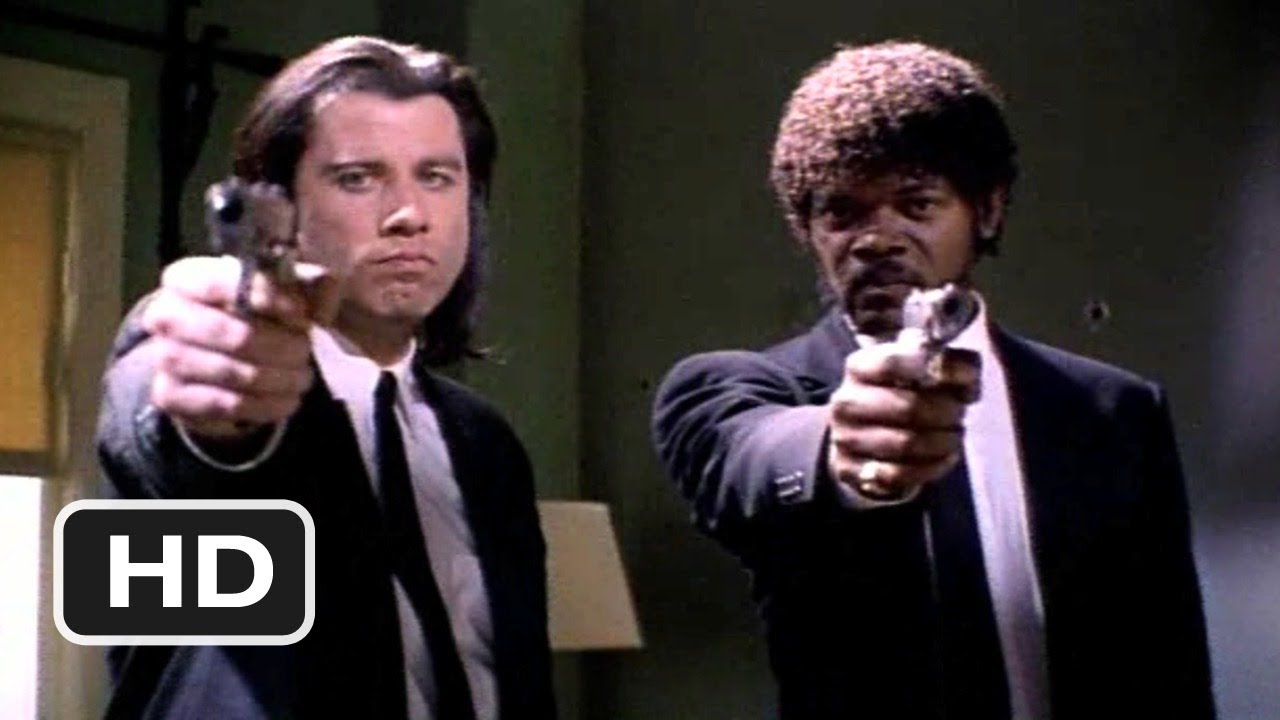
Pulp Fiction
Quentin Tarantino's nonlinear crime epic rewrote the rules of what indie films could be. Released October 1994 with a Palme d'Or win at Cannes, a $200 million global gross, and career resurrections for John Travolta and a breakthrough for Samuel L. Jackson, Pulp Fiction became the defining film of a generation hungry for something different.