Barbie

Ruth Handler's fashion doll was already three decades old when the 90s arrived — then had one of its biggest decades anyway. 1992 alone delivered Totally Hair Barbie, the best-selling Barbie of all time, and the 'Math class is tough!' scandal. Every toybox had at least one; every sibling war featured a hostage.
Mattel co-founder Ruth Handler watched her daughter Barbara give paper dolls adult roles and pitched an adult-bodied doll at a time when nearly all dolls were babies — an idea her husband Elliot and Mattel's directors initially shrugged off. A 1956 trip to Europe turned up the German Bild Lilli doll, the proof it could work; Handler brought three home, redesigned the concept with engineer Jack Ryan, and named the result after her daughter. Barbie debuted at the American International Toy Fair in New York on March 9, 1959 — a date Mattel still celebrates as her official birthday.
By the 90s, Barbie was less a toy than an institution, and 1992 was arguably her wildest year. Totally Hair Barbie — hair to her toes, 11.5 inches of it, sold with a tiny tube of Dep styling gel — racked up $100 million in sales that year and went on to move more than ten million units, making her the best-selling Barbie in Mattel's history. The same summer, Teen Talk Barbie chirped four phrases from a pool of 270, one of which was 'Math class is tough!' — the American Association of University Women objected, and by October Mattel apologized and offered swaps. A year later the Barbie Liberation Organization pranked toy stores by swapping Barbie voice boxes with G.I. Joe's and sneaking the dolls back onto shelves.
She closed the century as a pop-culture fixture big enough to sue over: Aqua's 1997 hit 'Barbie Girl' prompted Mattel v. MCA Records, which Mattel lost in 2002 when the court called the song 'parody and a social commentary.' By 2006 over a billion Barbies had been sold in more than 150 countries — Mattel claimed three per second — even as the 2000s brought a genuine rival in Bratz, a feud Mattel took to court too. The pink aisle was hers first.
Similar items

Barbie Girl
A Danish-Norwegian group called Aqua released a slab of pure pink synthetic pop in 1997 and accidentally created a song the world couldn't escape. "Barbie Girl" was everywhere — and Mattel sued, convinced it was watching its brand get mocked into oblivion.

Bratz
Fashion dolls from MGA Entertainment launched in 2001; the original four 'girls with a passion for fashion' (Yasmin, Cloe, Jade, Sasha) had oversized heads, big almond eyes, glossy pouty lips, and removable snap-off feet, with edgy trend-forward outfits. They seriously challenged Barbie's dominance in the mid-2000s and sparked a long legal battle with Mattel.

Polly Pocket
Thumb-sized figurines inside impossibly small clamshell compacts — you'd flip one open and find an entire world compressed into plastic the size of a mint tin. Invented by Chris Wiggs and made by UK's Bluebird Toys, these collapsible worlds were so addictive that parents had to confiscate them during family road trips.
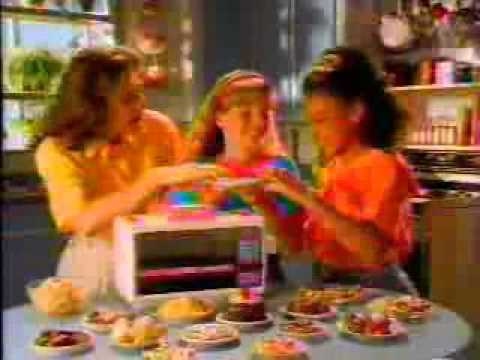
Easy-Bake Oven
A working toy oven that baked tiny cakes with the heat of a light bulb. You mixed a just-add-water pouch, slid the little pan in one side, waited an agonizing eternity, and pulled a real (if slightly rubbery) cake out the other — no grown-up oven required.