Shaq-and-Kobe Lakers (2000–2002 three-peat)
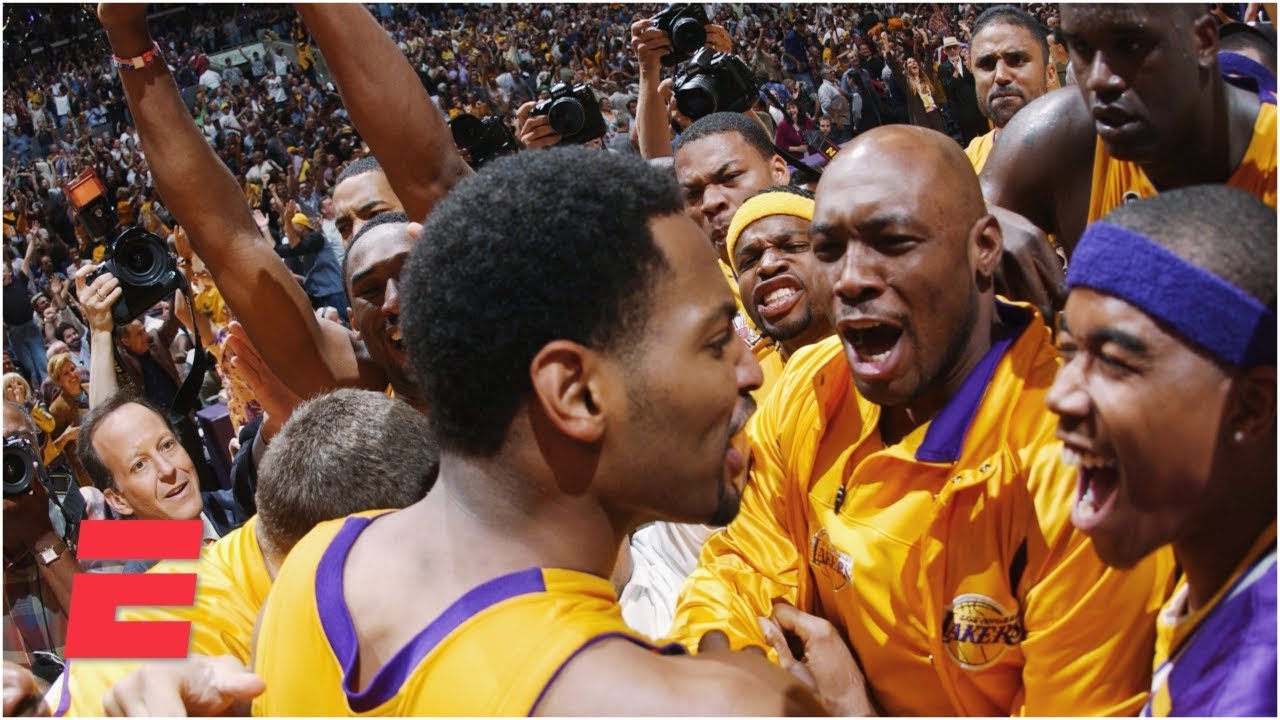
Three straight titles and one long argument about whose team it was. With Phil Jackson arriving in 1999, Shaquille O'Neal and Kobe Bryant ran off the 2000, 2001, and 2002 championships, the 15–1 postseason, and Robert Horry's buzzer-beater, until Shaq was traded to Miami in July 2004 and Kobe re-signed the next day.
The pieces arrived in 1996: Kobe Bryant's draft rights, acquired from Charlotte for Vlade Divac when Bryant was 17, a minor whose parents had to co-sign his rookie contract, and no team had drafted a guard straight out of high school, and free agent Shaquille O'Neal. In the 1999 offseason the franchise handed Phil Jackson, winner of six titles in Chicago, a five-year, $30 million contract. The first season in the new Staples Center went a league-best 67–15, O'Neal won the MVP with 120 of 121 first-place votes, and the team survived a Game 7 against Portland on June 4, 2000, erasing a double-digit fourth-quarter deficit with a 15–0 run that ended on Bryant's alley-oop to O'Neal. Indiana fell in six, and O'Neal was Finals MVP.
The 2001 team is the one people still argue about. The regular season was bumpy, with Derek Fisher out for the first 62 games and O'Neal reportedly asking for a trade after a December loss, but the Lakers won their last eight games and swept Portland, Sacramento, and San Antonio. The only loss of the playoffs was Game 1 of the Finals, when Allen Iverson scored 48 in an overtime win; Philadelphia lost the next four, and the 15–1 record stood as the best postseason mark in NBA history until Golden State went 16–1 in 2017.
The third title was the hardest. Down 2–1 to Sacramento in the conference finals and trailing 99–97 with 11.8 seconds left in Game 4, the Lakers watched Bryant and O'Neal miss consecutive layups before Divac knocked the ball away and it bounced straight to Robert Horry, "Big Shot Rob," whose three at the buzzer won it 100–99. Game 7 went to overtime in Sacramento in front of 23.8 million viewers, the most ever for a Western Conference finals game, and the Finals were a 4–0 sweep of New Jersey. O'Neal was Finals MVP for the third straight year, and no NBA, NFL, MLB, or NHL team has three-peated since.
The end came fast. In July 2003 Bryant was charged with sexual assault in Colorado (the criminal case was dismissed in September 2004 when his accuser declined to testify, and a civil suit was settled in 2005), and that October O'Neal called himself the team's leader while Bryant told ESPN's Jim Gray that O'Neal was out of shape and blamed others for losses. The favored Lakers lost the 2004 Finals to Detroit in five, Jackson's five-year contract ran out and he left, and on July 14, 2004, O'Neal was traded to Miami for Lamar Odom, Caron Butler, Brian Grant, and a first-round pick. Bryant re-signed for seven years and $136 million the next day. The two shook hands before a game in January 2006, shared All-Star MVP honors in 2009, and when Bryant's statue was unveiled in 2024, O'Neal narrated the tribute video.
Similar items

Shaquille O'Neal
A 7'1" force of nature who refused to stay on the court. Nineties Shaq dunked on the NBA, went platinum as a rapper, starred in a fighting game, and played a genie in Kazaam — the decade's most cheerfully unstoppable multimedia franchise disguised as a center.

Chicago Bulls (1990s dynasty)
Six rings in eight years as two three-peats: the defining sports dynasty of the 1990s. Jordan, Pippen, Phil Jackson's triangle, the 72–10 season, 'I'm back,' and the lights-out 'Sirius' intro every kid recreated in the driveway.

Michael Jordan
The Bulls dynasty alpha who made basketball bigger than basketball itself. Six NBA championships in two three-peats, a Gatorade slogan that became a religion, a baseball detour ended by a two-word press release, and Air Jordans that outlasted his career by decades.

The 1992 Dream Team
The 1992 Olympic basketball team wasn't just a team — it was a statement. Michael Jordan, Larry Bird, Magic Johnson, and nine others playing for gold in Barcelona, winning by an average of 44 points while their opponents asked for autographs. It was the moment American basketball became something the rest of the world would spend decades trying to catch up to.