Red vs. Blue
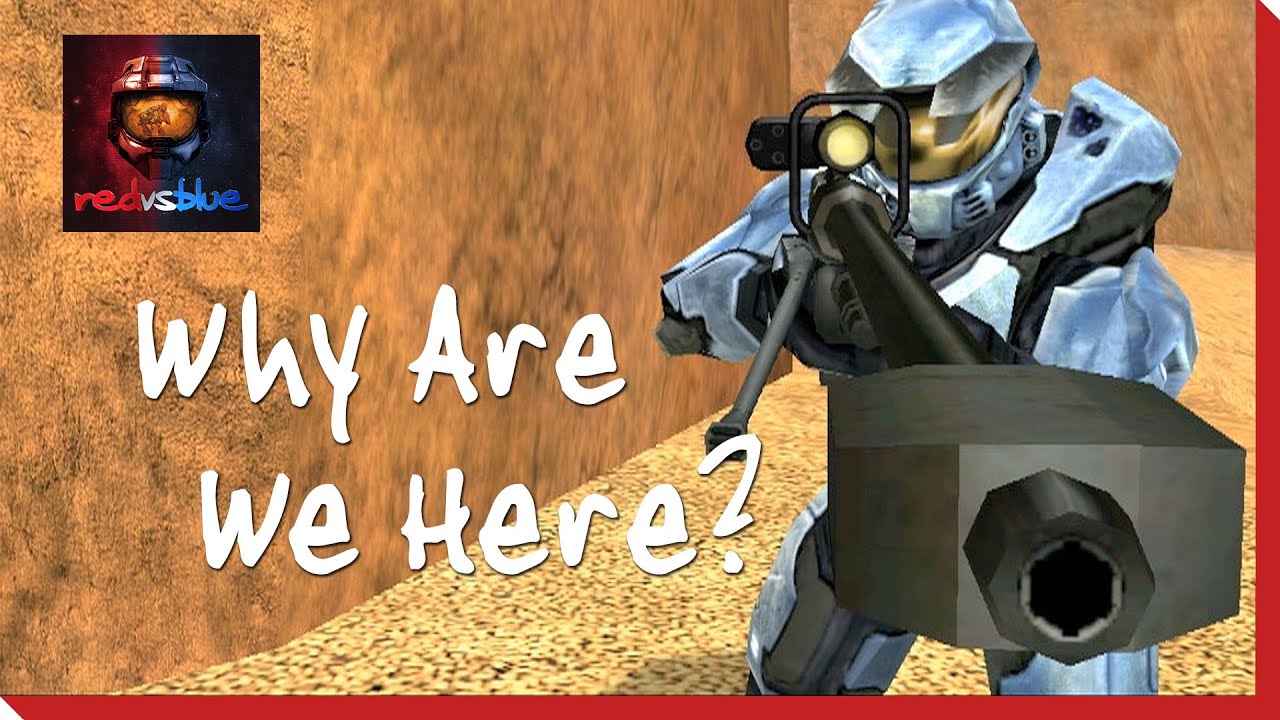
Two squads of Halo soldiers stand around a box canyon and bicker about why they're there. Burnie Burns and his friends at Rooster Teeth made Red vs. Blue by puppeteering Halo: Combat Evolved multiplayer and dubbing it with sitcom dialogue. It launched April 1, 2003, was meant to run six to eight episodes, and ran for twenty seasons.
Before it was a series it was a bit. Burnie Burns had been recording voiceover gags over Halo: Combat Evolved footage for drunkgamers.com, a site run by Geoff Ramsey and Gus Sorola, and one day the group argued over whether the game's Warthog jeep looked more like a puma. That argument, re-created in the second episode, was the spark. A trailer posted on the Drunkgamers site on September 5, 2002, was ignored, and the site soon closed; four months later Computer Gaming World asked to put a different Drunkgamers video on a magazine CD, and Burns and Ramsey realized they needed a website to catch the attention. Red vs. Blue was revived for it, and the first episode, "Why Are We Here?", went up on April 1, 2003.
The setup: two teams in a desolate canyon called Blood Gulch, each base existing only because the other does, waging a supposed civil war that nobody on either side much wants to fight. Burns played Church, Sorola the eager Simmons, Ramsey the lazy Grif, Matt Hullum the hotheaded Sarge, Jason Saldaña the self-styled ladies' man Tucker, Joel Heyman the dim Caboose and Kathleen Zuelch the mercenary Tex. The team had budgeted six to eight episodes of jokes; by the eighth episode they had covered only about a third of the list, and the thing kept growing. Everyone quit their jobs, and a T-shirt store paid the bills.
They did not know the word "machinima" yet; Hullum told GameSpy in 2004 they had assumed they were completely original. But Red vs. Blue is credited with dragging the form out of the underground: it won four awards from the Academy of Machinima Arts & Sciences, screened at Lincoln Center, and Bungie, building Halo 2, added a D-pad command that lowers a soldier's weapon so machinima makers could stage dialogue, a feature the journalist Clive Thompson wrote was designed solely to make Rooster Teeth's job easier. Season DVDs sold at Target and Walmart, more than a million of them by the company's 2017 count. The original Blood Gulch Chronicles ended with episode 100 on June 28, 2007; the show carried on through Halo 3 and the games that followed.
Rooster Teeth grew into a studio, then collapsed: its 2024 shutdown turned the final season, Restoration, into a feature-length movie released on May 7, 2024, with an episodic cut following in late 2025. Burns, who had left the company, came back to write the ending, and in February 2025 he bought the rights to Red vs. Blue out of the wreckage.
Similar items

Halo: Combat Evolved
Bungie's sci-fi FPS that proved console shooters could rival their PC counterparts. Released November 15, 2001 as an Xbox launch title, Halo: Combat Evolved sent you to a mysterious ringworld as Master Chief to fight the alien Covenant—and turned LAN parties into a rite of passage.

Halo 2
When Bungie's sequel launched on Xbox in November 2004, 1.5 million people had pre-ordered it. Midnight launches erupted at 7,000 stores across North America. And its matchmaking system became the template that online shooters copied for years afterward.

Halo 3
Bungie's trilogy-closer exploded into a September 2007 phenomenon that had entire dorm floors in line the night it launched. "Finish the Fight" did exactly that — Master Chief, the Covenant, the Flood, and forty million marketing dollars behind a "Believe" campaign built around a sprawling hand-made diorama. The numbers were untouchable: $170 million in one day, $300 million in a week, a million players on Xbox Live before anyone had slept.

Xbox Live (Original Xbox Era)
Microsoft's revolutionary bet on broadband gaming — the service that brought voice chat and Gamertags into living rooms and normalized trash-talking strangers over the internet. The $49.95 Starter Kit arrived in November 2002 with a wired headset, a year of subscription, and a radical demand: high-speed internet or stay offline. It worked — 150,000 kits sold in the first week.