Old Navy

Gap's cheaper little sibling, born in 1994 with shopping carts in the aisles, Performance Fleece for the whole family, and commercials in which a fashion editor in enormous glasses declared everything "Fabulous!" beside a dog named Magic.
Gap's chief executive Millard "Mickey" Drexler tried the idea first as Gap Warehouse, opened inside existing Gap outlet locations in 1993 as a cheaper alternative to Gap. On March 11, 1994 Gap Warehouse was renamed Old Navy Clothing Co., with the first stores in the Northern California towns of Colma, San Leandro and Pittsburg. Drexler had rejected proposed names including "Monorail" and "Forklift" before settling on two words he saw on a building during a visit to Paris. The stores were deliberately laid out like supermarkets, with flowing aisles, shopping carts and small impulse items by the registers.
The advertising is what people remember. In 1994 Morgan Fairchild fronted a campy campaign alongside Joan Collins and other formerly familiar television faces, so successful that Old Navy kept writing sequels around her glamour-vixen persona. In the fall of 1997 the company added Carrie Donovan, the former Vogue, Harper's Bazaar and New York Times Magazine style editor, then in her late sixties, in her trademark oversized glasses and black clothes; she made 42 spots, usually with Magic the dog and often with celebrities, in one of them piloting an airplane, pronouncing the clothes "Fabulous!" The Performance Fleece ads were on the air by the late 1990s, and the 1998 Christmas spot put Donovan, Fairchild and Magic on a sled. Old Navy's in-house marketing unit created the ads until Deutsch Los Angeles became the first outside agency in 2004; the 1997 national ad budget was $160 million, 2.5 percent of sales, and a spot in the 1998 Seinfeld finale cost $1.7 million per 30 seconds.
It worked. In 1997 Old Navy passed $1 billion in sales, the first apparel retailer to get there within its first four years by its own count, it had 500 stores by 2000, and by 2003 it was doing $6.4 billion, nearly 40 percent of Gap Inc.'s $15.8 billion. Donovan died in November 2001 at 73. Canada got its first stores in 2001, a 2019 plan to spin the chain off was reversed in January 2020, and revenue reached $8.2 billion in 2023.
Similar items
Abercrombie & Fitch
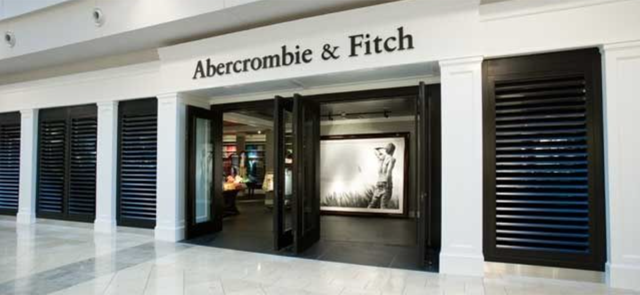
The dim-lit mall temple with impossibly loud music, a signature cologne so thick it hit you at thirty paces, and shopping bags plastered with shirtless male models. The Abercrombie & Fitch moose logo on polos and tees became a middle-school currency of cool in the 2000s. Wearing it meant you had money, taste, or both—or at least that's what everyone pretended to think. The brand launched its spinoff, Hollister, in 2000, spreading the gospel even wider.

Tommy Hilfiger
Prep meets hip-hop: the flag logo of a 1985 New York label, co-opted by Snoop Dogg, Aaliyah, and every mall kid of the 90s who wore it oversized and felt instantly cooler. The red-white-and-blue became a uniform.

Seinfeld
"A show about nothing" created by Jerry Seinfeld and Larry David became everything. NBC's quirky hit turned observational humor about minutiae—shirt buttons, parking spots, the mechanics of social obligation—into the decade's most quotable comedy.

JNCO Jeans
JNCO jeans were the uniform of 90s youth rebellion: outrageously baggy denim with cavernous pockets so deep you could lose a Walkman, decorated with zipper details and an attitude that rejected traditional fit. If you weren't tripping over your cuffs or making those pockets jingle, you weren't dressed for the decade.