Mister Rogers' Neighborhood

Fred Rogers walked in the door singing "Won't You Be My Neighbor?", traded his jacket for a cardigan and his shoes for blue sneakers, and for 33 years told children they were special exactly as they were. The Trolley to the Neighborhood of Make-Believe, the fish, the traffic light — it was television slowed to the speed of a child, and nothing else has ever felt quite like it.
Mister Rogers' Neighborhood debuted on NET, public television's predecessor, on February 19, 1968, produced with WQED in Pittsburgh by Fred Rogers' own company, Family Communications. Rogers wrote the scripts, composed the music, and performed most of the puppets himself — King Friday XIII, Daniel Striped Tiger — while the motorized Neighborhood Trolley carried viewers between his television house and the Neighborhood of Make-Believe. Every episode opened the same way: "Won't You Be My Neighbor?" (written in 1967), the cardigan, the sneakers, one ritual repeated for decades because the repetition was the point.
A year into the run, on May 1, 1969, Rogers gave one of television's most famous pieces of testimony, defending public broadcasting's funding before the Senate Subcommittee on Communications with a quiet recitation of what he tried to give children — and visibly winning over a skeptical chairman. The show itself ran in two stretches, 1968 to 1976 and 1979 to 2001, ultimately producing 912 episodes across 31 seasons. For the kids of the 80s and 90s it was simply always there, a daily PBS constant alongside faster, louder neighbors it never tried to imitate.
The final episode was recorded on December 1, 2000, and the series concluded on August 31, 2001. Rogers died in 2003, and the reverence has only deepened since — documentaries, a Tom Hanks film, and in 2026 an official YouTube channel that began streaming the archive, first episode included, to a generation raised on the exact opposite of his pacing.
Similar items

Reading Rainbow
"Butterfly in the sky, I can go twice as high." LeVar Burton spent more than two decades on PBS making one argument, gently and relentlessly: books are where the good stuff is. Then he'd hand the microphone to kids to review them — because you didn't have to take his word for it.
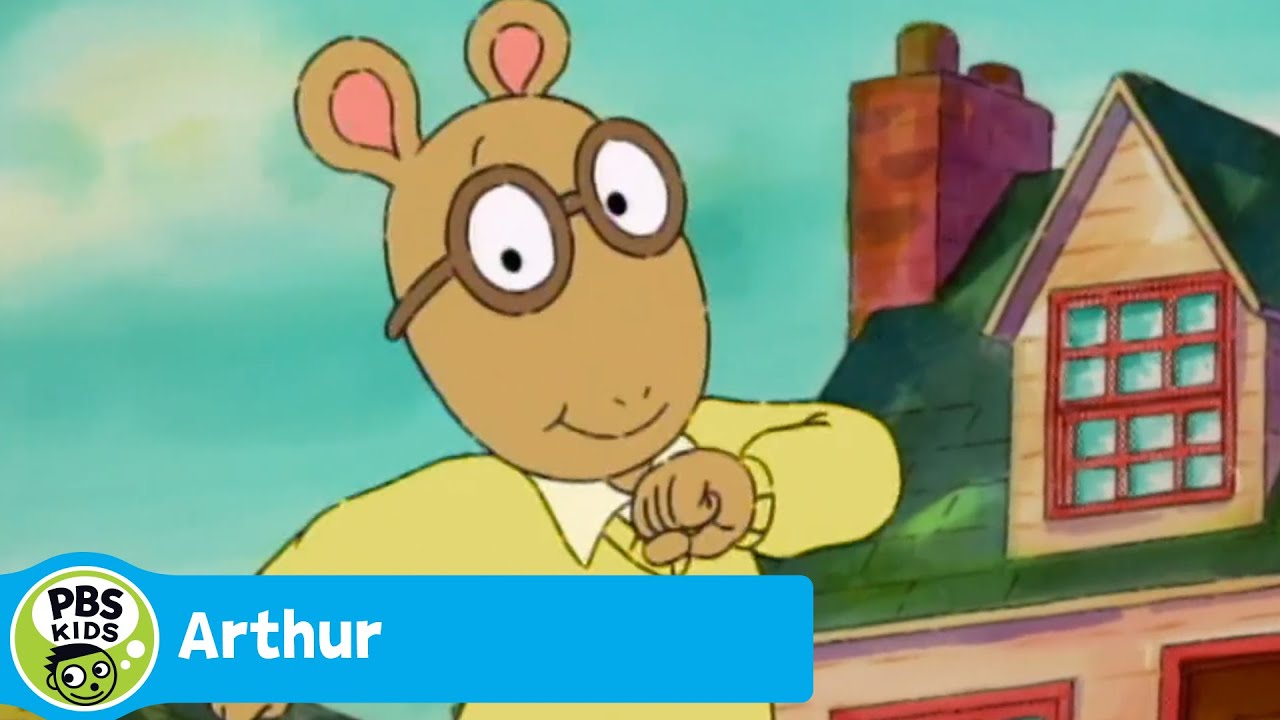
Arthur
PBS's 25-season juggernaut about an aardvark navigating school, friendship, and suburban angst. Arthur Read, his friends Buster, Francine, Muffy, and the Brain, and his little sister D.W. defined childhood TV for an entire generation. The show ran from 1996 to 2022, becoming one of the longest-running animated kids' series in US television history.

Blue's Clues
A live-action host talking directly to you from inside an animated storybook world, solving mysteries left behind by a blue-spotted puppy. Blue's Clues was built on research, tested with preschoolers before it aired, and the same episode played five days in a row so you could actually master it.

Barney the Dinosaur
The purple dinosaur that somehow became the most beloved and most despised children's television character of the 1990s — a phenomenon so massive it spawned both merchandise empires and playground backlash that made "Barney bashing" a genuine pop-culture sport. The closing song "I Love You" (sung to the tune of "This Old Man") made every parent's brain simultaneously swell with affection and shriek in agony.