In the Army Now

Pauly Shore in dog tags: two buddies join the Army Reserves to bankroll their dream electronics store — one weekend a month, two weeks a year, right? — and get shipped to an actual desert war. Nobody's idea of a critical darling, but a mid-90s cable staple a whole generation half-remembers without ever having chosen to watch it.
By 1994, Pauly Shore was mid-run in his five-film leading-man streak — after Encino Man (1992) and Son in Law (1993), before Jury Duty (1995) and Bio-Dome (1996) — and In the Army Now was the concept comedy at the center of it. Directed by Daniel Petrie Jr. and released by Hollywood Pictures on August 12, 1994, it knew exactly what it was: a war comedy that lived or died on the inherent ridiculousness of its hook.
The hook: Bones Conway (Shore) and his buddy Jack join the U.S. Army Reserves to bankroll their dream electronics store, lured by the recruiting slogan "One weekend a month, two weeks a year." Bones picks water purification as their specialty because it sounds combat-proof, and their crew embraces the nickname "the Waterboys." Then Libya starts planning an invasion of Chad, the reservists get called up for real, and the weekend warriors end up lost in the desert — captured, escaped, and somehow finishing a Special Forces mission by blowing up mobile Scud launchers. They come home heroes. The supporting cast — Andy Dick, Lori Petty, David Alan Grier and Esai Morales — sold the absurdity with the commitment of people who understood exactly how silly the movie was. Shore, for his part, actually went through the Army's water-treatment training to understand the job, turning method acting into its own kind of joke. The production was real-military adjacent throughout: basic-training scenes shot at Fort Sill, Oklahoma, water-purification training at Fort Lee, Virginia, and the desert war filmed around Yuma, Arizona.
It grossed $28.9 million — the fourth-highest-grossing Pauly Shore film, behind Encino Man, Son in Law and A Goofy Movie — and critics shrugged. What it became instead was the quintessential mid-90s cable artifact: the movie you stumbled into mid-scene on a Saturday afternoon and somehow couldn't turn off. Nobody chose In the Army Now. It was simply on, always, and that's how an entire generation ended up able to recite the water-boy scenes from memory.
Similar items

Pauly Shore
MTV's most relentless goofball — The Weasel, all surfer-dude Valley-speak, somehow the defining voice of early-90s cable. Pauly Shore rode that energy into a five-film leading-man run that shrank at the box office with every release while the Razzies stacked up. Then he made a mockumentary about the wreckage, because he was always in on the joke.

Bio-Dome
Two slackers wander into what they think is a mall looking for a bathroom and get hermetically sealed into a year-long ecological experiment. Critics handed it a 1/100 on Metacritic — tied for the lowest score in the site's history; kids with cable memorized every line anyway. Bio-Dome is the purest specimen of the gap between what the industry decided and what actually lived on late-night rotation.
Encino Man
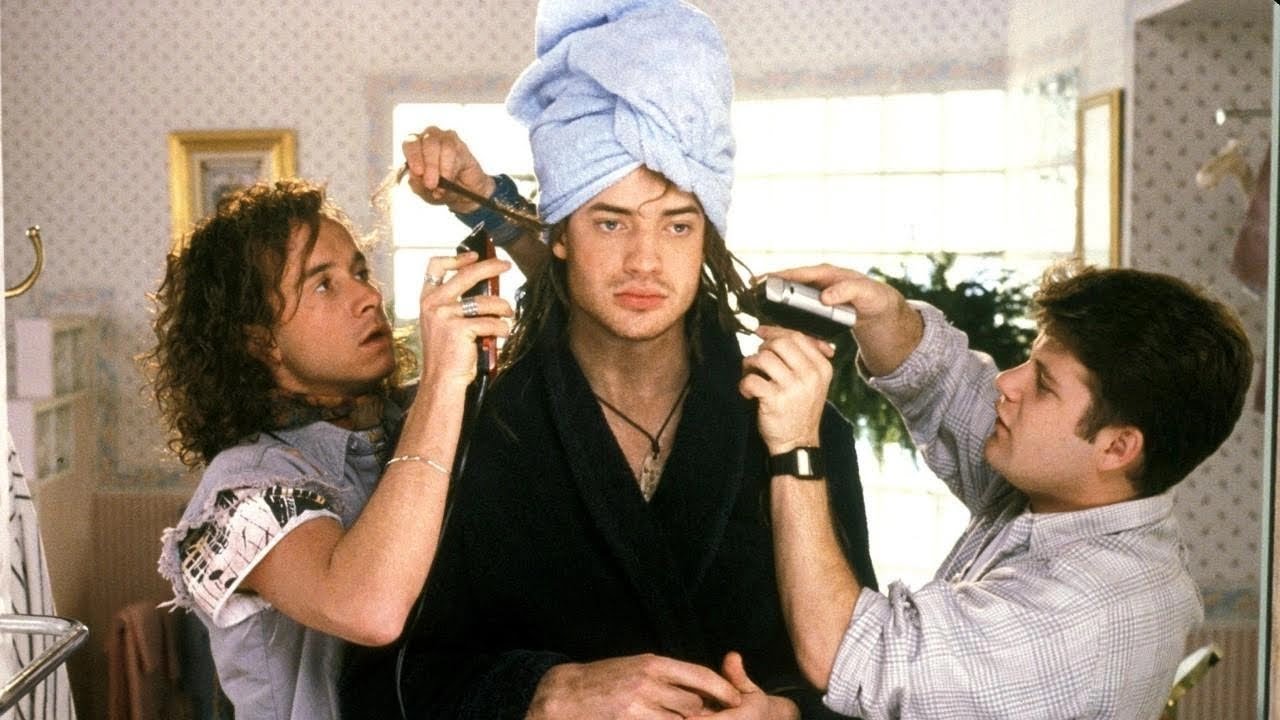
Two teenagers dig up a frozen caveman while excavating a backyard pool, thaw him out, and enroll him in high school. Brendan Fraser as Link, Sean Astin, and peak "weasel"-era Pauly Shore — critics gave it thumbs down, audiences gave it an A, and every '90s sleepover gave it another run.

Ace Ventura: Pet Detective
Alrighty then. A pet detective in a Hawaiian shirt talks out of his own rear end, rescues the Miami Dolphins' kidnapped mascot, and turns a $15 million comedy into the launchpad of Jim Carrey's insane 1994. Critics hated it; recess quoted it for years.